The 1962 Chevrolet Corvair Monza is the car that accidentally invented a market and deliberately invented another. Chevrolet had conceived the Corvair as a frugal economy compact, but buyers kept choosing the sporty Monza trim with its bucket seats and four-speed – and in doing so showed Detroit there was demand for affordable sporty cars, a lesson Ford would apply with the Mustang. Then in 1962 came the Monza Spyder, whose turbocharged flat-six was the first turbocharged production car engine from Chevrolet – an air-cooled, rear-engined, turbocharged six more than a decade before the Porsche 911 Turbo.
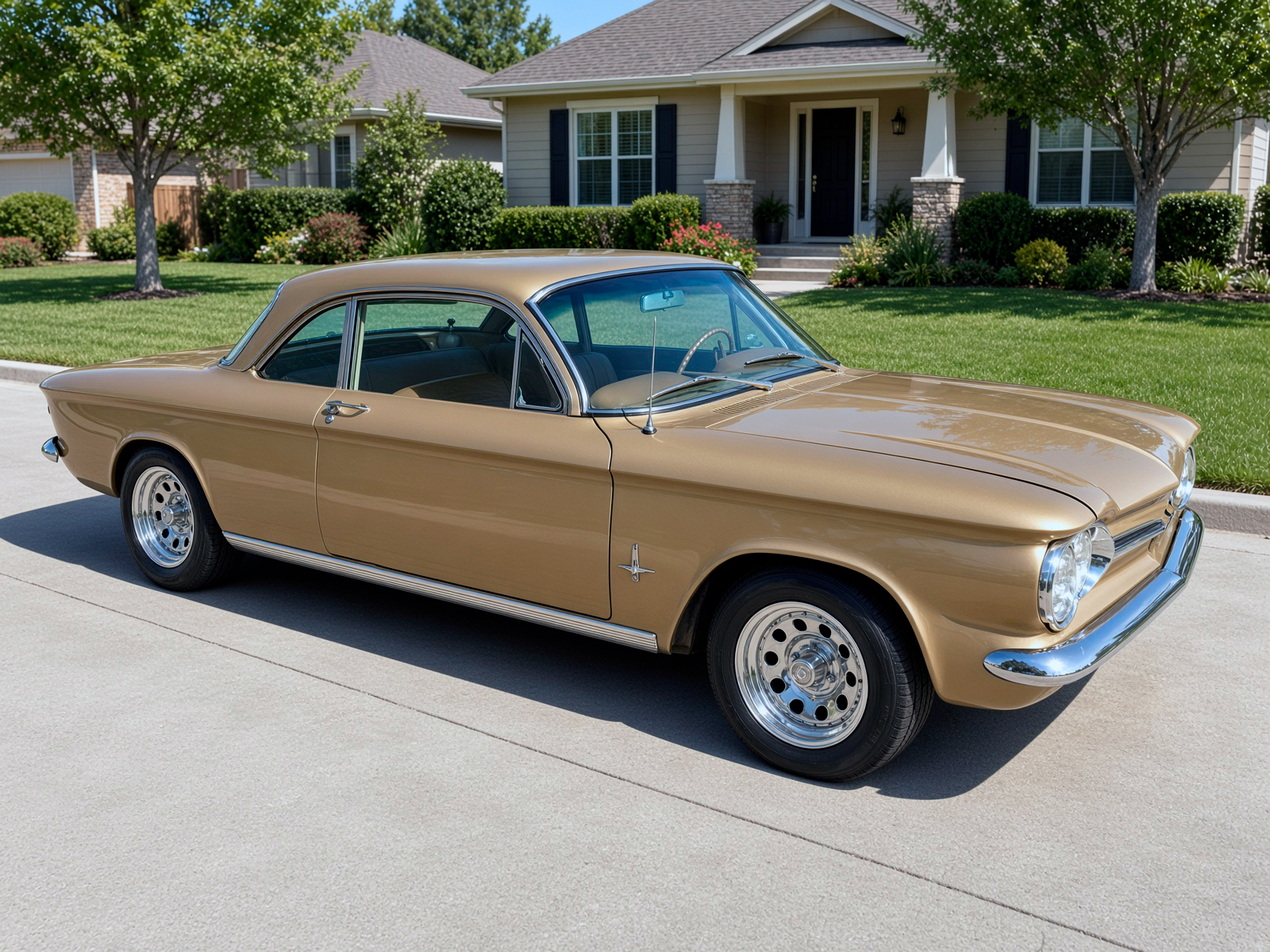
Table of Contents
- Overview and History
- What the Monza Was
- The Accidental Sporty Compact
- The Monza Spyder Turbo
- The First Turbocharged Production Engine
- Engine Lineup
- Body Styles and the New Convertible
- Transmissions
- Chassis, Suspension, and the Swing Axle
- Interior and Instrumentation
- What the Corvair Led To
- Collectibility and Buying
- Key Features Summary
- Full Specifications Table
Overview and History
The Corvair was General Motors’ great deviation from American practice. Produced from 1960 through 1969, it used an air-cooled, horizontally opposed six-cylinder engine mounted at the rear, with extensive aluminium construction, independent suspension at all four wheels, and a unibody chassis built by Fisher Body.
Ed Cole – Chevrolet’s chief engineer from 1952 to 1956 and general manager from 1956 to 1961 – was the person primarily responsible for getting the Corvair and its engine into production. The first engine fired in Chevrolet Engineering in December 1957.
The car was conceived as an economy compact to answer imported small cars and the domestic compacts arriving from Ford and Chrysler. What happened instead was that buyers gravitated to the sportier versions, and by 1962 the Monza had become the heart of the range.
1962 is the year that shift became undeniable, and the year Chevrolet acted on it with the turbocharged Spyder.
What the Monza Was
The Monza was the top trim level of the Corvair range, sitting above the plainer 500 and 700 series.
Its appeal was not mechanical in origin but presentational. The Monza offered bucket seats, better interior trim, additional brightwork, and – critically – availability of a four-speed manual transmission. In a market where American compacts were universally equipped with bench seats and column shifts, that combination felt European and sporting.
It worked. The Monza rapidly became the best-selling Corvair, and the economy-oriented lower trims faded in significance. Chevrolet had set out to sell frugality and found itself selling character instead.
For 1962 the Monza range expanded, and the Spyder performance package arrived within it.
The Accidental Sporty Compact
The Corvair Monza’s commercial significance extends well beyond its own sales figures, and it is worth stating plainly.
Chevrolet had designed an economy car. Buyers bought a sporty one. The Monza demonstrated that a substantial American market existed for an affordable car with bucket seats, a floor-mounted four-speed, and a sporting image – a market nobody had previously served or even identified.
Ford drew the obvious conclusion. The Mustang arrived in 1964 applying exactly that formula to conventional front-engined mechanicals, and created the pony car class.
Chevrolet’s own answer, the Camaro, would not arrive until 1967 – and its introduction is directly cited as a reason for the loss of factory interest in the Corvair from that year onward. The car that proved the market was ultimately displaced by the car built to serve it.
The Monza Spyder Turbo
The Monza Spyder arrived for 1962 as the performance version, and it was a genuinely radical piece of engineering for a mass-market American car.
Its engine was a turbocharged version of the Chevrolet Turbo-Air 6 – the air-cooled flat-six – producing 150 horsepower from 145 cubic inches. In a light, compact car that was a transformative figure.
The Spyder package extended beyond the engine. It brought a performance edge over standard Corvair models through supporting equipment and, importantly, a brushed aluminium dashboard with full instrumentation – including a tachometer and a manifold pressure gauge that doubled as a boost readout.
Turbocharged Corvair production ran from 1962 until 1966, and across that run the turbocharged Corvair moved roughly 40,000 units. The Spyder name was used for 1962 to 1964, after which the Corsa took over as the performance model for 1965 and 1966 with output rising to 180 horsepower.
The First Turbocharged Production Engine
This is the Corvair’s strongest claim on history, and the detail matters because it is often stated imprecisely.
In 1962 General Motors introduced the world’s first mass-produced turbocharged cars, beating Europe to it. Two GM products arrived that year: the Oldsmobile Jetfire and the Corvair Monza Spyder.
The sequence is documented: one month after the release of the turbocharged Oldsmobile, a turbocharged version of the Chevrolet Turbo-Air 6 engine was introduced in the Corvair Monza Spyder.
The two took different approaches. Oldsmobile focused on a high-tech turbocharged V8 that required a water-methanol injection fluid; Chevrolet applied turbocharging to an air-cooled flat-six. The Jetfire struggled to reach five-digit sales; the turbocharged Corvair moved roughly 40,000 units across its production run.
That difference matters. The Monza Spyder was the first car to make turbocharging a true mass-market proposition, moving the technology out of the laboratory and into ordinary driveways.
The layout deserves a final note. An air-cooled, rear-engined, turbocharged flat-six is a configuration most commonly associated with the Porsche 911 Turbo – and the Corvair arrived more than a decade earlier.
Engine Lineup
All Corvair engines were the Turbo-Air 6, an air-cooled horizontally opposed six built with extensive aluminium content at Tonawanda, with castings from the Massena plant.
For 1962 the range comprised:
- 80 hp – the base engine
- 102 hp – the optional higher-output version
- 150 hp turbocharged – Monza Spyder only
Displacement at this point was 145 cubic inches, enlarged to 164 cubic inches from 1964 onward.
The 102 hp engine is worth considering seriously. It is simpler than the turbo, easier to keep in tune, and gives the Monza a pleasant character without the forced-induction complications. Most surviving Monzas have it or the 80 hp unit.
Body Styles and the New Convertible
The 1962 Monza range covered:
- 2-Door Club Coupe
- 4-Door Sedan
- 2-Door Convertible – new for 1962
- Monza Station Wagon
The convertible is the significant addition. Introduced for 1962, it gave the Monza an open body for the first time and is the most desirable 1962 Corvair today – particularly in Spyder specification.
The first-generation Corvair body ran from 1960 to 1964 before the dramatically restyled second generation arrived for 1965 with pillarless hardtop styling and a completely new rear suspension.
Transmissions
The Monza’s appeal rested substantially on its transmission options. Available were:
- Three-speed manual
- Four-speed manual – the configuration that defined the car’s character
- Powerglide two-speed automatic
The four-speed is both the period-correct choice for a Monza and the one buyers want today. It was a genuine rarity in an American compact at the time and a large part of why the Monza felt European.
On a Spyder the four-speed is effectively essential – the turbocharged engine’s character demands it.
Chassis, Suspension, and the Swing Axle
The Corvair used unibody construction built by Fisher Body, with independent suspension at all four wheels and low-profile tyres on wider wheels – advanced specification for an American compact.
The first-generation rear suspension, however, used a swing axle, and this is the detail that defined the Corvair’s public reputation. Under certain conditions a swing axle can allow sudden rear-wheel camber change and consequent oversteer, and that characteristic generated sustained criticism.
The chronology matters and is frequently blurred. The criticism concerned the first-generation cars of 1960 to 1964. For 1965 Chevrolet replaced the swing axle entirely with a fully independent rear suspension that was a virtual copy of the Corvette Sting Ray’s – upper and lower control arms, with the uppers doubling as axle half-shafts.
So a 1962 Monza does have the swing-axle rear end. A buyer should understand that, drive the car with appropriate respect, and recognize that tyre pressures and suspension condition matter more on these cars than on most.
Brakes were drums at all four corners.
Interior and Instrumentation
The Monza interior was the car’s strongest selling point: bucket seats, upgraded upholstery, additional interior brightwork, and a presentation far removed from the plain 500 and 700 trims.
The Spyder went further with a brushed aluminium dashboard and a full complement of instruments – a tachometer, a cylinder head temperature gauge, and a manifold vacuum and pressure gauge that served as a boost gauge on the turbocharged car.
That instrumentation was exceptional for an American car of the period and reflects the Spyder’s European-influenced intent. The cylinder head temperature gauge in particular is a practical necessity on an air-cooled engine rather than decoration, and it carried forward to the later Corsa.
What the Corvair Led To
The Corvair’s influence runs in two directions.
Commercially, the Monza proved the affordable sporty car market existed, which led directly to the Mustang in 1964 and to the pony car class. Chevrolet’s own Camaro followed in 1967 – and its arrival contributed to the loss of factory interest in the Corvair from that year.
Technically, the Spyder’s turbocharger made forced induction a mainstream proposition. Turbocharged Corvair production ran to 1966, and manufacturing of the Turbo-Air 6 ended with Corvair production after 1969.
The Corsa succeeded the Spyder for 1965 and 1966 as the performance model, with the turbo rising to 180 horsepower and a naturally aspirated 140 hp four-carburettor engine as standard – paired with the new Corvette-derived rear suspension, making those the best-developed Corvairs of all.
Collectibility and Buying
The 1962 Monza is an affordable and genuinely interesting classic, with the Spyder carrying real historical weight as an early mass-market turbocharged car.
Values favour the Spyder convertible, then the Spyder coupe, then four-speed Monza convertibles, with sedans and wagons the most accessible. A documented, original turbo installation commands a clear premium.
Buying priorities:
- Verify the turbo is original on a Spyder claim – many have been removed or replaced over the decades
- Check the engine thoroughly. Air-cooled flat-sixes suffer from oil leaks, particularly at the pushrod tubes, and overheating damage is expensive
- Inspect the unibody for rust at the floors, rockers, and around the front suspension mounting points
- Assess suspension condition carefully, given the swing-axle rear end
- Confirm the four-speed if that is what is claimed
- Find a specialist. The Corvair community is knowledgeable and well organized, but general mechanics rarely understand these cars
Parts support through the Corvair clubs and specialists is better than the model’s obscurity suggests, though turbo-specific components are harder to source.
Key Features Summary
- Layout: Rear-mounted, air-cooled horizontally opposed six – unique in American production
- Engine Family: Turbo-Air 6, 145 cu in in 1962, with extensive aluminium construction
- Monza: Top trim level, with bucket seats, better trim, and four-speed availability
- Commercial Significance: Proved the affordable sporty car market existed – leading to the Mustang in 1964
- New for 1962: The Monza Spyder turbocharged performance package
- Spyder Output: 150 hp turbocharged
- Historical First: Among the world’s first mass-produced turbocharged cars, alongside the Oldsmobile Jetfire
- Sequence: Introduced one month after the turbocharged Oldsmobile
- Mass-Market Success: Turbocharged Corvair moved roughly 40,000 units against the Jetfire’s five-digit struggle
- Other Engines: 80 hp and 102 hp naturally aspirated
- Body Styles: Club coupe, four-door sedan, convertible new for 1962, station wagon
- Rear Suspension: Swing axle – replaced by a Corvette-derived independent layout for 1965
- Spyder Name Used: 1962–1964, then replaced by the Corsa
- Turbo Production Ended: 1966
The 1962 Chevrolet Corvair Monza Specs
| MODEL AND SERIES | |
| Manufacturer | Chevrolet (General Motors) |
| Model Position | Monza – top trim level, above the 500 and 700 series |
| Performance Version | Monza Spyder – new for 1962 |
| Generation | First generation (1960–1964) |
| Construction | Unibody, built by Fisher Body |
| Corvair Production Span | 1960–1969 |
| Responsible Engineer | Ed Cole |
| First Engine Fired | December 1957 |
| BODY STYLES | |
| 2-Door Club Coupe | Available |
| 4-Door Sedan | Available |
| 2-Door Convertible | New for 1962 |
| Station Wagon | Available in Monza trim |
| ENGINE – TURBO-AIR 6 FAMILY | |
| Type | Air-cooled, horizontally opposed six, rear-mounted |
| Displacement (1962) | 145 cu in |
| Later Displacement | 164 cu in from 1964 |
| Construction | Extensive use of lightweight aluminium |
| Engine Plant | Tonawanda; castings from Massena |
| Production Ended | With Corvair production after 1969 |
| 1962 ENGINE OPTIONS | |
| 80 hp | Base engine |
| 102 hp | Optional higher output |
| 150 hp | Turbocharged – Monza Spyder only |
| THE TURBOCHARGER | |
| Status | Among the world’s first mass-produced turbocharged car engines |
| Sequence | Introduced one month after the turbocharged Oldsmobile Jetfire |
| Approach | Turbocharging applied to an air-cooled flat-six |
| Oldsmobile Approach | High-tech turbocharged V8 |
| Sales Comparison | Turbo Corvair approx. 40,000 units; Jetfire struggled to reach five digits |
| Significance | First car to make turbocharging a true mass-market proposition |
| Layout Precedent | Air-cooled rear-engined turbo flat-six – over a decade before the Porsche 911 Turbo |
| Turbo Production Ran | 1962 to 1966 |
| TRANSMISSION | |
| Available | 3-speed manual; 4-speed manual; Powerglide 2-speed automatic |
| Defining Option | Four-speed manual – rare in an American compact at the time |
| Spyder Pairing | Four-speed effectively essential |
| SUSPENSION, STEERING, BRAKES | |
| Suspension | Independent at all four wheels |
| Rear Suspension (1960–64) | Swing axle |
| Rear Suspension (from 1965) | Fully independent, virtual copy of the Corvette Sting Ray layout |
| Tyres and Wheels | Low-profile tyres on wider wheels |
| Brakes | Drums front and rear |
| MONZA INTERIOR | |
| Seating | Bucket seats |
| Trim | Upgraded upholstery and interior brightwork |
| SPYDER INSTRUMENTATION | |
| Dashboard | Brushed aluminium |
| Gauges | Tachometer; cylinder head temperature; manifold vacuum and pressure (boost) |
| Note | Head temperature gauge is a practical necessity on an air-cooled engine |
| Carried Forward To | The Corsa, 1965–1966 |
| MODEL SUCCESSION | |
| Spyder Name Used | 1962–1964 |
| Corsa | Performance model for 1965–1966; turbo rose to 180 hp |
| Second Generation | 1965 – new body, pillarless styling, new rear suspension |
| COMMERCIAL LEGACY | |
| Market Proved | Affordable sporty cars with bucket seats and a four-speed |
| Ford’s Response | Mustang, 1964 – created the pony car class |
| Chevrolet’s Response | Camaro, 1967 |
| Consequence | Camaro’s introduction contributed to the loss of factory interest in the Corvair from 1967 |
| BUYING NOTES | |
| Turbo Verification | Confirm originality – many removed or replaced |
| Engine Risks | Oil leaks at pushrod tubes; overheating damage |
| Rust Areas | Floors, rockers, front suspension mounting points |
| Suspension | Assess carefully given the swing-axle rear end |
| Support | Strong club and specialist network; turbo parts harder to source |
| Value Order | Spyder convertible → Spyder coupe → four-speed Monza convertible → sedans and wagons |
1962 Chevrolet Corvair Monza – Frequently Asked Questions
Was the Corvair Monza the first turbocharged production car?
It was among the first, and the first to succeed commercially. In 1962 General Motors introduced the world’s first mass-produced turbocharged cars – the Oldsmobile Jetfire and the Corvair Monza Spyder, with the Corvair arriving one month after the Oldsmobile. The Jetfire struggled to reach five-digit sales while the turbocharged Corvair moved roughly 40,000 units, making the Spyder the first car to take turbocharging out of the laboratory and into ordinary driveways.
Did every Monza have a turbocharger?
No. The Monza was the top trim level – bucket seats, better interior trim, four-speed availability – and most were naturally aspirated, with either the 80 hp base engine or the 102 hp option. The turbocharged 150 hp engine belonged to the Monza Spyder, the performance package introduced for 1962.
How did the Monza lead to the Mustang?
By proving the market. Chevrolet had designed the Corvair as an economy compact, but buyers kept choosing the sporty Monza with its bucket seats and floor-mounted four-speed – a combination nobody else was offering in an affordable American car. Ford drew the conclusion and launched the Mustang in 1964 applying the same formula to conventional front-engined mechanicals, creating the pony car class. Chevrolet’s own Camaro did not arrive until 1967.
Does the 1962 Monza have the handling problem the Corvair is known for?
It has the swing-axle rear suspension that generated the criticism, yes. The first-generation cars of 1960 to 1964 used that layout, which under certain conditions can allow sudden rear-wheel camber change and oversteer. For 1965 Chevrolet replaced it entirely with a fully independent rear suspension that was a virtual copy of the Corvette Sting Ray’s. A 1962 should be driven with appropriate respect, and tyre pressures and suspension condition matter more on these cars than on most.
What is the difference between the Spyder and the Corsa?
They are the same idea in different eras. The Spyder was the turbocharged performance package for 1962 to 1964 on the first-generation car, at 150 hp. The Corsa replaced it for 1965 and 1966 on the restyled second-generation body, with the turbo raised to 180 hp and a naturally aspirated 140 hp four-carburettor engine as standard – and crucially with the new Corvette-derived rear suspension, making those the best-developed Corvairs.
What instrumentation does a Spyder have?
A full set on a brushed aluminium dashboard: a tachometer, a cylinder head temperature gauge, and a manifold vacuum and pressure gauge that doubles as a boost readout on the turbocharged car. That was exceptional for an American car of the period. The head temperature gauge is a practical necessity on an air-cooled engine rather than decoration, and the whole arrangement carried forward to the later Corsa.
What body styles were available in 1962?
Four in Monza trim: a two-door club coupe, a four-door sedan, a station wagon, and – new for 1962 – a two-door convertible. The convertible is the most desirable 1962 Corvair today, particularly in Spyder specification, since it gave the Monza an open body for the first time.
What should I check when buying one?
On a Spyder, verify the turbo installation is original – many have been removed or replaced over the decades. Inspect the air-cooled engine for oil leaks, particularly at the pushrod tubes, and for signs of overheating damage, which is expensive. Check the unibody for rust at the floors, rockers, and front suspension mounting points, and assess suspension condition carefully given the swing axle. Find a Corvair specialist; general mechanics rarely understand these cars.
