The 1981 Buick Riviera holds a small but genuine place in automotive history: it was the first car ever to wear Buick’s T-Type badge. Renaming the previous S-Type package, the T-Type brought a turbocharged V6, firmer suspension, and blacked-out trim to Buick’s front-wheel-drive personal luxury coupe — and the name would go on to appear on the Regal, Century, Skylark, Electra, and LeSabre through the decade. The 1981 Riviera also brought a new standard 4.1-liter V6 in place of the departed 350 V8, marking the moment Buick’s flagship coupe committed fully to six-cylinder power. Sophisticated, comfortable, and technically ambitious with front-wheel drive and four-wheel independent suspension, it was one of the most advanced American luxury coupes of its day.
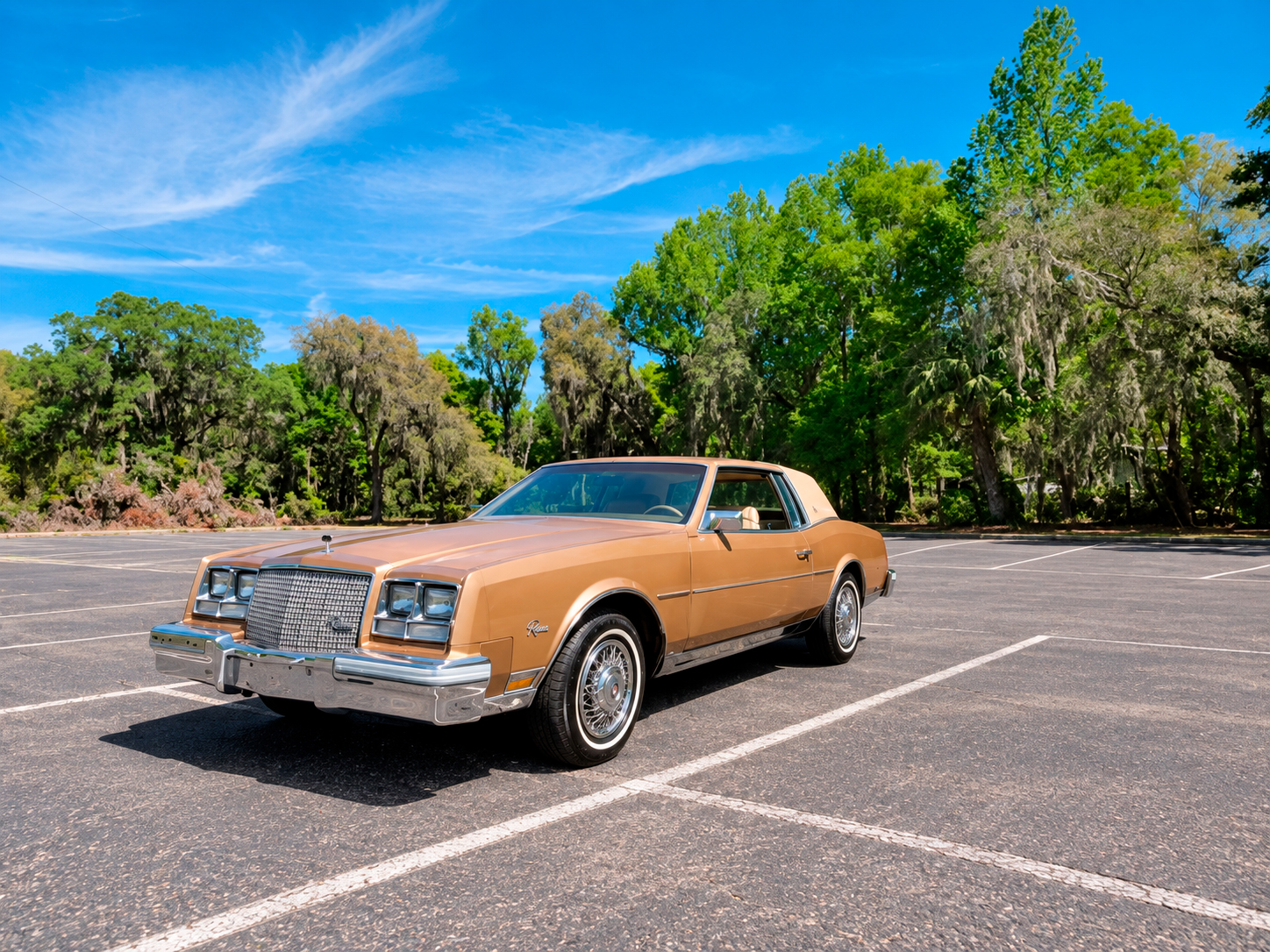
Table of Contents
- Overview and History
- The First T-Type
- What Changed for 1981
- Engine Lineup
- The Turbocharged V6
- The Diesel Option
- Front-Wheel Drive and Independent Suspension
- Interior and Equipment
- Production and Market Position
- Collectibility and Buying
- Key Features Summary
- Full Specifications Table
Overview and History
The Riviera had been comprehensively redesigned for 1979, moving to GM’s E-body platform with front-wheel drive — a bold step for a large American personal luxury coupe, and one that was not universally welcomed at the time. The gamble paid off handsomely: this generation became the best-selling Riviera ever, with roughly 370,000 built across its seven-year run.
The 1979 car’s technical package was genuinely advanced for its class. Front-wheel drive was paired with four-wheel independent suspension — torsion bars at the front and coil springs at the rear — giving the Riviera a ride and packaging advantage over conventional rear-drive coupes. The Riviera S-Type, with its turbocharged V6, took Motor Trend’s Car of the Year award.
By 1981 the formula was established and the changes were mostly evolutionary, but two of them mattered. The 350 V8 was gone, discontinued at the end of the 1980 model year, and in its place came a new 4.1-liter V6 as the standard engine with an Oldsmobile-built 307 V8 as the optional eight. And the sporting S-Type was renamed the T-Type — the first use of a badge that would define Buick performance for the rest of the decade.
The First T-Type
The 1981 Riviera was the first Buick to wear the T-Type name, and that alone gives it lasting significance. T stood for Touring, and the package replaced the previous S-Type with a more comprehensive set of upgrades.
The T-Type bundled the turbocharged 3.8-liter V6 as its standard engine with a firmer, sportier suspension, distinctive interior and exterior trim, and the blacked-out brightwork that would become the T-Type signature across the range. Where the earlier S-Type had offered flat-black window surrounds and brushed-black instrument panel trim, the T-Type went further with genuine performance and handling content.
Buick’s aim was to reach younger, European-minded buyers who wanted a car that handled as well as it rode. The badge spread quickly: by 1983 the Regal, Century, Skylark, and Skyhawk all offered T-Type versions, and the Regal T-Type became the celebrated sibling of the Grand National. It all traces back to this car.
One practical note for buyers: by 1981 the T-Type designation did not automatically guarantee a turbocharger, as the naturally aspirated engines could also be specified. There are few obvious visual cues distinguishing a T-Type, so verifying what is actually under the hood matters more than reading the badge.
What Changed for 1981
Beyond the T-Type renaming and the engine changes, the 1981 revisions were largely cosmetic. The Riviera received a new grille, amber turn signal lenses, and gray bumper impact strips. The integrated A-pillar-mounted side mirrors introduced for 1980 carried over, as did the standard halogen headlamps.
The more consequential change was under the hood. With the 350 V8 discontinued across GM after 1980, the Riviera’s standard engine became the new 4.1-liter V6, with the 307 cu in (5.0 L) Oldsmobile V8 phased in as the optional eight-cylinder. The turbocharged 3.8 V6 remained available on the standard Riviera as well as being the T-Type’s standard engine — a notable point, since it means a turbocharged non-T-Type Riviera is entirely legitimate.
Engine Lineup
4.1 L (252 cu in) V6 — standard. Buick’s new larger V6 for 1981, rated at 125 hp. It replaced the 350 V8 as the base engine and reflected the industry-wide shift toward six-cylinder power in large cars as fuel economy standards tightened.
3.8 L (231 cu in) turbocharged V6 — optional; standard on T-Type. The performance choice, rated at 185 hp (some sources cite 180). It substantially outpowered both the 4.1 V6 and the 307 V8, and turbocharged Rivieras could reach 60 mph in well under ten seconds — genuinely quick for 1981.
307 cu in (5.0 L) Oldsmobile V8 — optional. Rated at 140 hp, this replaced the discontinued 350 as the V8 option. Smooth and durable, it was the choice for buyers who wanted eight cylinders without turbo complexity, though it gave away considerable performance to the turbo V6.
350 cu in (5.7 L) Oldsmobile diesel V8 — optional. Rated at just 105 hp in its 1981 passenger-car calibration.
The Turbocharged V6
The turbo 3.8 was the engine that made this Riviera interesting. The front-wheel-drive application used a version of the engine that differed meaningfully from the rear-drive Regal’s: the turbocharger was mounted to the back of the intake and hung off the rear of the engine, rather than sitting above it as in the rear-drive cars. Most components are not interchangeable between the two.
At 185 hp it was the most powerful engine available in the Riviera and, in combination with front-wheel drive, a comfortable interior, and a luxurious equipment list, made for a package that was genuinely novel among personal luxury coupes at the time.
Turbocharged Rivieras of this era are generally considered less troublesome than many contemporary turbo cars, but turbocharger failure is still a real risk on any example that was not maintained religiously. Service history is worth more than mileage on these cars.
The Diesel Option
The Oldsmobile 350 diesel V8 deserves a frank assessment. Introduced to the Riviera for 1981 and offered through 1985, it produced 105 hp at 3,200 rpm and 205 lb-ft at 1,600 rpm — figures that made a large, heavy coupe distinctly slow.
For 1981 GM introduced a heavily reinforced “DX” block, and passenger-car versions were detuned through revised injection pump calibration to improve economy and lower peak cylinder pressures. Despite these improvements the engine’s reputation never recovered from early durability problems, and it is one of the most notorious engines of the era. Many diesel cars were converted to gasoline power long ago. A surviving original diesel is a curiosity rather than a prize, and buyers should investigate carefully.
Front-Wheel Drive and Independent Suspension
The Riviera’s chassis was its technical showpiece. Front-wheel drive freed up interior space and gave the car a flatter floor and better traction in poor weather than its rear-drive rivals, while the four-wheel independent suspension — torsion bars up front, coil springs at the rear — delivered a ride quality that was among the best in the class.
The T-Type’s firmer suspension tuning sharpened handling without destroying that ride, which was the whole point of the package. Buyers who wanted the traditional Buick experience could have the standard setup; those who wanted something closer to a European touring car could have the T-Type.
Brakes were power-assisted front discs with rear drums, and power steering was standard equipment on a car of this size and weight.
Interior and Equipment
The Riviera’s cabin was one of the most comfortable and well-appointed in the American market. Standard equipment was generous, and the options list ran to power windows and locks, six-way power seats, automatic climate control, cruise control, tilt steering, premium audio systems, and leather upholstery.
The T-Type added sportier front seats along with its trim upgrades, though it is worth noting that the 1981–1985 Rivieras retained a column shifter and a small console rather than the floor-shift arrangement used on later T-Type models in other lines. It was a sporting package applied to a luxury coupe, not a sports car conversion.
Production and Market Position
Riviera production for 1981 is commonly cited at approximately 52,007 units. That placed it below the volume Regal but comfortably within the successful run of this generation, which would peak at 65,305 for 1985 and total roughly 370,000 cars — the best-selling Riviera generation ever.
The Riviera sat at the top of Buick’s coupe range, competing with the Oldsmobile Toronado and Cadillac Eldorado within GM and with the Lincoln Mark and Chrysler’s personal luxury offerings outside it. Its combination of front-wheel drive, independent rear suspension, and an available turbocharged V6 made it the most technically adventurous of the group.
A footnote worth knowing: a Riviera convertible arrived for 1982 — the first Buick convertible since 1975 and the first GM convertible of its era — and a turbocharged Riviera convertible paced the 1983 Indianapolis 500.
Collectibility and Buying
The 1981 Riviera is an affordable and underappreciated classic with two genuine claims to significance: it is the first T-Type, and it represents the technical high point of American front-wheel-drive personal luxury coupes of the period.
Turbocharged T-Types are the ones to look for, combining the historical first with the best-performing engine. The 307 V8 cars make sensible, durable drivers. Diesel cars should be approached with clear eyes.
Practical checks: turbocharger condition and documented service history on turbo cars; the state of the Computer Command Control system, new across GM for 1981; the condition of the front-wheel-drive components and the four-wheel independent suspension; and paint condition, since the lacquer paints of the era are prone to crazing and a proper respray means going to bare metal. Because the T-Type had few distinguishing visual cues in 1981, verifying the car’s actual specification rather than trusting a badge is essential.
Key Features Summary
- Significance: The first Buick T-Type ever built
- Layout: Front-engine, front-wheel drive
- Platform: GM E-body (1979–1985 generation)
- Body Style: 2-door personal luxury coupe
- Suspension: Four-wheel independent — front torsion bars, rear coil springs
- Standard Engine: 4.1 L V6 — 125 hp (new for 1981, replacing the 350 V8)
- Performance Engine: Turbocharged 3.8 L V6 — 185 hp (standard on T-Type)
- V8 Option: 307 cu in (5.0 L) Oldsmobile V8 — 140 hp
- Diesel Option: 350 cu in Oldsmobile diesel V8 — 105 hp
- Performance: Turbo models reached 60 mph in well under 10 seconds
- 1981 Updates: New grille, amber turn signals, gray bumper impact strips
- Production: approx. 52,007 for 1981
- Generation Total: approx. 370,000 — the best-selling Riviera generation
The 1981 Buick Riviera Specs
| BODY | |
| Manufacturer | Buick (General Motors) |
| Body Style | 2-door personal luxury coupe |
| Platform | GM E-body |
| Generation | Sixth generation (1979–1985) |
| Trim Levels | Riviera; Riviera T-Type |
| Historical Note | First Buick to carry the T-Type badge |
| ENGINE — STANDARD (4.1 L V6) | |
| Engine Type | OHV V6, naturally aspirated |
| Displacement | 252 cu in (4,128 cc / 4.1 L) |
| Horsepower | 125 hp |
| Introduced | New as standard engine for 1981 |
| ENGINE — TURBOCHARGED (3.8 L Turbo V6) | |
| Displacement | 231 cu in (3.8 L), turbocharged |
| Horsepower | 185 hp (some sources 180 hp) |
| Turbocharger Mounting | Rear of intake, hanging off back of engine (FWD-specific) |
| Interchangeability | Most components differ from rear-drive turbo V6 |
| Application | Standard on T-Type; optional on standard Riviera |
| ENGINE — OPTIONAL V8 (307) | |
| Displacement | 307 cu in (5.0 L) — Oldsmobile-built |
| Horsepower | 140 hp |
| Note | Replaced the discontinued 350 V8 for 1981 |
| ENGINE — OPTIONAL DIESEL (350) | |
| Displacement | 350 cu in (5.7 L) — Oldsmobile diesel V8 |
| Horsepower | 105 hp @ 3,200 RPM |
| Torque | 205 lb·ft @ 1,600 RPM |
| 1981 Change | Reinforced “DX” block; detuned injection calibration |
| Availability | Riviera: 1981–1985 |
| DRIVETRAIN | |
| Drive Layout | Front-wheel drive |
| Transmission | Automatic |
| Engine Management | Computer Command Control (new across GM for 1981) |
| SUSPENSION, STEERING, BRAKES | |
| Suspension Layout | Four-wheel independent |
| Front Suspension | Independent, torsion bars |
| Rear Suspension | Independent, coil springs |
| T-Type Suspension | Firmer, sport-tuned |
| Steering | Power-assisted |
| Brakes | Power front discs, rear drums |
| PERFORMANCE | |
| 0–60 mph (Turbo V6) | well under 10 seconds |
| Relative Output | Turbo V6 (185 hp) > 307 V8 (140 hp) > 4.1 V6 (125 hp) > diesel (105 hp) |
| 1981 REVISIONS | |
| Grille | New design |
| Turn Signals | Amber lenses |
| Bumpers | Gray impact strips |
| Sport Package | S-Type renamed T-Type |
| Carried Over | A-pillar integrated mirrors; halogen headlamps |
| INTERIOR | |
| Shifter | Column shift with small console (1981–1985) |
| T-Type Seating | Sportier front seats |
| Available Features | Power windows and locks, six-way power seats, automatic climate control, cruise control, tilt steering, premium audio, leather |
| PRODUCTION | |
| 1981 Production | approx. 52,007 |
| Generation Total (1979–1985) | approx. 370,000 |
| Peak Year | 65,305 (1985) |
| EXTERIOR COLORS (1981, Riviera-specific additions) | |
| Riviera-only: Medium Blue (21), Camel (34), Beige (59). Shared across the line: White (11), Silver (15), Black (19), Dark Blue (29), Tan (63), Light/Medium/Dark Sandstone (63/68/69), Red Firemist (74), Dark Redwood (77) | |
1981 Buick Riviera – Frequently Asked Questions
What was the first Buick T-Type?
The 1981 Buick Riviera. Buick renamed its existing S-Type package as the T-Type — T for Touring — adding sportier trim, firmer suspension, and the turbocharged V6 as standard. The badge then spread across the range: the Regal, Century, Skylark, and Skyhawk all gained T-Type versions by 1983, and the Electra and LeSabre followed later in the decade.
How much horsepower does a 1981 Riviera have?
Four engines were offered. The standard 4.1 L V6 made 125 hp; the turbocharged 3.8 L V6 made 185 hp (some sources cite 180); the optional 307 cu in Oldsmobile V8 made 140 hp; and the 350 diesel V8 made just 105 hp. The turbo V6 was comfortably the most powerful option and the one to have.
Is a 1981 Riviera front-wheel drive?
Yes. The Riviera moved to front-wheel drive with its 1979 redesign on GM’s E-body platform, paired with four-wheel independent suspension — torsion bars at the front and coil springs at the rear. This was technically advanced for a large American personal luxury coupe and gave the Riviera a packaging and ride advantage over its rear-drive rivals.
Does a T-Type badge mean the car has a turbocharger?
Not necessarily. Although the turbocharged 3.8 L V6 was the T-Type’s standard engine, by 1981 the designation could also mean primarily cosmetic and suspension content, with a naturally aspirated engine fitted. There are few obvious visual cues distinguishing a T-Type, so verify the actual engine rather than relying on the badge when evaluating a car.
What happened to the 350 V8 in the 1981 Riviera?
It was discontinued. Both the Oldsmobile and Buick 350s were dropped at the end of the 1980 model year. For 1981 the Riviera’s standard engine became the new 4.1-liter V6, with the smaller 307 cu in Oldsmobile V8 phased in as the optional eight-cylinder — a clear illustration of how quickly large-displacement V8s disappeared from the American market at the turn of the decade.
Should I avoid a diesel 1981 Riviera?
Approach it carefully. The Oldsmobile 350 diesel produced only 105 hp in a large, heavy coupe, and the engine earned a poor durability reputation despite the reinforced “DX” block introduced for 1981. Many were converted to gasoline power decades ago. A surviving original diesel is more curiosity than prize, and thorough inspection and realistic expectations are essential.
How many 1981 Rivieras were built?
Approximately 52,007 for the 1981 model year. This generation as a whole was the most successful in Riviera history, producing roughly 370,000 cars between 1979 and 1985 and peaking at 65,305 units in 1985.
Is a 1981 Riviera a good classic to buy?
It is an affordable and underrated one. It offers real historical significance as the first T-Type, genuine technical interest in its front-wheel-drive and four-wheel independent suspension package, and a comfortable, well-equipped cabin. Turbocharged T-Types are the most desirable; 307 V8 cars make durable drivers. Check turbocharger service history, the Computer Command Control system, front-drive components, and paint condition — the lacquer finishes of the era commonly craze and need bare-metal respray.
