The 1966 Pontiac LeMans was the top-of-the-line trim in Pontiac’s intermediate A-body lineup, sitting above the base Tempest and Tempest Custom. Restyled with swooping “Coke-bottle” curves, a tunneled hardtop roofline, and powered by a revolutionary new overhead cam six-cylinder engine unique to American production cars, the 1966 LeMans was one of the most visually and technically distinctive cars of the mid-1960s.
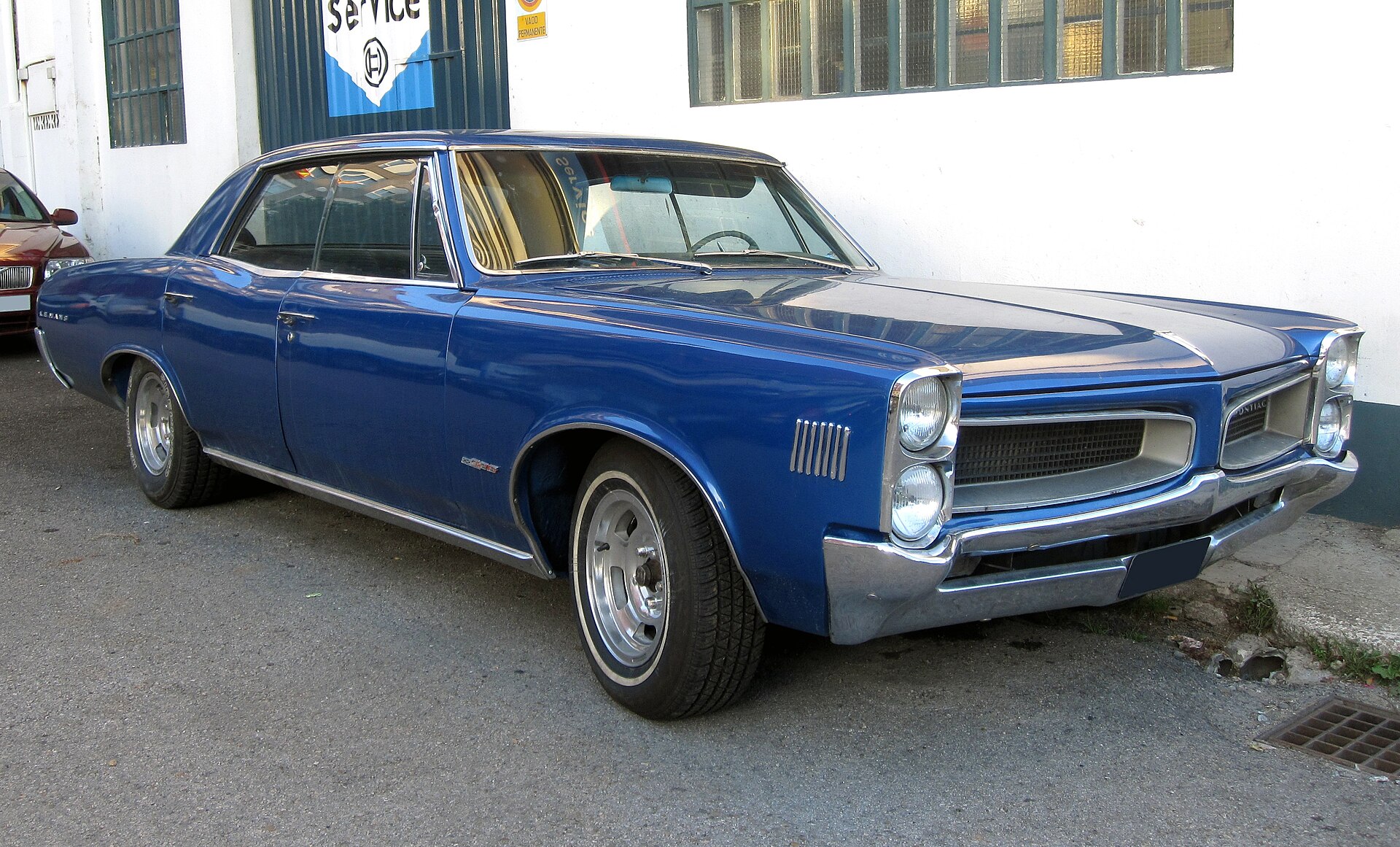
Table of Contents
- Overview and History
- Body Styles and Design
- Standard Engine — OHC 230 Inline-6
- The Sprint Performance Package
- V8 Engine Options — 326 cu in
- Transmission and Drivetrain
- Suspension, Steering, and Brakes
- Relationship to the GTO
- Performance Test Data
- Production Numbers and Assembly
- Collectibility and Current Market
- Key Features Summary
- Full Specifications Table
Overview and History
The Pontiac LeMans name first appeared in 1961 as a sporty trim package on the compact Tempest. By 1964, when GM’s A-body intermediate platform grew to full mid-size proportions, the LeMans became its own distinct model within the Pontiac lineup. For 1966, it entered its third year on the restyled A-body and received the most dramatic visual and mechanical update of its run to that point.
The entire GM intermediate lineup — Chevelle, Olds Cutlass, Buick Skylark, and Pontiac Tempest/LeMans — was restyled for 1966 with smoother, more curvaceous bodywork. Pontiac’s version gained more prominent “Coke-bottle” contours, wider wheel openings, and rounded edges that gave the car a sense of movement even at a standstill. Two-door hardtops received distinctive C-pillar buttresses that swept the roofline rearward in a style borrowed from European grand tourers.
Under the hood, 1966 brought Pontiac’s most significant engineering announcement in years: the OHC 230 cu in Inline-6, the first American production car engine with a single overhead camshaft since the 1917 Chevrolet, and the first American engine ever to drive its camshaft via a toothed rubber timing belt rather than a chain or gear set. This made the LeMans the only car in the American market offering a modern overhead-cam six-cylinder. The engine was developed under the direction of engineer Malcolm McKellar and championed by Pontiac’s general manager John Z. DeLorean, who recognized the marketing value of European-style engine architecture in an American muscle car era.
The LeMans occupied an important middle position in Pontiac’s range. It was more luxurious and sporty than the base Tempest, offering standard bucket seats, better interior trim, and more standard equipment. It was also the model from which the GTO had grown — though for 1966 the GTO became its own separate Pontiac series rather than a LeMans option package, a reflection of its enormous commercial success. The LeMans itself remained a strong seller, with over 121,000 units produced for the 1966 model year.
Body Styles and Design
The 1966 Pontiac LeMans was available in four body styles on the 115-inch wheelbase GM A-body platform:
- 2-door Sports Coupe (pillared coupe) — Model 23707
- 2-door Hardtop Coupe — Model 23717 (most popular; no B-pillar)
- 4-door Hardtop — Model 23727 (new for 1966; replaced the 4-door pillared sedan)
- 2-door Convertible — Model 23767
All bodies were manufactured by Fisher Body, a GM division. The 4-door hardtop was a new addition for 1966, replacing the previous 4-door pillared sedan in the LeMans lineup and reflecting buyer preference for the pillarless look.
The 1966 restyle gave all body styles more rounded, sculpted contours compared to the flatter, more boxy 1965 models. From the side, the new LeMans showed a pronounced dip at the beltline and a kicked-up rear quarter — the “Coke-bottle” or “hip” effect that defined American mid-size styling in the latter half of the decade. The front retained Pontiac’s signature vertically stacked quad headlights, flanking a wider, more recessed split grille with a fine horizontal bar texture.
Two-door hardtops featured a distinctive tunnel-back roof with buttresses extending from the C-pillars, creating a fastback-like silhouette that was more aerodynamically aggressive than the formal roofline of the 1965 model. The rear panel used a full-width tail lamp design with a clean horizontal theme. On the convertible, the top stowed beneath a manually or power-operated cloth top with a glass rear window.
Standard exterior trim on the LeMans over the Tempest included chrome lower-body moldings, specific LeMans badging, and the option for additional appearance packages. The interior featured standard bucket seats and a more finished instrument panel with a sport steering wheel, distinguishing the LeMans clearly from the bench-seat Tempest models below it.
Standard Engine — OHC 230 Inline-6
The headline mechanical news for 1966 was the introduction of the Pontiac OHC 230 cu in Inline-6 as the base engine across the Tempest and LeMans lineup, replacing the previous Chevrolet-sourced 215 cu in pushrod six. Its arrival was without precedent in the American market: a belt-driven single overhead camshaft on an American passenger car engine had not been offered since 1917.
The architecture married a specially developed Pontiac single-overhead-cam cylinder head and cam carrier to the proven Chevrolet 230/250 inline-six block. The timing belt — a first for any American production engine — was a toothed rubber unit with a tensioner, substantially quieter than a chain-driven system and requiring no lubrication. Contemporary Pontiac advertising celebrated the engineering with the tagline “America’s only overhead-cam six.”
In standard single-barrel form, the OHC 230 produced 165 hp at 4,700 RPM and 216 lb·ft of torque at 2,600 RPM with a 9.0:1 compression ratio. It was smooth, free-revving by the standards of its era, and designed primarily for economy-minded LeMans buyers who wanted refined performance without stepping up to a V8. Hydraulic valve lifters kept maintenance demands low and the engine quiet.
The Sprint Performance Package
Recognizing the marketing potential of the OHC architecture, Pontiac made available an optional Sprint package on the LeMans (and Tempest Custom) that transformed the base six into a genuine performance proposition. The Sprint-equipped OHC 230 used a 4-barrel carburetor, a hotter camshaft, and revised cylinder head porting to produce 207 hp at 5,200 RPM and 238 lb·ft of torque at 3,800 RPM — a 42 hp increase over the base unit — with compression raised to 10.5:1.
The Sprint package was not simply an engine upgrade. It included as standard:
- High-output OHC 230 cu in / 207 hp Inline-6 with 4-barrel carburetor
- High-performance camshaft
- Floor-mounted 3-speed fully synchronized manual transmission with Hurst shifter
- Performance suspension kit (stiffer springs and stabilizer)
- Body striping
- “Sprint” badging
A 4-speed manual and the standard Tempest 2-speed automatic were optional in place of the standard 3-speed. The Sprint package was available on non-wagon body styles only. Its character — high-revving, free-breathing, and European in temperament — earned praise from the automotive press, which frequently compared it favorably to import performance cars of the era. Motor Trend and Car and Driver noted that the Sprint offered a distinctly different kind of performance than the torque-heavy V8 muscle cars of the period.
Pontiac’s advertising campaign emphasized the unique technology, running ads that read: “The only American car with an overhead cam engine.” The Sprint OHC-6 LeMans has since earned a loyal collector following for its engineering character and relative rarity compared to V8-powered examples.
V8 Engine Options — 326 cu in
For buyers who preferred traditional V8 power, Pontiac offered the 326 cu in (5.3 L) V8 in two states of tune on the LeMans. The 326 was an overhead-valve V8 with a cast-iron block and five main bearings, available exclusively in the Tempest, Tempest Custom, and LeMans lines — it was specifically not available in the GTO, which used the larger 389 exclusively.
326 cu in V8 (2-barrel, 250 hp): The base V8 used a 2-barrel carburetor, a 9.2:1 compression ratio, and produced 250 hp at 4,600 RPM and 333 lb·ft of torque at 2,800 RPM. It was a smooth, torquey engine well-suited to daily driving with an automatic transmission, and made the LeMans a genuinely brisk performer without the demands of a high-performance setup.
326 cu in V8 HO (4-barrel, 285 hp): The High Output version used a Carter AFB 4-barrel carburetor, a 10.5:1 compression ratio, and a more aggressive camshaft to produce 285 hp at 5,000 RPM and 359 lb·ft of torque at 2,900 RPM. This engine was a strong performer in the LeMans’s lighter body, delivering 0–60 times in the low-to-mid 7-second range with proper gearing. It was this engine that most directly blurred the lines between the LeMans and its legendary stablemate, the GTO.
It is worth noting that the full-size 389 cu in V8 that made the GTO famous was not offered in the 1966 LeMans. GM had formalized the separation of the GTO as its own model that year, and with it came exclusive use of the 389. LeMans buyers wanting 389-level performance had no factory option — they had to order a GTO.
Transmission and Drivetrain
The 1966 Pontiac LeMans offered a wide range of transmission options depending on the engine chosen. The standard transmission was a 3-speed manual with column shift, appropriate for economy-oriented buyers with the base OHC six. A heavy-duty 3-speed was optionally available.
For more spirited driving, Pontiac offered a 4-speed manual in both wide-ratio (M20) and close-ratio (M21) configurations — both were floor-shifted with a Hurst shifter and were compatible with V8 engines. The Sprint package mandated a floor-shifted, fully synchronized 3-speed manual with Hurst shifter as its standard unit, with the 4-speed optional.
Automatic transmission buyers could select the 2-speed Powerglide (paired with the OHC six and base 326 V8) or the 2-speed Super Turbine 300. While the two-speed automatic was adequate for economy use, V8 buyers preferring an automatic increasingly found the Powerglide’s limitation frustrating compared to the three-speed automatics becoming available elsewhere in the market.
All LeMans models were rear-wheel drive via a semi-floating Hotchkiss rear axle. A Positraction limited-slip differential was available as an option across all drivetrains, strongly recommended when the 4-barrel V8 or Sprint engine was specified.
Suspension, Steering, and Brakes
Front suspension used Pontiac’s proven short/long arm (SLA) independent setup with unequal-length upper and lower A-arms, coil springs, and direct-acting shock absorbers. A front stabilizer bar was standard on the LeMans. The geometry gave the car a well-balanced, progressive handling character that compared favorably to most American intermediates of the period.
Rear suspension was a conventional live axle with multi-leaf semi-elliptic springs — a simple and durable setup standard throughout the industry for rear-wheel-drive intermediates. Shock absorber calibration on standard LeMans models prioritized ride comfort; the optional ride and handling package substituted stiffer springs and a larger-diameter front stabilizer bar for noticeably sharper handling behavior.
Steering was a recirculating ball system, offered in standard manual form or with optional power assist. The manual setup required more effort than power-assisted systems but gave slightly better road feel — a trade-off many enthusiast buyers of the era preferred.
Brakes were drums all around as standard — 9.5-inch diameter on all four corners, self-adjusting. For 1966, Pontiac made available optional front disc brakes for the first time on the LeMans, a significant advancement that noticeably improved fade resistance and straight-line stopping power under hard use. Rear drums were retained even with the front disc option. Power assist was available as a separate option with either drum or disc front brakes.
Relationship to the GTO
The 1966 LeMans occupies a historically significant place in the muscle car era as the direct ancestor of the Pontiac GTO. In 1964 and 1965, the GTO had existed as a $295 option package on the LeMans — buyers simply checked a box on the LeMans order form and received the 389 V8, heavy-duty suspension, and GTO badging. The combination proved so wildly popular that the GTO outsold virtually all expectations.
For 1966, General Motors made the GTO a separate Pontiac model (series 242), no longer a LeMans variant. This meant the LeMans and GTO were now distinct cars sharing the same body shell and platform but with entirely separate model identities. The GTO received exclusive use of the 389 V8 (in 335 hp 4-barrel and 360 hp Tri-Power forms), while the LeMans was limited to the OHC six and the 326 V8.
For the collector, this lineage matters. A 1966 LeMans with the 326 HO engine, 4-speed manual, Positraction, and handling package is a genuine performance car — if not a GTO. Pontiac Historical Services (PHS) documentation is the recommended resource for verifying original engine and option configurations on both models.
Performance Test Data
| Configuration | 0–60 mph | Quarter Mile |
|---|---|---|
| OHC 230 / 165 hp / 3-speed auto | approx. 13.0 sec | approx. 19.0 sec |
| OHC 230 Sprint / 207 hp / 4-speed | approx. 9.5 sec | approx. 17.2 sec @ 82 mph |
| 326 V8 / 250 hp / automatic | approx. 9.0 sec | approx. 16.8 sec @ 82 mph |
| 326 HO / 285 hp / 4-speed | approx. 7.2 sec | approx. 15.5 sec @ 90 mph |
| Top Speed (326 HO, estimated) | approx. 115–120 mph | |
Production Numbers and Assembly
Total 1966 Pontiac LeMans production reached 121,740 units across all body styles and engine combinations. Of those, 22,862 were equipped with synchromesh (manual) transmissions and 98,878 received automatic transmissions — reflecting the strong American buyer preference for automatics even in a sporty model. Combined Tempest and LeMans production for 1966 totaled 207,414 units.
Assembly was carried out at multiple GM plants across the United States, identified by the seventh digit of the VIN. Principal assembly locations included Pontiac, Michigan; Arlington, Texas; Doraville, Georgia; Framingham, Massachusetts; Kansas City (Fairfax), Kansas; and South Gate, California.
The GTO, now a separate model, accounted for approximately 96,946 additional units in 1966 — sharing the LeMans body shell and platform but fitted exclusively with the 389 V8 and its own distinct badging and equipment.
Collectibility and Current Market
The 1966 Pontiac LeMans occupies a well-established place in the classic car market. Convertibles and 2-door hardtops in desirable colors with V8 or Sprint engines are the most sought-after configurations. Values range from approximately $15,000–$20,000 for project-grade examples up to $45,000–$60,000 or more for fully restored or exceptional survivor-quality specimens in rare colors or rare configurations.
Factors that command premium values include:
- Convertible body style — significantly more desirable than hardtops or coupes
- 326 HO 4-barrel V8 with 4-speed manual and Positraction
- Sprint OHC 230 package — rare and technically distinctive
- Documented PHS (Pontiac Historical Services) certification of original build specifications
- Desirable colors: Montero Red, Martinique Bronze, Nightwatch Blue, Starlight Black
- Original build sheet and Protect-O-Plate documentation
- Unrestored “survivor” examples with original drivetrain and paint
- Factory-installed optional disc brakes (rare and practical)
Sprint OHC-6 examples occupy a unique niche — they trade at a premium over base six-cylinder cars but below comparable V8 models in most markets, valued primarily by enthusiasts who appreciate their engineering novelty and European-inspired character. Pontiac Historical Services (PHS) documentation is the gold standard for verifying factory Sprint specification on a given VIN.
Key Features Summary
- Layout: Front-engine, rear-wheel drive (FR)
- Platform: GM A-body (second generation intermediate)
- Body Styles: 2-door Sports Coupe, 2-door Hardtop, 4-door Hardtop (new), 2-door Convertible
- Standard Engine: OHC 230 cu in Inline-6, 165 hp — first American OHC production engine since 1917
- Performance Engine Option: Sprint OHC 230, 207 hp with 4-barrel carburetor and hotter cam
- V8 Options: 326 cu in / 250 hp (2-bbl) or 326 HO / 285 hp (4-bbl)
- Top V8 available: 326 HO 285 hp — 389 was exclusive to GTO
- Transmission: 3-speed manual standard; 4-speed manual (Hurst), 2-speed automatic optional
- Brakes: 9.5-inch drums standard; optional front discs (new for 1966 LeMans)
- Wheelbase: 115.0 inches
- Overall Length: 206.4 inches
- Total LeMans Production: 121,740 units
- Design Highlight: “Coke-bottle” styling, tunneled hardtop roofline, stacked quad headlights
- GTO Link: LeMans shares its body shell with the GTO — now a separate model in 1966
The 1966 Pontiac LeMans Specs
| BODY | |
| Body Maker | Fisher (General Motors) |
| Body Styles Available | 2-door Sports Coupe (pillared); 2-door Hardtop Coupe; 4-door Hardtop (new for 1966); 2-door Convertible |
| Model / Series | 237 (LeMans) |
| Model Numbers | 23707 (Sports Coupe), 23717 (Hardtop Coupe), 23727 (4-dr Hardtop), 23767 (Convertible) |
| Platform | GM A-body (second generation intermediate) |
| No. of Doors | 2 (coupe / convertible) or 4 (hardtop sedan) |
| Seating Capacity | 5 |
| Standard Interior | Bucket seats (front), fold-down rear seat; sport steering wheel |
| Roof Styles | Hardtop (pillarless), pillared coupe, convertible (cloth top, glass rear window) |
| DIMENSIONS | |
| Wheelbase | 115.0 inches (2,921 mm) |
| Overall Length (passenger cars) | 206.4 inches (5,243 mm) |
| Overall Width | 74.4 inches (1,890 mm) |
| Overall Height (LeMans hardtop) | 54.8 inches (1,392 mm) |
| Front Track | 58.0 inches (1,473 mm) |
| Rear Track | 59.0 inches (1,499 mm) |
| Curb Weight (2-dr hardtop, OHC six) | approx. 3,100 lbs (1,406 kg) |
| Curb Weight (convertible, V8) | approx. 3,250 lbs (1,474 kg) |
| ENGINE 1 — STANDARD (OHC 230 Inline-6, 1-barrel) | |
| Engine Type | SOHC Inline-6, belt-driven camshaft, naturally aspirated |
| Displacement | 230 cu in (3,769 cc / 3.8 L) |
| Bore × Stroke | 3.875 × 3.250 inches |
| Compression Ratio | 9.0:1 |
| Horsepower (SAE Gross) | 165 hp @ 4,700 RPM |
| Torque (SAE Gross) | 216 lb·ft @ 2,600 RPM |
| Carburetor | 1-barrel |
| Valve Lifters | Hydraulic |
| Camshaft Drive | Toothed rubber timing belt (first on any American production engine) |
| Cylinder Head Material | Cast iron |
| Cylinder Block Material | Cast iron (Chevrolet 230 block) |
| Fuel Required | Regular |
| ENGINE 2 — OPTIONAL (OHC 230 Sprint, 4-barrel) | |
| Engine Type | SOHC Inline-6, belt-driven camshaft, high-performance |
| Displacement | 230 cu in (3,769 cc / 3.8 L) |
| Bore × Stroke | 3.875 × 3.250 inches |
| Compression Ratio | 10.5:1 |
| Horsepower (SAE Gross) | 207 hp @ 5,200 RPM |
| Torque (SAE Gross) | 238 lb·ft @ 3,800 RPM |
| Carburetor | 4-barrel |
| Valve Lifters | Hydraulic |
| Camshaft | High-performance (hotter profile) |
| Fuel Required | Premium |
| Package Includes | Floor-mounted 3-speed Hurst-shifted manual, suspension kit, body striping, Sprint badging |
| Available On | Non-wagon body styles only |
| ENGINE 3 — OPTIONAL (326 V8, 2-barrel) | |
| Engine Type | OHV V8, naturally aspirated |
| Displacement | 326 cu in (5,343 cc / 5.3 L) |
| Bore × Stroke | 3.718 × 3.750 inches |
| Main Bearings | 5 |
| Compression Ratio | 9.2:1 |
| Horsepower (SAE Gross) | 250 hp @ 4,600 RPM |
| Torque (SAE Gross) | 333 lb·ft @ 2,800 RPM |
| Carburetor | 2-barrel |
| Valve Lifters | Hydraulic |
| Block / Head Material | Cast iron |
| Fuel Required | Regular |
| Available On | Tempest, Tempest Custom, LeMans — not available on GTO |
| ENGINE 4 — OPTIONAL (326 HO V8, 4-barrel) | |
| Engine Type | OHV V8, high output, naturally aspirated |
| Displacement | 326 cu in (5,343 cc / 5.3 L) |
| Bore × Stroke | 3.718 × 3.750 inches (98.4 × 95.25 mm) |
| Main Bearings | 5 |
| Compression Ratio | 10.5:1 |
| Horsepower (SAE Gross) | 285 hp @ 5,000 RPM |
| Torque (SAE Gross) | 359 lb·ft @ 2,900 RPM |
| Carburetor | Carter AFB 4-barrel (manual: 4035S; automatic: 4036S) |
| Camshaft Timing Intake | 269° |
| Camshaft Timing Exhaust | 277° |
| Camshaft Overlap | 47° |
| Camshaft Lift | 0.370 inches |
| Valve Lifters | Hydraulic |
| Fuel Required | Premium |
| Available On | Tempest, Tempest Custom, LeMans — not available on GTO |
| TRANSMISSION | |
| Drive Layout | Front-engine, rear-wheel drive (FR) |
| Standard Transmission | 3-speed manual, column-shifted, fully synchronized |
| Optional Transmission 1 | 3-speed manual, floor-shifted with Hurst shifter (standard on Sprint) |
| Optional Transmission 2 | 4-speed manual, wide-ratio M20, floor-shifted (Hurst) |
| Optional Transmission 3 | 4-speed manual, close-ratio M21, floor-shifted (Hurst) |
| Optional Transmission 4 | 2-speed Powerglide automatic |
| Optional Transmission 5 | 2-speed Super Turbine 300 automatic |
| REAR AXLE | |
| Axle Type | Semi-floating, Hotchkiss hypoid |
| Differential | Open standard; Positraction limited-slip optional |
| Available Ratios | Multiple; 3.08:1, 3.23:1, 3.36:1, 3.55:1, 3.73:1 depending on engine and transmission |
| SUSPENSION | |
| Front Type | Independent, short/long arm (SLA), unequal-length upper and lower A-arms, coil springs, direct-acting shock absorbers |
| Front Stabilizer Bar | Standard (LeMans) |
| Rear Type | Live axle, multi-leaf semi-elliptic springs, direct-acting shock absorbers |
| Optional Performance Package | Ride and handling package — stiffer springs, larger front stabilizer bar |
| STEERING | |
| Type | Recirculating ball |
| Standard | Manual |
| Optional | Power assist |
| BRAKES | |
| Service System | Hydraulic, single-circuit |
| Standard Front | 9.5-inch drum, self-adjusting |
| Standard Rear | 9.5-inch drum, self-adjusting |
| Optional Front | 11-inch disc (first year available on LeMans) |
| Power Assist | Optional (vacuum assisted) |
| WHEELS AND TIRES | |
| Standard Wheel | 14 × 5JK steel rim |
| Standard Tire | 6.95 × 14 |
| Optional Tire | 7.35 × 14 |
| Optional Wheel | Wire wheel covers; Rally wheels (extra-cost option) |
| CAPACITIES | |
| Fuel Tank | 20 gallons |
| Engine Oil (V8) | 5 quarts (with filter) |
| Engine Oil (OHC-6) | 4 quarts (with filter) |
| Cooling System (V8) | approx. 18 quarts |
| VIN / VEHICLE IDENTIFICATION | |
| VIN Example | 237076P100001 |
| Total VIN Digits | 13 |
| Digit 1 | GM Division (2 = Pontiac) |
| Digits 2–3 | Series (37 = LeMans) |
| Digits 4–5 | Body Style Code (07 = Sports Coupe, 17 = Hardtop Coupe, 27 = 4-dr Hardtop, 67 = Convertible) |
| Digit 6 | Model Year (6 = 1966) |
| Digit 7 | Assembly Plant (P = Pontiac MI, A = Atlanta GA, B = Baltimore MD, G = Framingham MA, K = Kansas City KS, L = South Gate CA, R = Arlington TX, Z = Fremont CA) |
| Digits 8–13 | Sequential Production Number |
| Engine Code Location (OHC-6) | Cylinder head-to-block contact surface behind oil filter pipe |
| Engine Code Location (V8) | Stamped on right front of block or beneath production number on right-hand bank pad |
| Axle Code Location | On flange end of axle shaft and on or near carrier |
| PRODUCTION (1966) | |
| Total LeMans Units Built | 121,740 |
| With Synchromesh (manual) Transmission | 22,862 |
| With Automatic Transmission | 98,878 |
| Combined Tempest + LeMans Production | 207,414 |
| GTO Production (separate model) | approx. 96,946 |
| Base Price (2-dr Sports Coupe) | approx. $2,511 |
| Base Price (2-dr Hardtop Coupe) | approx. $2,567 |
| Base Price (4-dr Hardtop) | approx. $2,691 |
| Base Price (Convertible) | approx. $2,800 |
| Sprint Package Adder | approx. $116 |
| EXTERIOR COLORS (1966) | |
| Starlight Black, Burgundy, Cameo Ivory, Blue Charcoal, Fontaine Blue, Nightwatch Blue, Palmetto Green, Mission Beige, Reef Turquoise, Marina Turquoise, Barrier Blue, Montero Red, Martinique Bronze, Platinum, Candelite Cream | |
| OPTIONAL EQUIPMENT (SELECTED) | |
| Sprint Package (OHC 230, 207 hp) | Opt. — 4-bbl, hotter cam, Hurst 3-spd floor shift, suspension, striping |
| 326 cu in V8 / 250 hp (2-bbl) | Opt. |
| 326 HO V8 / 285 hp (4-bbl) | Opt. |
| 4-speed Manual Transmission (M20 or M21) | Opt. |
| 2-speed Powerglide Automatic | Opt. |
| Positraction Limited-Slip Differential | Opt. |
| Front Disc Brakes | Opt. (first year available) |
| Power Steering | Opt. |
| Power Brakes | Opt. |
| Ride and Handling Package | Opt. — stiffer springs, larger front stabilizer bar |
| Air Conditioning | Opt. (available with V8; not with Sprint OHC) |
| AM Radio | Opt. |
| AM/FM Radio | Opt. |
| 8-track Stereo Tape Player | Opt. |
| Power Windows | Opt. |
| Power Convertible Top | Opt. (convertible only) |
| Tilt Steering Wheel | Opt. |
| Rally Wheels | Opt. |
| Wire Wheel Covers | Opt. |
| Vinyl Roof Cover | Opt. (hardtop body styles) |
| Rear Window Defroster | Opt. |
| Comfort and Convenience Group | Opt. |
| Red Plastic Inner Fender Liners (Option Code 522) | Opt. — distinctive new-for-1966 styling detail |
Frequently Asked Questions
What engine does the 1966 Pontiac LeMans have?
The 1966 LeMans came standard with the OHC 230 cu in Inline-6 (165 hp) — the first American production car engine with a single overhead camshaft since 1917, and the first ever to drive its cam via a rubber timing belt. Optional engines were the Sprint OHC 230 (207 hp with 4-barrel), the 326 cu in V8 (250 hp, 2-barrel), and the 326 HO V8 (285 hp, 4-barrel). The 389 V8 was exclusive to the GTO and not available in the LeMans.
How is the 1966 LeMans different from the 1966 GTO?
They share the same body shell, platform (115-inch wheelbase A-body), and many components, but are distinct models. For 1966, the GTO became a separate Pontiac series (no longer a LeMans option package) and received exclusive use of the 389 cu in V8 in 335 hp and 360 hp Tri-Power forms. The LeMans was limited to the OHC six and 326 V8. The GTO also came with a standard heavy-duty suspension and specific exterior and interior badging not shared with the LeMans.
How many 1966 Pontiac LeMans were built?
121,740 LeMans were produced for the 1966 model year — 22,862 with manual transmissions and 98,878 with automatics. Combined Tempest and LeMans production reached 207,414 units. The GTO, now a separate model, added approximately 96,946 more units built on the same platform.
What is the Sprint package?
The Sprint was a performance option available on non-wagon LeMans (and Tempest Custom) models. It upgraded the base OHC 230 six-cylinder from 165 hp to 207 hp via a 4-barrel carburetor, hotter camshaft, and raised compression (10.5:1). The package also included a floor-mounted 3-speed Hurst-shifted manual transmission, performance suspension, body striping, and Sprint badges. A 4-speed manual was optional in place of the 3-speed.
What body styles were available on the 1966 LeMans?
Four body styles were offered: a 2-door Sports Coupe (pillared), a 2-door Hardtop Coupe (no B-pillar), a 4-door Hardtop (new for 1966, replacing the previous 4-door pillared sedan), and a 2-door Convertible. All shared the 115-inch wheelbase and the same basic dimensions.
Did the 1966 LeMans have disc brakes?
Drum brakes were standard on all four wheels. However, optional front disc brakes (11-inch) became available for the first time on the 1966 LeMans — a notable advancement that significantly improved fade resistance. Rear drums were retained even with the front disc option. Power assist was an additional separate option.
What did a 1966 Pontiac LeMans cost new?
Base prices started at approximately $2,511 for the 2-door Sports Coupe, $2,567 for the 2-door Hardtop, $2,691 for the 4-door Hardtop, and around $2,800 for the Convertible — all with the standard OHC 230 six-cylinder. The Sprint package added approximately $116; V8 engines and additional options could add several hundred dollars more to the final price.
What is a 1966 Pontiac LeMans worth today?
Values depend on body style, engine, condition, and documentation. Project-grade examples start at roughly $12,000–$18,000. Solid driver-quality cars range from $20,000–$35,000, while restored or exceptional examples — particularly convertibles with the 326 HO and 4-speed, or documented Sprint models — can reach $45,000–$65,000 or more. PHS documentation and original drivetrain are the most important value factors.
Was air conditioning available on the 1966 LeMans?
Yes — air conditioning was available on the 1966 LeMans when ordered with the V8 engine. It was not compatible with the Sprint OHC-6 package, as the high-performance camshaft’s aggressive profile created idle characteristics incompatible with the A/C compressor load. Base OHC six-cylinder models could also be ordered with A/C.
How can I verify if a 1966 LeMans is a real Sprint model?
The most reliable method is Pontiac Historical Services (PHS) documentation, which provides a certified record of the car’s original factory build specifications based on the VIN. Physically, Sprint engines carry specific casting numbers and carburetor part numbers. The presence of a floor-shifted transmission with Hurst shifter is consistent with Sprint specification. Be aware that Sprint components can be added to non-Sprint cars — PHS documentation is the only definitive proof.

Great content! Keep up the good work!