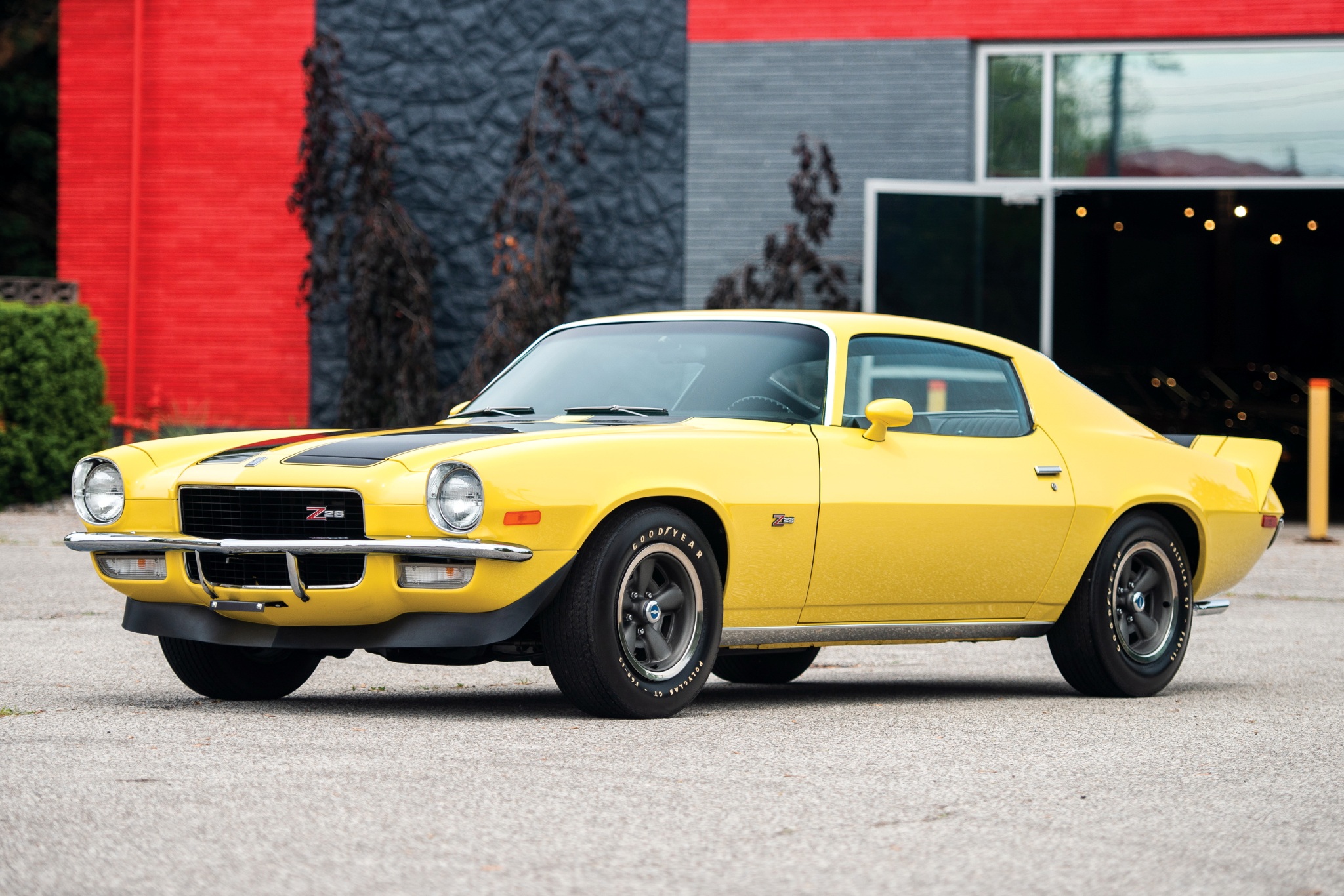
The 1970 Chevrolet Camaro Z/28 is widely regarded as one of the greatest American performance cars ever built. Powered by the Corvette’s own LT1 small-block V8, born on the Trans-Am racing circuit, and riding on a brand-new second-generation F-body platform, the 1970 Z/28 became an instant classic the moment it was introduced.
Table of Contents
- Overview and History
- Body Styles and Design
- Engine — Chevrolet LT1 350 V8
- The Z/28 Special Performance Package (RPO Z28)
- Transmission and Drivetrain
- Suspension, Steering, and Brakes
- Trans-Am Racing Connection
- Performance Test Data
- Production Numbers and Assembly
- Collectibility and Current Market
- Key Features Summary
- Full Specifications Table
- FAQ
Overview and History
The 1970 Chevrolet Camaro Z/28 debuted as part of the completely redesigned second-generation Camaro — a car so thoroughly rethought that Chevrolet engineers started from a blank page. Due to production delays, the 1970 Camaro was not introduced until February 26, 1970, arriving halfway through the model year. Because of this, some enthusiasts refer to it as the “1970½,” but it is officially designated the 1970 model year Camaro.
The Z/28 package (RPO Z28) had existed since late 1966 as a homologation special for the SCCA’s Trans-American Sedan Championship. Previous years required a purpose-built 302 cu in V8 due to the series’ displacement cap. For 1970, the SCCA raised that limit to 350 cubic inches, and Chevrolet responded by fitting the Corvette’s formidable LT1 small-block directly into the new Camaro. The result was a Z/28 that was more powerful, more tractable, and better suited to daily driving than its predecessors, while remaining a world-class road racer.
The new second-generation platform was longer, lower, and wider than the outgoing car, with a dramatically swept-back windshield, a long-hood / short-deck roofline, and a completely redesigned interior. Convertible body styles were discontinued. The car earned nearly universal praise from the automotive press and has never lost its status as a design landmark.
Body Styles and Design
Unlike the first-generation Camaro, the 1970 model was offered exclusively as a 2-door sport coupe (hardtop). The Z/28 was not a separate model but a Special Performance Package (RPO Z28) ordered on the base V8 Sport Coupe (model 12487).
The new Camaro was 2.0 inches longer, 1.1 inches lower, and 0.4 inches wider than its predecessor, retaining the same 108-inch wheelbase. Front track was widened by 1.7 inches and rear track by 0.5 inches. Doors were 8 inches longer, and the swept-back windshield improved forward visibility by 10%.
The Z/28 package brought its own visual signature: hood and decklid racing stripes, a black-painted grille, Z/28 emblems on the grille, front fenders, and rear decklid, special 15×7-inch mag-style steel wheels, a one-piece rear deck spoiler standard from the factory, and a front chin spoiler. A taller three-piece high rear spoiler was available as a COPO option after April 20, 1970. The new Camaro also featured four round taillights deeply recessed into the rear panel — one of the most distinctive styling details in the car’s history.
The Rally Sport package (RPO Z22) could be combined with the Z/28 at additional cost, replacing the standard front bumper with a soft Endura grille surround and separate chrome bumperettes, creating the desirable RS/Z28 combination.
Engine — Chevrolet LT1 350 V8
The heart of the 1970 Z/28 was the Chevrolet LT1 350 cu in small-block V8 — the very same engine used in the 1970 Corvette. It produced 360 hp at 6,000 RPM and 380 lb·ft of torque at 4,000 RPM (SAE gross). Key specifications included:
- Displacement: 350 cu in (5,733 cc / 5.7 L)
- Bore × Stroke: 4.001 × 3.484 inches
- Compression Ratio: 11.0:1
- Carburetor: Holley 780 cfm 4-barrel
- Valvetrain: OHV, solid (mechanical) lifters, 2 valves per cylinder
- Intake Valves: 2.023 inches; Exhaust Valves: 1.605 inches
- Camshaft Intake Lift: 0.458 inches; Exhaust Lift: 0.484 inches
- Rocker Arm Ratio: 1.50:1 (intake and exhaust)
- Cylinder Block and Heads: Cast iron (large-port Corvette LT1 heads)
The solid lifter valvetrain gave the engine crisp throttle response and the ability to rev freely to its power peak. The 11.0:1 compression ratio required premium high-octane fuel. This was the last year such high-compression engines were widely available — tightening emissions regulations would force dramatic compression reductions beginning in 1971.
Note: Air conditioning was not available on the 1970 Z/28. The aggressive solid-lifter camshaft was incompatible with the idle characteristics required to run an A/C compressor.
The Z/28 Special Performance Package (RPO Z28)
The Z/28 package added approximately $572–$573 to the base price of the V8 Camaro Sport Coupe. Standard package contents included:
- LT1 350 cu in / 360 hp V8 engine with bright engine accents
- Heavy-duty high-capacity radiator
- Dual exhaust system with chrome tips
- Black-painted grille
- Z/28 emblems — grille, front fenders, and rear decklid
- Special performance suspension (RPO F41) — mandatory
- Heavy-duty front coil springs and 5-leaf rear springs
- Staggered heavy-duty shock absorbers (rear)
- Link-type rear stabilizer bar
- 15×7 inch mag-style steel wheels with special center caps and trim rings
- F60-15 white-letter Polyglas GT tires
- One-piece low-profile rear deck spoiler
- Front chin spoiler
- Hood and decklid racing stripes
- Hood insulation pad
- Rear bumper guards
- Interior Accent Group (RPO Z23) — included at no charge
Two additional items were mandatory options with the Z/28: the Hurst-shifted Muncie 4-speed manual transmission (approx. $206) and Positraction rear axle with 3.73:1 gears (approx. $44). A 4.10:1 performance axle ratio was optionally available. For 1970, Chevrolet also made a Turbo Hydra-Matic 400 automatic transmission available on the Z/28 for the first time.
Transmission and Drivetrain
The primary transmission for the Z/28 was the Muncie 4-speed manual, available as the M20 wide-ratio or M21 close-ratio. The heavy-duty M22 “Rock Crusher” 4-speed was also available — of the 8,733 Z/28s built in 1970, 1,185 were equipped with the M22. All 4-speeds were shifted via a Hurst shifter. The Turbo Hydra-Matic 400 3-speed automatic was available as an alternative. All Z/28 models used a mandatory 12-bolt rear axle with Positraction.
Suspension, Steering, and Brakes
The mandatory F41 Special Performance Suspension replaced standard spring and shock components with much firmer calibrations tuned for performance driving.
Front suspension used unequal-length upper and lower A-arms, coil springs, ball joints, heavy-duty shock absorbers, and a 1.0-inch front stabilizer bar. Front spring rate was approximately 300 lb/in.
Rear suspension used a 5-leaf semi-elliptic spring at approximately 125 lb/in, staggered heavy-duty shock absorbers (a road racing technique to reduce axle hop), and a link-type rear stabilizer bar.
Steering was recirculating ball type. The standard non-power ratio was 18.8:1 (4.1 turns lock-to-lock). Optional variable-ratio power steering ranged from 14.3:1 to 10.9:1 (2.3 turns lock-to-lock).
Brakes: The Z/28 came standard with 11-inch vented front disc brakes with vacuum power assist and 9.5-inch self-adjusting rear drums.
Trans-Am Racing Connection
The Z/28 package existed to homologate the Camaro for the SCCA’s Trans-American Sedan Championship. In the 1970 Trans-Am season, the factory Camaro team competed against the Ford Mustang Boss 302 driven by Parnelli Jones, who ultimately won the championship. The Camaro finished second in the constructor standings. Despite not taking the title, the season proved the LT1-powered Camaro’s credibility as a serious competition machine.
Performance Test Data
| Measurement | Result |
|---|---|
| 0–60 mph | 6.3 seconds |
| 0–100 mph | approx. 14.5 seconds |
| Quarter Mile (ET) | approx. 14.2 seconds |
| Quarter Mile (Trap Speed) | approx. 99–101 mph |
| Top Speed (estimated) | 135 mph |
| Power-to-Weight Ratio | approx. 9.5 lb/hp |
| Fuel Economy (combined) | approx. 8–10 mpg |
Production Numbers and Assembly
Total 1970 Camaro production reached 124,901 units — 12,578 six-cylinder and 112,323 V8. Of those, 8,733 were Z/28 packages. Assembly was carried out at two plants: Norwood, Ohio and Van Nuys, California.
Collectibility and Current Market
The 1970 Camaro Z/28 is among the most sought-after American muscle cars. Factors commanding premium values include numbers-matching LT1 engine, original M22 transmission, RS/Z28 combination, desirable colors (Hugger Orange, Mulsanne Blue, Fathom Green, Cranberry Red), and documented build history. Properly documented, numbers-matching examples in excellent condition regularly achieve $60,000–$120,000+ at auction.
Key Features Summary
- Layout: Front-engine, rear-wheel drive (FR)
- Platform: GM F-body, Second Generation
- Body Style: 2-door Sport Coupe (hardtop) only
- Engine: 350 cu in LT1 V8 — 360 hp, solid lifters, Holley 4-bbl
- Transmission: Muncie M20/M21/M22 4-speed manual or TH400 automatic
- Rear Axle: 12-bolt Positraction, 3.73:1 standard / 4.10:1 optional
- Brakes: 11-inch vented front discs (power) / 9.5-inch rear drums
- Tires: F60-15 Polyglas GT white-letter
- Wheels: 15×7 inch mag-style steel
- Wheelbase: 108.0 inches
- Curb Weight: approx. 3,417 lbs with Z/28 equipment
- Z/28 Package Price: approx. $572–$573 above base V8 Coupe
- Total Z/28 Production: 8,733 units
The 1970 Chevrolet Camaro Z/28 Specs
| BODY | |
| Body Maker | Fisher (General Motors) |
| Body Style | 2-Door Sport Coupe (hardtop) |
| No. of Doors | 2 |
| Seating Capacity | 4 |
| Platform | GM F-body (Second Generation) |
| Model Number | 12487 + RPO Z28 |
| RPO Code | Z28 (Special Performance Package) |
| Variants | Base Z/28 Sport Coupe; RS/Z28 (with RPO Z22 Rally Sport) |
| DIMENSIONS | |
| Overall Length | 188.0 inches (4,775 mm) |
| Overall Width | 74.4 inches (1,890 mm) |
| Overall Height | 50.1 inches (1,273 mm) |
| Wheelbase | 108.0 inches (2,743 mm) |
| Front Track | 61.3 inches (1,557 mm) |
| Rear Track | 60.3 inches (1,532 mm) |
| Curb Weight (base V8 coupe) | 3,278 lbs (1,487 kg) |
| Curb Weight (with Z/28 equipment) | approx. 3,417 lbs (1,550 kg) |
| Cargo Volume | 6.3 cu ft (trunk) |
| ENGINE | |
| Engine Family / Code | Chevrolet Small-Block V8 — LT1 |
| Type / Configuration | V8, 90° overhead valve (OHV), naturally aspirated |
| Displacement | 350 cu in (5,733 cc / 5.7 L) |
| Bore | 4.001 inches (101.6 mm) |
| Stroke | 3.484 inches (88.4 mm) |
| Compression Ratio | 11.0:1 |
| Horsepower (SAE Gross) | 360 hp @ 6,000 RPM |
| Torque (SAE Gross) | 380 lb·ft (515 N·m) @ 4,000 RPM |
| Valvetrain | OHV, 2 valves per cylinder, solid (mechanical) lifters |
| Rocker Arm Ratio | 1.50:1 (intake and exhaust) |
| Intake Valve Diameter | 2.023 inches |
| Exhaust Valve Diameter | 1.605 inches |
| Camshaft Intake Lift | 0.458 inches |
| Camshaft Exhaust Lift | 0.484 inches |
| Cylinder Block Material | Cast iron |
| Cylinder Head Material | Cast iron (large-port Corvette LT1 heads) |
| Carburetor | Holley 780 cfm 4-barrel (single) |
| Main Bearing Journal Diameter | 2.450 inches |
| Rod Journal Diameter | 2.100 inches |
| Fuel Required | Premium (high-octane, leaded) |
| Lubrication | Full pressure to all main, rod, and cam bearings |
| Cooling System | Water-cooled; heavy-duty radiator standard on Z/28 |
| Exhaust System | Dual exhaust, chrome-tipped outlets |
| Air Conditioning Available | No — incompatible with solid-lifter camshaft |
| TRANSMISSION | |
| Drive Layout | Front-engine, rear-wheel drive (FR) |
| Standard Transmission | Muncie M20 wide-ratio or M21 close-ratio 4-speed manual, Hurst shifted (mandatory with Z/28) |
| Optional H.D. Transmission | Muncie M22 “Rock Crusher” 4-speed (heavy-duty aluminum case) |
| Optional Automatic | Turbo Hydra-Matic 400 3-speed automatic (first year offered on Z/28) |
| Gear Ratios — 4-Speed M20 (1st) | 2.52:1 |
| Gear Ratios — 4-Speed M20 (2nd) | 1.88:1 |
| Gear Ratios — 4-Speed M20 (3rd) | 1.46:1 |
| Gear Ratios — 4-Speed M20 (4th) | 1.00:1 |
| Gear Ratios — 4-Speed M20 (Reverse) | 2.59:1 |
| Clutch Diameter | 11.0 inches |
| Clutch Type | Single plate dry disc |
| REAR AXLE | |
| Axle Type | 12-bolt, semi-floating, hypoid (mandatory on Z/28) |
| Differential | Positraction limited-slip — standard on Z/28 |
| Standard Axle Ratio | 3.73:1 |
| Performance Option Axle Ratio | 4.10:1 |
| SUSPENSION (RPO F41 — Standard on Z/28) | |
| Front Type | Independent, unequal-length upper/lower A-arms, coil springs, ball joints, direct-acting shock absorbers |
| Front Stabilizer Bar | 1.0 inch (heavy-duty) |
| Front Spring Rate | approx. 300 lb/in |
| Rear Type | 5-leaf semi-elliptic springs, staggered heavy-duty shock absorbers, link-type rear stabilizer bar |
| Rear Spring Rate | approx. 125 lb/in |
| Rear Shock Absorber Stagger | Yes — left shock front of axle, right shock rear of axle (anti-wheel-hop) |
| STEERING | |
| Type | Recirculating ball |
| Standard Ratio (non-power) | 18.8:1 |
| Turns Lock-to-Lock (non-power) | 4.1 |
| Optional Power Steering Ratio | Variable — 14.3:1 to 10.9:1 |
| Turns Lock-to-Lock (power) | 2.3 |
| Turning Radius | approx. 38.5 feet |
| BRAKES | |
| Service System | Hydraulic, dual-circuit |
| Front Brakes | 11-inch vented cast-iron disc, vacuum power assist (standard on Z/28) |
| Rear Brakes | 9.5-inch drum, self-adjusting |
| Emergency Brake | Mechanical, acting on rear drums |
| WHEELS AND TIRES | |
| Wheel Type | Mag-style steel, special center caps and trim rings |
| Wheel Size | 15 × 7 inches |
| Tire Size | F60-15 |
| Tire Type | Polyglas GT, white-letter raised sidewall |
| Spare Location | Trunk |
| CAPACITIES | |
| Fuel Tank | 18 gallons |
| Engine Oil | 5 quarts (with filter) |
| Cooling System | approx. 17 quarts |
| Rear Differential | approx. 4.25 pints |
| Manual Transmission | approx. 3.5 pints |
| VIN / VEHICLE IDENTIFICATION | |
| VIN Example | 124870N500001 |
| Total VIN Digits | 13 |
| Digit 1 | GM Division (1 = Chevrolet) |
| Digits 2–3 | Model Series (24 = 8-cylinder Camaro) |
| Digits 4–5 | Body Type (87 = 2-door Sport Coupe) |
| Digit 6 | Model Year (0 = 1970) |
| Digit 7 | Assembly Plant (N = Norwood OH, L = Van Nuys CA) |
| Digits 8–13 | Production Sequence Number (started at 500001) |
| Assembly Plants | Norwood, Ohio; Van Nuys, California |
| PRODUCTION | |
| Dealer Introduction Date | February 26, 1970 |
| Total 1970 Camaro Production | 124,901 units (12,578 six-cyl; 112,323 V8) |
| Z/28 Units Produced | 8,733 |
| Z/28 with M22 Transmission | 1,185 |
| Base Price (V8 Sport Coupe) | $2,839 |
| Z/28 Package Adder | approx. $572–$573 |
| Rally Sport Package (RPO Z22) | $168.55 additional |
| EXTERIOR COLORS (1970) | |
| Tuxedo Black, Classic White, Shadow Gray Metallic, Cortez Silver Metallic, Mulsanne Blue, Fathom Blue Metallic, Astro Blue Metallic, Fathom Green Metallic, Forest Green Metallic, Citrus Green, Hugger Orange, Cranberry Red, Daytona Yellow, Classic Copper Metallic, Autumn Gold Metallic, Champagne Gold Metallic | |
| OPTIONAL EQUIPMENT | |
| Rally Sport Package (RPO Z22) | Opt. — $168.55 (unique nose, split bumpers, hidden wipers) |
| Turbo Hydra-Matic 400 Automatic | Opt. (new for Z/28 in 1970) |
| Muncie M22 “Rock Crusher” 4-speed | Opt. (heavy-duty aluminum case) |
| 4.10:1 Performance Axle Ratio | Opt. (in place of standard 3.73:1) |
| Power Steering (RPO N40) | Opt. |
| Custom Interior (RPO Z87) | Opt. — deluxe seat, wood-grain trim, luggage mat |
| Gauge Group w/ Tachometer (RPO U14) | Opt. — approx. $84 (tachometer not standard) |
| AM Radio (RPO U63) | Opt. |
| AM/FM Radio (RPO U69) | Opt. |
| Rear Window Defroster (RPO C50) | Opt. — $26.35 |
| Vinyl Roof Cover (RPO C08) | Opt. — $89.55 |
| Hide-A-Way Wipers (RPO C24) | Opt. — $19.00 |
| Sport Mirrors L/R Remote (RPO D35) | Opt. — $26.35 |
| 3-Piece High Rear Spoiler (COPO 9796) | Opt. — available after April 20, 1970 |
| Soft-Ray Tinted Glass (RPO A01) | Opt. — $37.95 |
| Air Conditioning | Not available — incompatible with solid-lifter cam |
1970 Chevrolet Camaro Z/28 – Frequently Asked Questions
How much horsepower does the 1970 Camaro Z/28 have?
The 1970 Camaro Z/28 produces 360 horsepower at 6,000 RPM and 380 lb·ft of torque at 4,000 RPM (SAE gross), courtesy of the LT1 350 cu in V8. This is the same engine used in the 1970 Corvette, where it was rated at 370 hp due to differences in exhaust tuning.
What engine does the 1970 Camaro Z/28 have?
The 1970 Z/28 uses the Chevrolet LT1 small-block V8 — a 350 cu in (5.7 L) engine with solid (mechanical) lifters, large-port cast-iron cylinder heads, an 11.0:1 compression ratio, and a single Holley 780 cfm 4-barrel carburetor. It was borrowed directly from the Corvette parts bin when SCCA Trans-Am rules were changed to allow displacements up to 350 cubic inches for 1970.
How fast is the 1970 Camaro Z/28?
The 1970 Z/28 reaches 0–60 mph in approximately 6.3 seconds and covers the quarter mile in roughly 14.2 seconds at around 100 mph. Top speed is estimated at 135 mph. Period road tests consistently ranked it among the quickest and best-handling American cars available at any price.
How many 1970 Camaro Z/28s were produced?
8,733 Z/28 packages were built for the 1970 model year, out of a total Camaro production of 124,901 units. Of those, only 1,185 received the heavy-duty Muncie M22 “Rock Crusher” 4-speed transmission, making that combination especially desirable to collectors today.
How much did the 1970 Camaro Z/28 cost new?
The base V8 Camaro Sport Coupe started at $2,839. The Z/28 Special Performance Package added approximately $573, bringing the starting price to around $3,412 before mandatory options. The Hurst-shifted Muncie 4-speed (approx. $206) and Positraction rear axle (approx. $44) were required with the package, pushing the real-world price higher.
What is the difference between the 1969 and 1970 Camaro Z/28?
The differences are substantial. The 1970 model introduced an entirely new second-generation body — longer, lower, and wider, with a more European-inspired fastback roofline and no convertible option. More importantly, the engine changed from the 302 cu in small-block (required by the old Trans-Am rules) to the far more powerful and street-friendly LT1 350 cu in V8. The 1970 Z/28 also gained an automatic transmission option for the first time, 11-inch front disc brakes as standard, and a significantly improved interior.
Why doesn’t the 1970 Camaro Z/28 have air conditioning?
Air conditioning was not available on the 1970 Z/28 because the LT1 engine used a high-overlap, solid-lifter camshaft that required higher RPM to run smoothly. The rough idle this produced was incompatible with the load placed on the engine by an A/C compressor at low speeds. A/C did not become available on the Z/28 until the 1973 model year, by which time the camshaft profile had been softened significantly.
What does “Z/28” stand for?
Z/28 is simply a Chevrolet Regular Production Option (RPO) code — Z28 — assigned internally to the Special Performance Package when it was created in 1966. It carries no other formal meaning. The “Z” prefix denoted a special equipment group, and “28” was the next available number in sequence. The designation stuck and became one of the most recognized performance badges in automotive history.
How do I know if a Camaro is a genuine Z/28 and not a clone?
The most reliable method is to check the partial VIN stamped on the engine block, which should match the car’s full VIN, and verify the engine suffix code (for 1970, codes CTB or CTC indicate a Z/28 LT1 engine). On Norwood-assembled 1970 Camaros, the trim tag also contains build information. Original Z/28s have the 12-bolt Positraction rear axle as standard equipment, and the absence of an air conditioning system is consistent with a genuine 1970 example. A professional inspection of casting numbers, date codes, and build documentation is strongly recommended before any purchase.
What is a 1970 Camaro Z/28 worth today?
Values depend heavily on condition, documentation, and originality. Numbers-matching examples in excellent condition regularly sell for $60,000–$120,000 at major auctions. Rare configurations — such as the RS/Z28 combination, M22-equipped cars, or highly original survivors in desirable colors like Hugger Orange or Mulsanne Blue — can exceed those figures. Unrestored “survivor” cars with documented history command a premium. Project-level examples with confirmed matching numbers still attract strong interest due to the model’s rarity and collector demand.
