The 1967 Chevrolet Suburban was a landmark truck — the year the nameplate entered its “Action Line” generation alongside the all-new C/K pickups, and the year it made two changes that reshaped what a Suburban could be. For the first time in the model’s long history, it gained a third passenger door, and for the first time it was offered in a heavier ¾-ton rating and in four-wheel drive. Built on the same handsome, car-like new sheet metal as the 1967 pickups, riding a 127-inch wheelbase, and offered with everything from a frugal six to a 327 V8, the ’67 Suburban was a genuine three-row people-and-cargo hauler at exactly the moment America’s camping and recreation boom was taking off.
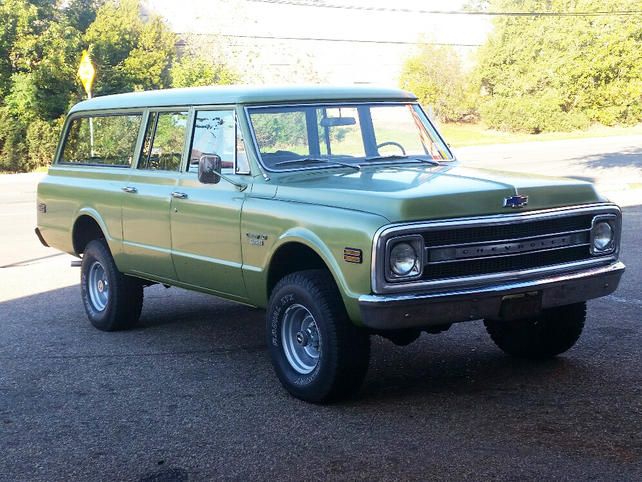
Table of Contents
- Overview and History
- The Action Line Redesign
- The New Third Door
- Rear Access: Tailgate vs Panel Doors
- Models: C10, K10, C20, K20
- Engine Lineup
- Transmissions
- Chassis, Suspension, and Brakes
- Interior, Seating, and Safety
- The Suburban’s Panel Truck Sibling
- Collectibility Today
- Key Features Summary
- Full Specifications Table
Overview and History
The Chevrolet Suburban was already one of the longest-running nameplates in the industry by 1967 — a steel-bodied, wagon-style carryall built on a truck chassis, in continuous production since the 1930s. For decades it had followed the same basic recipe: take a light-truck platform, put an enclosed wagon body on it with seating for a crowd, and give it a rear opening for cargo. What changed for 1967 was that the entire underlying truck was replaced.
Chevrolet’s light trucks were completely redesigned for 1967, launching what enthusiasts now call the “Action Line” generation (the C/K series produced through 1972). GM itself described the change as the most significant cab and sheet-metal restyle in the company’s history. The Suburban rode along with that redesign, gaining not just the new look but two genuinely important functional upgrades: a third door for passenger access, and — for the first time — a heavier ¾-ton model and factory four-wheel drive.
The timing was ideal. The mid-1960s camping, boating, and recreation boom was creating strong demand for a vehicle that could carry a large family and its gear, tow a trailer, and go off the pavement when needed. The 1967 Suburban answered all three needs at once, and sales climbed accordingly.
The Action Line Redesign
The 1967 restyle gave Chevrolet’s trucks a lower, wider, more modern stance with distinctly car-like lines. The cab sat lower to the ground than before, with a larger glass area and a new rigid roof for added strength. The front end was clean and handsome: single headlights recessed into square bezels at each end of a grille dominated by a single wide center bar.
Just as important as the looks was a major push on corrosion resistance and safety. The new bodies used smooth, undercoated full fender skirts to shield sheet metal from mud, water, and road salt, with liberal use of spot-weld sealers. Inside, a long list of new safety equipment arrived: a dual-circuit brake master cylinder, an energy-absorbing telescoping steering column, a padded instrument panel and sun visors, recessed instruments, flat-surfaced control knobs, hazard flashers, a brake-system warning lamp, and thicker laminated windshield glass. These were among the first federally influenced safety features to reach light trucks, and they make a ’67 a more reassuring vehicle to drive today than its pre-1967 predecessors.
The New Third Door
The single most significant change to the Suburban itself for 1967 was the addition of a third door. Every previous Suburban had been a two-door design — a door on each side at the front, and nothing for the rear passengers but to clamber past a folded front seat.
The Action Line Suburban fixed that with an asymmetric door layout: a single door on the driver’s side and two doors on the passenger (curb) side. The extra curb-side door meant second- and third-row passengers could climb in and out directly and safely at the roadside rather than squeezing past the front seat. It was a small idea with a big effect on usability, and it is a defining identifying feature of a 1967-and-later Suburban of this generation. If you see a Suburban of this vintage with three side doors arranged two-on-the-right, one-on-the-left, you are looking at the Action Line design.
Rear Access: Tailgate vs Panel Doors
At the back, the Suburban continued to offer the two rear-access arrangements that had long been part of the model, and the choice between them matters to buyers today.
Tailgate with lift-up glass. A station-wagon-style arrangement: a drop-down tailgate below and a lift-up rear window above. This is the more car-like, family-friendly setup, and it is generally the more sought-after configuration on a restored Suburban.
Double “barn door” cargo doors. A pair of side-hinged doors that swing open at the rear — the more commercial, utilitarian arrangement, favored for loading bulky cargo. These are functionally excellent but less common on passenger-optioned trucks.
The distinction is worth confirming on any car you consider, because it affects both the character of the vehicle and its value. The panel-truck sibling of the Suburban (covered below) always used the barn-door rear regardless of glass.
Models: C10, K10, C20, K20
Because the Suburban shared its platform and running gear with the pickups, it inherited their model structure. For 1967 that meant, for the first time, a choice of load ratings and drive types:
- C10 — ½-ton, two-wheel drive (the volume model)
- K10 — ½-ton, four-wheel drive (new)
- C20 — ¾-ton, two-wheel drive (new)
- K20 — ¾-ton, four-wheel drive (new)
The ½-ton C10 was the mainstream family choice; the new ¾-ton C20 added heavier chassis components for buyers who needed to tow or haul serious weight, such as a travel trailer or camper. The K-series four-wheel-drive models opened the Suburban up to genuine off-pavement use for the first time from the factory. All shared the same 127-inch wheelbase and outer sheet metal, differing in chassis strength, spring rates, axles, and drivetrain.
Engine Lineup
The Suburban shared the pickups’ powertrain menu, which for 1967 spanned two sixes and two small-block V8s.
250 cu in Turbo-Thrift six (standard). An overhead-valve inline-six with seven main bearings and a one-barrel carburetor, producing 155 hp at 4,200 rpm and 235 lb-ft of torque. Durable and economical, it was the standard engine.
292 cu in Turbo-Thrift six (optional). A larger, torquier six rated at 170 hp at 4,000 rpm and 275 lb-ft — a sensible choice for a loaded Suburban that would spend its life hauling people and gear without the running costs of a V8.
283 cu in V8 (optional). The base V8, a High-Torque small-block with a two-barrel carburetor, 175 hp at 4,600 rpm, and 275 lb-ft of torque at a low 2,400 rpm.
327 cu in V8 (optional). The top engine, a four-barrel High-Torque small-block making 220 hp at 4,400 rpm and a stout 320 lb-ft at 2,800 rpm. This was the engine to have for towing or for anyone who wanted effortless performance from a big, heavy body.
All four engines used cast-iron blocks and hydraulic lifters. The 327 was newly offered on the four-wheel-drive trucks for 1967, extending strong V8 performance to the K-series for the first time.
Transmissions
The standard transmission was a column-shifted three-speed manual, with a broad set of options depending on the model:
- Three-speed manual — standard on ½- and ¾-ton models
- Three-speed heavy-duty manual — optional
- Three-speed manual with overdrive — optional on ½-ton models
- Four-speed manual — optional on ½- and ¾-ton models
- Powerglide two-speed automatic — optional on ½-ton models
- Turbo Hydra-Matic 400 three-speed automatic — optional on ¾-ton models
The availability of the Turbo Hydra-Matic on the ¾-ton trucks made a well-optioned C20 Suburban a genuinely comfortable tow vehicle by the standards of the day. Positraction limited-slip was optional on V8-equipped trucks where the axle allowed.
Chassis, Suspension, and Brakes
The Suburban rode the long 127-inch wheelbase shared with the 8-foot-bed pickups, giving an overall length of roughly 206 inches. Two-wheel-drive ½-ton models used independent front suspension with coil springs and a coil-sprung rear, delivering the “car-like ride” Chevrolet advertised — a real advantage over leaf-sprung rivals of the era.
The four-wheel-drive K-series and the heavier ¾-ton trucks used sturdier arrangements: leaf-spring suspensions on the 4×4s (of a new weight-saving tapered-leaf design that reduced inter-leaf friction for a smoother ride), heavier-gauge frames, and beefier axles to withstand off-road and heavy-haul duty. Chevrolet’s engineers relocated the 4×4 transfer case higher and attached it directly to the transmission, which lowered overall height by about five inches while retaining 12½ inches of ground clearance.
Braking was by drums at all four wheels, but with the important new dual-circuit master cylinder as standard, providing a safety margin if one hydraulic circuit failed. Vacuum power brakes and power steering were on the options list — power steering being especially welcome on a vehicle of this size and weight. Standard Suburban tires were 8.15 × 15 on the ½-ton two-wheel-drive models.
Interior, Seating, and Safety
Inside, the Suburban was configured as a true multi-passenger vehicle, with available second- and (with the appropriate configuration) third-row seating to carry a large family or work crew. The new third door made that rear seating genuinely practical rather than an afterthought.
The 1967 cab brought a raft of new safety and comfort features shared with the pickups: a deep-dish three-spoke steering wheel, the telescoping energy-absorbing column, a padded dash and sun visors, recessed instruments, flat-surfaced control knobs, and safety belts. Options ran from air conditioning and a heater/defroster to tinted Soft-Ray glass, an AM radio, full wheel covers, gauges, and the Custom Sport Truck and Custom trim packages that dressed up the utilitarian cabin considerably.
The Suburban’s Panel Truck Sibling
Alongside the Suburban, Chevrolet offered a closely related Panel truck on the same body. The distinction is worth understanding when identifying these vehicles:
The Panel was a commercial delivery vehicle. It had no side passenger doors at all beyond the front cab doors, and its rear used barn-door cargo doors that always carried windows. It could be ordered with a fully closed, windowless rear section for maximum cargo security, or with side windows similar to the Suburban’s. The Suburban, by contrast, had the passenger side doors and, when so equipped, the station-wagon-style tailgate-and-liftglass rear. In short: side passenger doors and a wagon tailgate mark a Suburban; no side doors and windowed barn rear doors mark a Panel.
Collectibility Today
The Action Line trucks of 1967–1972 are among the most beloved and collectible American vehicles of their era, and the Suburban has ridden that wave upward. Once seen as a humble family and work hauler, a clean 1967 Suburban is now a genuinely desirable classic — the combination of handsome first-year Action Line styling, three-row versatility, and the practicality of a vehicle you can actually use with a modern family has made it a favorite for both restoration and restomod builds.
Values vary widely with configuration and condition. Four-wheel-drive K-series trucks command a premium over two-wheel-drive C models, as do V8 cars (especially the 327) over sixes, and tailgate examples over barn-door ones for family-oriented buyers. First-year 1967 examples carry particular appeal for their status as the debut of the generation. As with the pickups, originality and rust-free sheet metal are the key value drivers, and the Suburban’s larger body means there is simply more metal to inspect — a thorough look underneath and at the lower body is essential before buying.
Key Features Summary
- Generation: First year of the “Action Line” C/K generation (1967–1972)
- Layout: Front-engine, rear- or four-wheel drive
- Wheelbase: 127 inches (shared with 8-ft-bed pickups)
- Body: Steel wagon-style carryall on a light-truck chassis
- Major New Feature: Third passenger door (one driver-side, two curb-side)
- New Models: ¾-ton (C20/K20) and factory four-wheel drive (K10/K20) offered for the first time
- Rear Access: Choice of wagon tailgate with lift-glass, or double barn doors
- Standard Engine: 250 cu in six, 155 hp
- Top Engine: 327 cu in V8, 220 hp
- Transmissions: 3-speed manual standard; overdrive, 4-speed, Powerglide, or Turbo Hydra-Matic optional
- Safety: Dual-circuit brakes, energy-absorbing column, padded dash — new for 1967
- Ride: Independent front / coil-sprung on ½-ton 2WD; tapered-leaf on 4×4
- Sibling: Panel truck — no side doors, windowed barn rear doors
The 1967 Chevrolet Suburban Specs
| BODY | |
| Body Maker | Chevrolet (General Motors) |
| Body Type | Steel wagon-style carryall (Suburban) on light-truck chassis |
| Generation | “Action Line” C/K (1967–1972), first year |
| Side Doors | Three — one driver side, two curb (passenger) side |
| Rear Access | Wagon tailgate with lift-up glass, or double barn cargo doors |
| Seating | Multi-row; up to three rows / nine passengers depending on configuration |
| MODELS | |
| C10 | ½-ton, two-wheel drive |
| K10 | ½-ton, four-wheel drive (new for 1967) |
| C20 | ¾-ton, two-wheel drive (new for 1967) |
| K20 | ¾-ton, four-wheel drive (new for 1967) |
| DIMENSIONS | |
| Wheelbase | 127 inches (3,226 mm) |
| Overall Length | approx. 206.25 inches (5,239 mm) |
| Overall Height | approx. 71 inches (1,803 mm) |
| Front Tread | 63.1 inches (1,603 mm) |
| Rear Tread | 61.1 inches (1,552 mm) |
| 4×4 Ground Clearance | approx. 12.5 inches |
| GVW (½-ton) | 4,400–5,000 lbs (2WD); approx. 5,600 lbs (4×4) |
| GVW (¾-ton) | up to approx. 7,500–7,600 lbs |
| ENGINE — STANDARD (250 Turbo-Thrift Six) | |
| Engine Type | OHV inline-6, cast iron, 7 main bearings |
| Displacement | 250 cu in (4,097 cc / 4.1 L) |
| Bore × Stroke | 3.875 × 3.530 inches |
| Compression Ratio | 8.5:1 |
| Horsepower | 155 hp @ 4,200 RPM |
| Torque | 235 lb·ft @ 1,600 RPM |
| Carburetor | Rochester 1-barrel |
| ENGINE — OPTIONAL (292 Turbo-Thrift Six) | |
| Displacement | 292 cu in (4,786 cc / 4.8 L) |
| Bore × Stroke | 3.875 × 4.125 inches |
| Compression Ratio | 8.5:1 |
| Horsepower | 170 hp @ 4,000 RPM |
| Torque | 275 lb·ft @ 1,600 RPM |
| Carburetor | Rochester 1-barrel |
| ENGINE — OPTIONAL (283 High-Torque V8) | |
| Displacement | 283 cu in (4,638 cc / 4.6 L) |
| Bore × Stroke | 3.875 × 3.00 inches |
| Compression Ratio | 9.0:1 |
| Horsepower | 175 hp @ 4,600 RPM |
| Torque | 275 lb·ft @ 2,400 RPM |
| Carburetor | Rochester 2GV 2-barrel |
| ENGINE — OPTIONAL (327 High-Torque V8, top) | |
| Displacement | 327 cu in (5,359 cc / 5.4 L) |
| Bore × Stroke | 4.00 × 3.25 inches |
| Compression Ratio | 8.5:1 |
| Horsepower | 220 hp @ 4,400 RPM |
| Torque | 320 lb·ft @ 2,800 RPM |
| Carburetor | Rochester 4-barrel |
| Note | Newly offered on 4×4 (K-series) for 1967 |
| TRANSMISSION | |
| Standard | 3-speed manual, column shift |
| Optional | 3-speed heavy-duty manual |
| Optional | 3-speed manual with overdrive (½-ton) |
| Optional | 4-speed manual |
| Optional | Powerglide 2-speed automatic (½-ton) |
| Optional | Turbo Hydra-Matic 400 3-speed automatic (¾-ton) |
| DRIVETRAIN | |
| Drive Layout | Rear-wheel drive (C) or four-wheel drive (K) |
| Transfer Case (4×4) | 2-speed, mounted directly to transmission |
| Limited Slip | Positraction — optional on V8 where axle allowed |
| SUSPENSION AND STEERING | |
| Front (½-ton 2WD) | Independent, coil springs |
| Rear (½-ton 2WD) | Coil-sprung live axle |
| Suspension (4×4 / ¾-ton) | Tapered leaf springs, heavier-gauge frame |
| Steering | Recirculating ball; power steering optional |
| BRAKES AND WHEELS | |
| Master Cylinder | Dual-circuit — standard for 1967 |
| Brakes | Drums, front and rear |
| Power Brakes | Vacuum-assist optional |
| Standard Tires (½-ton Suburban) | 8.15 × 15 |
| SAFETY (new/standard for 1967) | |
| Steering Column | Energy-absorbing, telescoping |
| Brakes | Dual-circuit master cylinder |
| Interior | Padded dash and sun visors, recessed instruments |
| Other | Hazard flashers, brake warning lamp, thicker laminated windshield, safety belts |
| EXTERIOR COLORS (1967 Chevrolet trucks) | |
| Light Green, Dark Green, Medium Blue (poly), Light Blue, Dark Blue, Dark Aqua (poly), Red, Vermilion (poly), Omaha Orange, Yellow, White, Silver (poly), Ivory. Standard two-tone was white above the belt line with the second color below. | |
| OPTIONAL EQUIPMENT (SELECTED) | |
| Four-Wheel Drive (K-series) | Opt. (new for 1967) |
| 327 V8 Engine | Opt. |
| Turbo Hydra-Matic Automatic | Opt. (¾-ton) |
| Power Steering | Opt. |
| Vacuum Power Brakes | Opt. |
| Positraction | Opt. |
| Air Conditioning | Opt. |
| Custom Sport Truck (CST) Equipment | Opt. |
| Custom / Chrome Trim Packages | Opt. |
| Soft-Ray Tinted Glass | Opt. |
| AM Radio and Antenna | Opt. |
| Full Wheel Covers | Opt. |
| Heavy-Duty Cooling / Radiator | Opt. |
| Auxiliary / Heavy-Duty Springs | Opt. |
| Front Stabilizer Bar | Opt. |
| Camper Special Package | Opt. |
| Towing Hooks | Opt. |
1967 Chevrolet Suburban – Frequently Asked Questions
What was new about the 1967 Chevrolet Suburban?
Two things stand out. First, 1967 introduced the all-new “Action Line” body and chassis shared with the redesigned C/K pickups. Second, and specific to the Suburban, it gained a third passenger door for the first time — one on the driver’s side and two on the curb side — and became available in a heavier ¾-ton rating and in four-wheel drive for the first time. A raft of new safety features, including dual-circuit brakes and an energy-absorbing steering column, also arrived.
How many doors does a 1967 Suburban have?
Three side doors: a single door on the driver’s side and two doors on the passenger (curb) side, giving rear-seat passengers direct access from the roadside. At the rear it had either a station-wagon-style tailgate with lift-up glass or a pair of side-hinged barn doors, depending on how it was ordered. This three-side-door arrangement is a key way to identify an Action Line Suburban.
What engines were available in the 1967 Suburban?
Four, shared with the pickups: the standard 250 cu in six (155 hp), the optional 292 cu in six (170 hp), the 283 cu in V8 (175 hp), and the top 327 cu in V8 (220 hp). All were cast-iron, hydraulic-lifter engines. The 327 was newly available on the four-wheel-drive K-series for 1967.
Was the 1967 Suburban available in four-wheel drive?
Yes — for the first time. The K10 (½-ton) and K20 (¾-ton) models brought factory four-wheel drive to the Suburban. Chevrolet mounted the two-speed transfer case directly to the transmission and raised it, which lowered overall height by about five inches while keeping roughly 12½ inches of ground clearance. The 4×4 models used tapered-leaf suspension and heavier frames.
What is the difference between the C10 and K10 Suburban?
The C10 is the ½-ton, two-wheel-drive model; the K10 is the ½-ton, four-wheel-drive model. The “C” prefix denotes rear-wheel drive and the “K” prefix denotes four-wheel drive throughout Chevrolet’s light-truck line. The heavier ¾-ton versions are the C20 (2WD) and K20 (4WD).
What is the difference between a Suburban and a Panel truck?
They share the same basic body, but the Panel is a commercial delivery vehicle with no side passenger doors and rear barn doors that always carry windows (it could be ordered with a windowless or windowed cargo area). The Suburban has the passenger-side doors and, typically, a station-wagon-style tailgate-and-lift-glass rear, making it a people-carrier rather than a delivery vehicle.
How big is a 1967 Suburban?
It rides a 127-inch wheelbase — the same as an 8-foot-bed pickup — with an overall length of roughly 206 inches and a height around 71 inches. GVW ranged from about 4,400–5,000 lbs on the ½-ton two-wheel-drive models up to roughly 7,500 lbs on the ¾-ton versions.
Is a 1967 Chevrolet Suburban a good classic to buy?
For many buyers, yes. The 1967–1972 Action Line trucks are among the most sought-after American classics of their era, and the Suburban adds three-row family practicality to that appeal. First-year 1967 examples carry particular interest. Four-wheel-drive K models and V8 cars (especially the 327) command premiums, as do clean tailgate examples. As always with trucks of this age, rust-free sheet metal and originality are the key value drivers — and the Suburban’s large body means there is a lot of metal to inspect.
What colors did the 1967 Suburban come in?
The 1967 Chevrolet truck palette included Light Green, Dark Green, Medium Blue, Light Blue, Dark Blue, Dark Aqua, Red, Vermilion, Omaha Orange, Yellow, White, Silver, and Ivory. The standard two-tone scheme placed white above the belt line with the chosen second color below — a common and attractive look on Suburbans of this year.
