The 1967 Chevrolet Impala Sport Sedan — the four-door hardtop — was the stylish way to carry a full family. Where the ordinary pillared Sedan prioritized practicality, the Sport Sedan chased the look: it is a genuine pillarless four-door hardtop, with no fixed center post, so lowering all four side windows opens the entire flank of the car into a single uninterrupted space. That hardtop profile, wrapped in the exaggerated “Coke-bottle” sheet metal that makes the 1967 among the most admired of all Impalas, is exactly why this is the four-door most collectors seek out today. It rode the same full-size 119-inch B-body platform as the rest of the line, but wore its roof with far more flair.
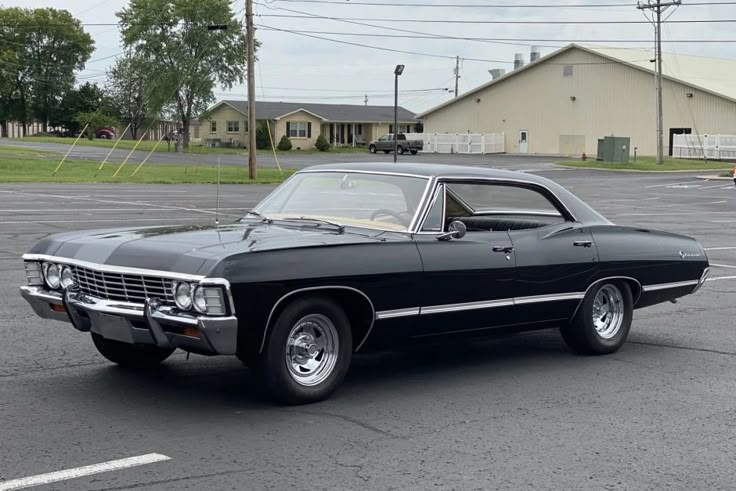
Table of Contents
- Overview and History
- What Makes It the Hardtop Sport Sedan
- Styling and Design for 1967
- Engine Lineup
- Transmissions
- Chassis, Suspension, and Brakes
- Interior and Comfort
- Safety Equipment
- Where the Impala Sat in the Full-Size Range
- Production and Pricing
- Collectibility Today
- Key Features Summary
- Full Specifications Table
Overview and History
By 1967 the Impala had been Chevrolet’s flagship full-size car for nearly a decade, and it was carrying the entire division on its shoulders commercially. The full-size Chevrolet had been comprehensively re-engineered for 1965 — the old X-frame gave way to a full-width perimeter frame with all-coil suspension — and 1967 was the second and final year of that particular body shell before another restyle arrived for 1969.
The 1967 model year is significant for reasons beyond styling. It was the first year of a number of federally mandated safety features, the first year a dual-circuit brake master cylinder was standard, and the first year front disc brakes appeared on the full-size Chevrolet options list. The Impala stood at the top of a four-rung full-size ladder — above the Biscayne and Bel Air, below only the Caprice — and within the Impala line the Sport Sedan was the body style for buyers who wanted family space without giving up the drama of a hardtop roof.
The Impala remained the best-selling car in the United States in 1967, with roughly 575,600 examples built across all body styles. The overwhelming majority left the factory with V8 power; only around 18,800 kept the base six-cylinder engine. The Sport Sedan combined four-door convenience with hardtop glamour, and it was the choice of buyers who could stretch a little past the plain pillared Sedan.
What Makes It the Hardtop Sport Sedan
Precision matters here, because “1967 Impala 4-door” actually refers to two different cars, and this article is about the hardtop. The Sport Sedan is a pillarless four-door hardtop: there is no fixed B-pillar between the front and rear door glass, and the side windows are frameless. Roll all four down and the entire side of the car becomes one open aperture — the signature hardtop effect. Its companion body, the plain Sedan, has a fixed pillar and framed glass and is covered in its own article.
The choice between them is entirely about the roof, and it is a meaningful one. The hardtop’s open, airy greenhouse is the whole point of the Sport Sedan — it is dramatically more attractive with the windows down, and it is the reason this body carries a premium in the collector market today. The trade-offs are the flip side of the same coin: without a fixed pillar the hardtop body is marginally less rigid and a touch noisier at speed than the pillared Sedan, and the more complex window sealing is something to inspect on any car you consider.
Its body style code was 39, appearing as 16339 for the six-cylinder car and 16439 for the V8 on the cowl tag and encoded in the VIN. If you are reading a data plate and see a “39” in the body-style position, you are looking at the pillarless Sport Sedan hardtop; a “69” would indicate the plain pillared Sedan instead.
Styling and Design for 1967
The 1967 restyle took the clean 1965–66 shape and pushed its “Coke-bottle” theme considerably further, adding pronounced bulges over the front and rear wheel arches inspired by the Corvette and giving the car a muscular, hip-heavy stance. A pinch line ran along the top of the front and rear fenders, and the grille was extended to wrap around the leading edges of the front fenders.
The Impala was distinguished from the cheaper Bel Air and Biscayne by generous brightwork: bright lower body-side moldings, roof drip-cap and reveal moldings on the hardtops, a silver deck-lid center-panel accent with a Chevrolet emblem, and black-accented taillight surrounds. Full wheel covers were standard. On the Sport Sedan the pillarless hardtop roof was clean and formal — distinct from the fast semi-fastback roof used on the two-door Sport Coupe — and the frameless side glass gave the profile its unbroken, open character. The result was a car that looked a full class more expensive than its price suggested, and the hardtop roof pushed that impression further still.
Engine Lineup
One of the defining features of the full-size Chevrolet in this era was the sheer breadth of the engine list. A Sport Sedan could be a mild six-cylinder family car or, in principle, a big-block bruiser — the body style did not restrict the choice.
250 cu in Turbo-Thrift six. The standard engine: an overhead-valve inline-six with a single-barrel carburetor, producing 155 hp at 4,200 rpm. Adequate for gentle use and inexpensive to run.
283 cu in Turbo-Fire V8. The base V8 and by far the most common Sport Sedan engine, a two-barrel small-block rated at 195 hp. It struck the balance most buyers wanted between smoothness, economy, and cost.
327 cu in Turbo-Fire V8 (RPO L30). The step-up small-block, with a four-barrel carburetor and 275 hp. This was the sweet spot for an owner who wanted effortless highway performance without big-block running costs, and 1967 was the first year the three-speed Turbo Hydra-Matic automatic could be paired with it.
396 cu in Turbo-Jet V8 (RPO L35). The entry big-block, a Mark IV with a four-barrel and 325 hp.
427 cu in Turbo-Jet V8 (RPO L36). The top regular-production engine, rated at 385 hp and 460 lb-ft of torque. A very rare, late-availability L72 427 rated at 425 hp was also technically offered on the full-size line — believed to have gone into only around eleven cars.
In practice, the vast majority of Sport Sedans left the factory with the 283 or the 327. A big-block hardtop four-door exists but is uncommon, since buyers who wanted a 396 or 427 usually chose the two-door body styles.
Transmissions
The standard transmission across the range was a column-shifted three-speed manual with full synchromesh. From there the choices depended on the engine:
- Two-speed Powerglide automatic — the automatic offered with the six-cylinder and the base 283 V8
- Three-speed Turbo Hydra-Matic (M40) — the superior three-speed automatic, available with the 327, 396, and 427; newly extended to the 275 hp 327 for 1967
- Four-speed manual (RPO M20) — offered with the V8 engines, though rarely chosen in a four-door hardtop
- Overdrive — optional on the base six and base 283
For a Sport Sedan, the overwhelmingly common combination was the base or 327 V8 paired with an automatic — Powerglide behind the smaller engines, Turbo Hydra-Matic behind the 327. That drivetrain defines the character of the car: relaxed, torque-rich, and built for effortless cruising with the windows down.
Chassis, Suspension, and Brakes
The 1967 Impala used the full-perimeter frame introduced for 1965, a substantial improvement over the older X-frame in both rigidity and crash protection. The wheelbase was 119 inches, with an overall length of roughly 213 inches — a genuinely large car by any standard. As a pillarless hardtop, the Sport Sedan relied more on that frame for structural rigidity, since it lacked the fixed B-pillar that stiffens the plain Sedan.
Suspension was independent at the front with coil springs and control arms, and a coil-sprung live axle located by trailing arms at the rear. The tuning was unapologetically soft, prioritizing the smooth, isolated ride that full-size American buyers expected. Optional heavy-duty suspension with front and rear sway bars was available for those who wanted flatter cornering.
Brakes marked a meaningful step forward for 1967. A dual-circuit master cylinder became standard, providing a critical safety margin if one hydraulic circuit failed. The standard brakes were drums at all four corners, but for the first time front disc brakes were available as an option — a worthwhile upgrade on a car of this size and weight. Disc-brake cars used 15-inch wheels rather than the standard 14-inch. Standard tires were 8.25 × 14; disc-brake cars ran 8.15 × 15. Power steering and power brakes were optional and, given the car’s size, highly desirable.
Interior and Comfort
Inside, the Impala was pitched a clear step above the workaday Biscayne and Bel Air. Standard equipment included upgraded door panels with carpeting on the lower section, an electric clock, a cigarette lighter, armrests with built-in ashtrays, a lockable glove compartment, and color-keyed floor carpeting. Cloth-and-vinyl upholstery was standard, with all-vinyl trim optional — and, new for 1967, offered in a range of colors rather than only black. On the Impala hardtops, all-vinyl trim was a natural pairing with the sportier character of the body.
The Sport Sedan was a comfortable six-passenger car with bench seats front and rear, and its pillarless greenhouse made it feel especially light and spacious inside — the openness that pillared sedans simply cannot match. New options for 1967 included a stereo 8-track tape player, a fiber-optic exterior light monitoring system, and vacuum-operated power door locks, signaling how far the full-size Chevrolet had moved toward genuine near-luxury.
Safety Equipment
1967 was a landmark year for automotive safety, and the Impala reflected the new federal requirements. Standard safety equipment now included a fully collapsible, energy-absorbing steering column, side marker lights, a dual-circuit brake master cylinder, and shoulder belts for closed body styles — which included the Sport Sedan hardtop. These were among the first generation of mandated safety systems that would become universal over the following years, and they make a 1967 a slightly safer classic to drive than its 1965–66 predecessors.
Where the Impala Sat in the Full-Size Range
Understanding the Impala means understanding the ladder it sat on. Chevrolet’s 1967 full-size line ran, from bottom to top: the Biscayne (the plain fleet and budget model), the Bel Air (a modest step up), the Impala (the high-volume near-luxury model), and the Caprice (the top-trim flagship, itself spun off from an Impala option only two years earlier).
The Sport Sedan therefore represented the stylish heart of the Impala line: substantially better trimmed and equipped than a Bel Air, a step above the plain Impala Sedan in showroom appeal, but still short of a Caprice. For a family that wanted a big, comfortable, good-looking Chevrolet with the glamour of a hardtop roof — without paying flagship money — the Impala Sport Sedan was the obvious answer.
Production and Pricing
Chevrolet built approximately 575,600 Impalas for 1967 across all body styles. The company did not publish consistently reliable body-style-by-body-style breakdowns for the base Impala series, and the figures that circulate for individual four-door totals should be treated with some caution. What is well documented is the series-wide picture and the specialty totals:
- Total 1967 Impala production: approximately 575,600
- Impala Super Sport (all SS): 76,055
- Impala SS-427 (RPO Z24): 2,124
- Full-size Chevrolet convertibles: 29,937, including 9,545 SS convertibles
- Six-cylinder Impalas (all styles): roughly 18,800 — the rest were V8
The hardtop Sport Sedan listed at $2,790 with the six-cylinder engine (add approximately $105 for the base V8). By comparison, the pillared Sedan was $2,720, the two-door Sport Coupe $2,740, and the convertible $2,990. That roughly $70 premium over the plain Sedan bought the hardtop roof and its open, frameless profile — a price many buyers were happy to pay for the look. Because so many were built and so many were simply used up as ordinary transportation, well-preserved original Sport Sedans are less common today than the raw production figures might suggest.
Collectibility Today
For decades the four-door Impala was the poor relation of the collector world — enthusiasts wanted the two-door hardtops, the convertibles, and above all the SS 427, and four-doors were often broken up for parts to restore those more valuable cars. That has changed. As values of the two-door cars have climbed out of reach, the four-door Impala has become one of the most sensible entry points into 1960s American classic ownership — and within the four-door world, the pillarless Sport Sedan is the one to have.
The Sport Sedan carries a premium over the plain pillared Sedan precisely because of its more glamorous, open hardtop roofline, while still costing a fraction of an equivalent two-door hardtop or convertible. It offers the same handsome styling, the same comfortable ride, and considerably more usable space than a two-door. The four-door hardtop also has a cultural following of its own — the black 1967 Impala four-door hardtop is instantly recognizable to a generation of television viewers, which has done no harm at all to demand for clean, correct examples. For a buyer who wants the best-looking affordable way into a big 1960s classic, the Sport Sedan is hard to beat.
Key Features Summary
- Layout: Front-engine, rear-wheel drive (FR)
- Platform: GM B-body, 119-inch wheelbase, full-perimeter frame
- Body Style: Pillarless 4-door hardtop (Sport Sedan, frameless glass, no B-pillar), style code 39
- Position in Range: Above Biscayne and Bel Air, below Caprice
- Standard Engine: 250 cu in Turbo-Thrift six, 155 hp
- Most Common Engine: 283 cu in Turbo-Fire V8, 195 hp
- Top Regular Engine: 427 cu in Turbo-Jet V8, 385 hp (L36)
- Transmissions: 3-speed manual standard; Powerglide, Turbo Hydra-Matic, 4-speed, or overdrive optional
- Brakes: Standard dual-circuit master cylinder; front discs newly optional
- Safety: Collapsible steering column, side markers, shoulder belts
- Styling: Enhanced “Coke-bottle” shape with Corvette-inspired fender bulges
- Base Price: $2,790 (six) — a modest premium over the pillared Sedan
- Collector Appeal: The four-door to have — hardtop glamour at four-door value
The 1967 Chevrolet Impala Sport Sedan (4-Door Hardtop) Specs
| BODY | |
| Body Maker | Fisher (General Motors) |
| Body Style | 4-Door Sport Sedan (pillarless hardtop, no B-pillar, frameless glass) |
| Series | Impala — series 163 (6-cyl) / 164 (V8) |
| Body Style Code | 39 (16339 six / 16439 V8) |
| Platform | GM B-body (full-size) |
| Chassis | Full-perimeter frame, separate body |
| No. of Doors | 4 |
| Seating Capacity | 6 (front and rear bench) |
| Position in Full-Size Range | Above Biscayne and Bel Air; below Caprice |
| DIMENSIONS | |
| Wheelbase | 119.0 inches (3,023 mm) |
| Overall Length | approx. 213.2 inches (5,415 mm) |
| Overall Width | approx. 79.9 inches (2,029 mm) |
| Front Track | 62.5 inches (1,588 mm) |
| Rear Track | 62.4 inches (1,585 mm) |
| Curb Weight | approx. 3,500–3,700 lbs depending on engine and equipment |
| ENGINE — STANDARD (250 Turbo-Thrift Six) | |
| Engine Type | OHV inline-6, naturally aspirated |
| Displacement | 250 cu in (4,097 cc / 4.1 L) |
| Horsepower | 155 hp @ 4,200 RPM |
| Torque | 235 lb·ft @ 1,600 RPM |
| Carburetor | Rochester 1-barrel |
| Valve Lifters | Hydraulic |
| Block / Head | Cast iron |
| ENGINE — BASE V8 (283 Turbo-Fire, most common) | |
| Engine Type | OHV 90° V8, small-block |
| Displacement | 283 cu in (4,638 cc / 4.6 L) |
| Horsepower | 195 hp @ 4,800 RPM |
| Carburetor | Rochester 2-barrel |
| Compression Ratio | 9.25:1 |
| Main Bearings | 5 |
| OPTIONAL ENGINES | |
| 327 Turbo-Fire V8 (L30) | 275 hp @ 4,800 RPM, 4-barrel, 10.0:1 |
| 396 Turbo-Jet V8 (L35) | 325 hp, big-block, 4-barrel, 10.25:1 |
| 427 Turbo-Jet V8 (L36) | 385 hp, 460 lb·ft @ 3,400 RPM, 10.25:1 |
| 427 Turbo-Jet V8 (L72) | 425 hp — very rare late availability, approx. 11 full-size cars |
| TRANSMISSION | |
| Standard | 3-speed manual, column shift, full synchromesh |
| Powerglide (automatic) | 2-speed — six and base 283 V8 |
| Turbo Hydra-Matic (M40) | 3-speed automatic — 327, 396, 427 |
| 4-Speed Manual (M20) | Optional with V8 engines |
| Overdrive | Optional on base six and base 283 |
| DRIVETRAIN | |
| Drive Layout | Front engine, rear-wheel drive |
| Rear Axle | Live axle, coil sprung |
| Limited Slip | Positraction — optional |
| SUSPENSION AND STEERING | |
| Front Suspension | Independent, coil springs, control arms |
| Rear Suspension | Live axle, trailing arms, coil springs |
| Heavy-Duty Suspension | Optional — with front and rear sway bars |
| Steering | Recirculating ball; power steering optional |
| BRAKES AND WHEELS | |
| Master Cylinder | Dual-circuit — standard for 1967 |
| Standard Brakes | Drums, front and rear |
| Front Disc Brakes | Optional (new for 1967) |
| Standard Tires | 8.25 × 14 |
| Disc-Brake Tires / Wheels | 8.15 × 15 |
| PERFORMANCE (typical, 283 / 327 V8) | |
| 0–60 mph (283 V8, automatic) | approx. 11–12 seconds |
| 0–60 mph (327 V8) | approx. 9–10 seconds |
| Character | Relaxed, torque-rich highway cruiser |
| SAFETY (new/standard for 1967) | |
| Steering Column | Collapsible energy-absorbing |
| Brakes | Dual-circuit master cylinder |
| Lighting | Side marker lights |
| Restraints | Shoulder belts (closed body styles) |
| VIN / VEHICLE IDENTIFICATION | |
| VIN Example | 164397T115167 |
| Digit 1 | Chevrolet Division (1) |
| Digits 2–3 | Series (63 = Impala 6-cyl, 64 = Impala V8) |
| Digits 4–5 | Body Style (39 = 4-dr Sport Sedan hardtop) |
| Digit 6 | Model Year (7 = 1967) |
| Digit 7 | Assembly Plant (letter code, e.g. T = Tarrytown NY) |
| Remaining Digits | Sequential Production Number |
| Cowl Tag | Firewall — body style, paint, trim, and build-date codes |
| PRODUCTION AND PRICING (1967) | |
| Total Impala Production (all styles) | approx. 575,600 |
| Six-Cylinder Impalas (all styles) | approx. 18,800 |
| Impala Super Sport (all) | 76,055 |
| Impala SS-427 | 2,124 |
| 4-Door Sport Sedan Base Price (six) | $2,790 |
| Base V8 Premium | approx. +$105 |
| EXTERIOR COLORS (1967, with codes) | |
| AA Tuxedo Black, CC Ermine White, DD Nantucket Blue, EE Deepwater Blue, FF Marina Blue, GG Granada Gold, HH Mountain Green, KK Emerald Turquoise, LL Tahoe Turquoise, MM Royal Plum, NN Madeira Maroon, RR Bolero Red, SS Sierra Fawn, TT Capri Cream, YY Butternut Yellow (15 single-tone colors, plus seven two-tone combinations) | |
| OPTIONAL EQUIPMENT (SELECTED) | |
| Front Disc Brakes | Opt. (new for 1967) |
| Power Steering | Opt. |
| Power Brakes | Opt. |
| Turbo Hydra-Matic Automatic | Opt. (327/396/427) |
| Positraction Rear Axle | Opt. |
| Heavy-Duty Suspension with Sway Bars | Opt. |
| Air Conditioning | Opt. |
| All-Vinyl Interior | Opt. (now in multiple colors) |
| Stereo 8-Track Tape Player | Opt. (new for 1967) |
| Fiber-Optic Light Monitoring | Opt. (new for 1967) |
| Vacuum Power Door Locks | Opt. (new for 1967) |
| Power Windows | Opt. |
| Tilt Steering Wheel | Opt. |
| AM/FM Radio | Opt. |
| Vinyl Roof | Opt. |
1967 Chevrolet Impala Sport Sedan (4-Door Hardtop) – Frequently Asked Questions
What is the difference between the Impala Sport Sedan and the 4-Door Sedan?
The Sport Sedan — the car in this article — is a pillarless four-door hardtop: there is no fixed B-pillar between the doors and the side glass is frameless, so with the windows down the entire side of the car opens up. The Sedan is the conventional pillared four-door, with a fixed center post and framed door glass. They are mechanically identical and share the same body shell below the roof. The hardtop Sport Sedan is the sportier, more sought-after body and carries a small price premium; the pillared Sedan is slightly cheaper, quieter, and structurally stiffer. Body style codes are 39 for the Sport Sedan and 69 for the Sedan.
How much horsepower does a 1967 Impala Sport Sedan have?
It depends entirely on the engine ordered. The standard 250 cu in six made 155 hp; the base 283 V8 made 195 hp; the popular 327 V8 made 275 hp. Big-block options ran to the 396 at 325 hp and the 427 at 385 hp (L36). The body style did not limit the engine choice, though Sport Sedans were overwhelmingly built with the 283 or 327.
Is the Sport Sedan a true hardtop?
Yes. The Sport Sedan is a genuine pillarless four-door hardtop — there is no fixed B-pillar, and the side windows are frameless. Lowering all four side windows leaves an uninterrupted opening along the entire side of the car, which is the defining characteristic of a hardtop and the whole reason the body style exists. The plain Sedan, by contrast, keeps a fixed pillar and framed glass.
How many 1967 Impalas were built?
Chevrolet built approximately 575,600 Impalas for 1967, making it the best-selling car in the United States that year. The great majority were V8-powered, with only around 18,800 six-cylinder cars. Chevrolet did not publish fully reliable body-style breakdowns for the base Impala, so an exact total for the Sport Sedan alone should be treated with some caution.
What did a 1967 Impala Sport Sedan cost new?
The hardtop Sport Sedan started at $2,790 with the six-cylinder engine — about $70 more than the pillared Sedan, the premium buying the hardtop roof. Adding the base V8 raised the price by roughly $105, and options such as an automatic transmission, power steering, power brakes, and air conditioning could add several hundred dollars more.
What engine is best for a 1967 Impala Sport Sedan?
For most owners the 327 cu in V8 with the Turbo Hydra-Matic automatic is the ideal combination — smooth, torque-rich, easy to live with, and better suited to modern traffic than the two-speed Powerglide. The 283 is perfectly pleasant and the most authentic “typical” choice, while a big-block 396 or 427 hardtop is uncommon and comes with higher running costs.
Did the 1967 Impala Sport Sedan have disc brakes?
Front disc brakes became optional on the full-size Chevrolet for the first time in 1967; standard equipment was four-wheel drums. A significant related improvement was that a dual-circuit brake master cylinder became standard for 1967, giving a safety margin if one hydraulic circuit failed. A disc-brake car is a worthwhile find on a Sport Sedan you plan to drive regularly.
Is a 1967 Impala Sport Sedan a good classic to buy?
For many buyers, yes — and within the four-door world it is the one to have. The pillarless Sport Sedan carries a premium over the plain pillared Sedan for its more attractive open roofline, yet still sells for a fraction of the price of the equivalent two-door hardtops and convertibles. It offers the same handsome styling, the same comfortable ride, and considerably more usable interior space than a two-door. For the best-looking affordable way into a big 1960s American classic, it is hard to beat.
How can I decode a 1967 Impala Sport Sedan VIN?
Reading a sample such as 164397T115167: 1 = Chevrolet, 64 = Impala V8 series, 39 = four-door Sport Sedan hardtop body style, 7 = 1967 model year, T = Tarrytown, New York assembly plant, and the remaining digits are the sequential production number. A “69” in the body-style position would indicate the plain pillared Sedan instead. The cowl tag on the firewall adds the paint, trim, and build-date codes.
What colors were available on the 1967 Impala?
Chevrolet offered 15 single-tone exterior colors for the 1967 Impala, plus seven two-tone combinations. The single tones were Tuxedo Black, Ermine White, Nantucket Blue, Deepwater Blue, Marina Blue, Granada Gold, Mountain Green, Emerald Turquoise, Tahoe Turquoise, Royal Plum, Madeira Maroon, Bolero Red, Sierra Fawn, Capri Cream, and Butternut Yellow. Interior colors included black, white, blue, green, red, fawn, aqua, and gold in cloth-and-vinyl or all-vinyl trim.
