The 1964 Chevrolet Impala was the top of Chevrolet’s full-size range and one of the best-selling cars in America — a handsome, comfortable, near-luxury flagship offered in a full spread of body styles from practical four-door sedan to glamorous convertible. It was also the final year of a beloved body shell before the all-new 1965 restyle, which has given the 1964 a special place in the hearts of collectors. Riding a 119-inch wheelbase and available with everything from a frugal six to the legendary 409 V8, the ’64 Impala combined mainstream sensibility with genuine performance potential, and it remains one of the most recognizable American cars of the decade.
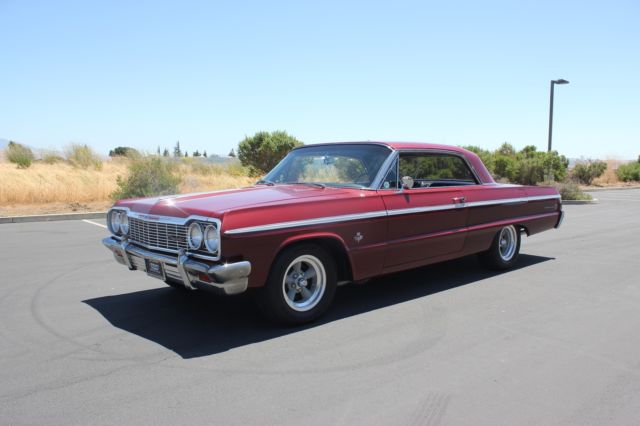
Table of Contents
- Overview and History
- Body Styles
- Where the Impala Sat in the Range
- Styling and Design
- Engine Lineup
- Transmissions
- Chassis, Suspension, and Brakes
- Interior and Standard Equipment
- The Impala SS Becomes Its Own Model
- Production and Pricing
- Collectibility Today
- Key Features Summary
- Full Specifications Table
Overview and History
By 1964 the Impala had been Chevrolet’s full-size flagship for six years and was firmly established as one of the best-selling cars in the United States. The 1964 model year brought no radical mechanical changes — the powertrains carried over from 1963, and the car retained its 119-inch wheelbase and roughly 209.9-inch overall length — but it received new sheet metal and cosmetic revisions that many enthusiasts consider the high point of the early-1960s Impala look.
Its significance is partly a matter of timing. The 1964 was the last of a body generation; for 1965 Chevrolet introduced a completely restyled full-size car with a new perimeter frame and curved “Coke-bottle” styling. That makes the ’64 the final example of the crisp, upright, chrome-accented design language of the early 1960s Impala — and, for a great many collectors, the definitive one.
Production continued to soar. Chevrolet built well over 880,000 Impalas for 1964 across all body styles, making it a cornerstone of the company’s business and a genuinely common sight on American roads. The vast majority were V8-powered, though the model line spanned an enormous breadth, from economy-minded six-cylinder sedans to 425-horsepower 409 performance cars.
Body Styles
The 1964 Impala was offered in a full range of body styles, so a buyer could have essentially any kind of full-size car under the same top-trim nameplate:
- 4-Door Sedan — the pillared, practical volume model
- 4-Door Sport Sedan — the pillarless four-door hardtop, with no fixed B-pillar
- 2-Door Sport Coupe — the pillarless two-door hardtop, with its distinctive semi-fastback roofline
- 2-Door Convertible — the open-top glamour model
- 4-Door Station Wagon — offered in 6-passenger and 9-passenger form
This breadth is one of the Impala’s defining traits: the same well-trimmed, well-equipped flagship experience was available whether a buyer needed a nine-passenger family hauler or a two-door hardtop. The Sport Coupe’s crisp semi-fastback roof is especially prized today and is the body most associated with the era’s performance image.
Where the Impala Sat in the Range
Chevrolet’s 1964 full-size line ran, from bottom to top: the Biscayne (the plain, budget and fleet model), the Bel Air (a mid-level step up), and the Impala (the top-of-the-line flagship). There was no Caprice yet — that name would arrive for 1965 as an even more luxurious Impala sub-model — so in 1964 the Impala was the most prestigious full-size Chevrolet available, and, once the Impala SS is counted, the division’s second-most-expensive line overall.
That flagship status came with visibly richer standard equipment than the Bel Air and Biscayne, and it is a large part of why the Impala outsold its cheaper siblings so decisively.
Styling and Design
The 1964 restyle refined rather than reinvented the Impala. The body kept its clean, upright, formal lines with a full-width grille, a bright horizontal bar theme, and the Impala’s signature six taillights — three round lamps on each side of the rear panel, a hallmark of the model that distinguishes it from lesser full-size Chevrolets, which used four.
Bright exterior trim marked the Impala as the flagship: full-length lower body-side moldings, bright window and roof accents on the hardtops, and Impala script and emblems. The overall effect was of a substantial, dignified car that still looked crisp and modern. The Sport Coupe’s semi-fastback roofline gave that body a sportier silhouette, while the four-door Sport Sedan offered the open, airy character of a pillarless hardtop in a family-friendly package.
Engine Lineup
One of the great strengths of the full-size Chevrolet was the sheer breadth of its engine list, and in 1964 the Impala offered a remarkable seven-strong range spanning economy to genuine muscle.
230 cu in Turbo-Thrift six. The standard engine, rated at 140 hp. Economical and durable, but chosen by only a small minority of buyers.
283 cu in Turbo-Fire V8. The base V8, offered in 170 hp and 195 hp forms — by far the most common Impala engine, striking the balance most buyers wanted between smoothness, economy, and cost.
327 cu in Turbo-Fire V8. The step-up small-block, available in three states of tune: 250 hp, 300 hp (four-barrel, dual exhaust), and 340 hp (solid lifters, dual exhaust). The 327 gave the big Impala effortless performance without big-block running costs and was a popular choice.
409 cu in Turbo-Fire V8 (“W” big-block). The performance flagship, offered in 340 hp, 400 hp, and 425 hp forms. The top 425 hp version used twin four-barrel carburetors, solid lifters, a high-lift camshaft, impact-extruded pistons, forged steel connecting rods, and a five-main-bearing crankshaft. Both the 400 and 425 hp 409s required the four-speed manual gearbox. Crucially, the 409 could be ordered in any 1964 full-size Chevrolet — Biscayne, Bel Air, Impala, or Impala SS — though the majority went into Super Sports.
The 409 was already a cultural icon by 1964, immortalized by the Beach Boys’ 1962 hit “409,” and the 1963–64 425 hp versions remained the most powerful 409s Chevrolet ever built.
Transmissions
The base transmission was a column-shifted three-speed manual. Options included:
- Three-speed manual with overdrive — a $108 option
- Four-speed manual — the enthusiast’s choice, and mandatory with the 400 and 425 hp 409 engines
- Powerglide two-speed automatic — the smooth, easygoing automatic favored by most family buyers
Performance buyers pairing the top 409s with the four-speed could specify low first-gear ratios and Positraction limited-slip high-performance axle ratios of 4.11:1 or 4.56:1 for serious acceleration.
Chassis, Suspension, and Brakes
The 1964 Impala used a conventional and well-proven full-size chassis with a 119-inch wheelbase. Front suspension was independent with coil springs; the rear used a coil-sprung live axle. The tuning prioritized the smooth, quiet, isolated ride expected of a full-size American flagship, and the Impala delivered it well.
Braking was by drums at all four wheels — adequate for the era but a genuine limitation on a heavy car with a 409 under the hood, and something to bear in mind on any performance-oriented example today. Power brakes ($43) and power steering ($75) were popular options that made the big car far easier to live with, and given its size, power steering in particular is a worthwhile feature to look for.
Interior and Standard Equipment
As the flagship, the Impala came with noticeably richer standard equipment than the Bel Air and Biscayne. Standard Impala features included extra-thick foam seat cushions, bright aluminum front-seat end panels, a bright instrument-panel insert with nameplate molding, an electric clock, a parking-brake warning light, an Impala emblem in the center of the steering wheel, and specially padded armrests front and rear.
The result was a cabin that felt a clear step above the mid-range full-size Chevrolets, in keeping with the Impala’s position at the top of the line. A long list of comfort and convenience options was available, including air conditioning ($364), tinted glass ($36), the Impala comfort and convenience group ($31), and a six-way power seat ($97), allowing a buyer to build anything from a plain flagship to a genuinely luxurious road car.
The Impala SS Becomes Its Own Model
The most significant change for 1964 was administrative but consequential: the Impala Super Sport became its own separate model rather than an option package layered onto a standard Impala, as it had been from 1961 through 1963. For collectors this matters enormously, because it makes genuine 1964 SS cars far easier to identify and authenticate than the earlier option-package cars.
The SS was offered only as a two-door Sport Coupe or convertible, with bucket seats, a center console, and special exterior and interior trim. It shared the Impala’s full engine range and its flagship character, but added a sportier, more personal focus. The Super Sport is covered in depth in its own dedicated article; for the standard Impala buyer, the key point is simply that from 1964 the SS was a distinct model sitting just above the regular Impala in prestige and price.
Production and Pricing
Chevrolet built well over 880,000 Impalas for 1964 across all body styles — a figure that includes the 185,325 Impala Super Sports, since the SS production is counted within the Impala total. This made the Impala one of the highest-volume cars in America and a mainstay of Chevrolet’s business.
Selected 1964 engine option pricing (added to the base Impala price) illustrates how the range stretched from economy to muscle:
- 250 hp 327 V8: $191
- 300 hp 327 V8: $245
- 340 hp 327 V8: $349
- 400 hp 409 V8: $428
- 425 hp 409 V8: $484
Of all 1964 full-size Chevrolets, approximately 8,684 were built with a 409 engine in one of its three forms, the majority of them Impala Super Sports — making any genuine 409 car, in any body, a comparatively rare find today.
Collectibility Today
The 1964 Impala is one of the most beloved American classics of its era, prized for its clean styling, its status as the last of the pre-1965 body, and its enormous versatility as a restoration, cruiser, or custom base. Its popularity in lowrider and custom culture — the two-door hardtop especially — has kept demand strong for decades and made it one of the most recognizable classic Chevrolets of all.
Values vary widely with body style, engine, and condition. Four-door sedans remain among the most affordable ways into a big, handsome 1960s classic, while two-door Sport Coupes and convertibles command significant premiums, and genuine 409 cars occupy the top of the market. As always, documentation, originality, and rust-free sheet metal are the key value drivers — and because the Impala was produced in such numbers and used so heavily, well-preserved original examples are less common than the raw production figures suggest. For a first classic that combines everyday usability, iconic looks, and deep parts availability, the 1964 Impala is hard to beat.
Key Features Summary
- Layout: Front-engine, rear-wheel drive (FR)
- Wheelbase: 119 inches; overall length approx. 209.9 inches
- Position: Top-of-the-line full-size Chevrolet (above Bel Air and Biscayne)
- Body Styles: 4-dr Sedan, 4-dr Sport Sedan hardtop, 2-dr Sport Coupe hardtop, Convertible, Wagon
- Signature Detail: Six round taillights (three per side)
- Standard Engine: 230 cu in six, 140 hp
- Most Common Engine: 283 cu in V8, 195 hp
- Top Engine: 409 cu in V8, up to 425 hp (dual-quad)
- Transmissions: 3-speed manual standard; overdrive, 4-speed, or Powerglide optional
- Significance: Last year of the pre-1965 body; SS became its own model
- Production: well over 880,000 (incl. 185,325 SS)
- 409 Cars: approx. 8,684 across all full-size models
- Collector Appeal: Iconic styling, huge versatility, strong custom following
The 1964 Chevrolet Impala Specs
| BODY | |
| Body Maker | Fisher (General Motors) |
| Body Styles | 4-dr Sedan; 4-dr Sport Sedan (hardtop); 2-dr Sport Coupe (hardtop); Convertible; Station Wagon (6- and 9-passenger) |
| Series | Impala — top-of-line full-size Chevrolet |
| Platform | GM full-size (B-body) |
| Chassis | Separate body-on-frame |
| Signature Detail | Six round taillights (three per side) |
| Position in Range | Above Biscayne and Bel Air (no Caprice until 1965) |
| DIMENSIONS | |
| Wheelbase | 119.0 inches (3,023 mm) |
| Overall Length | 209.9 inches (5,331 mm); wagons 210.8 inches |
| Seating Capacity | 6 (up to 9 in wagon) |
| ENGINE — STANDARD (230 Turbo-Thrift Six) | |
| Engine Type | OHV inline-6, naturally aspirated |
| Displacement | 230 cu in (3,769 cc / 3.8 L) |
| Horsepower | 140 hp |
| Carburetor | 1-barrel |
| ENGINE — BASE V8 (283 Turbo-Fire) | |
| Displacement | 283 cu in (4,638 cc / 4.6 L) |
| Horsepower | 170 hp or 195 hp |
| Carburetor | 2-barrel |
| ENGINE — OPTIONAL (327 Turbo-Fire V8) | |
| Displacement | 327 cu in (5,359 cc / 5.4 L) |
| 250 hp | 4-barrel |
| 300 hp | 4-barrel, dual exhaust — $245 |
| 340 hp | Solid lifters, dual exhaust — $349 |
| ENGINE — OPTIONAL (409 “W” Big-Block V8) | |
| Displacement | 409 cu in (6,702 cc / 6.7 L) |
| 340 hp | Single 4-barrel, hydraulic lifters |
| 400 hp | Single 4-barrel, high-lift cam — $428, requires 4-speed |
| 425 hp | Twin 4-barrel, solid lifters, high-lift cam — $484, requires 4-speed |
| 425 hp Internals | Impact-extruded pistons, forged steel rods, 5-main crank, dual exhaust |
| Availability | 409 could be ordered in any full-size Chevrolet |
| TRANSMISSION | |
| Standard | 3-speed manual, column shift |
| Optional — Overdrive | 3-speed with overdrive — $108 |
| Optional — 4-Speed | 4-speed manual (mandatory with 400/425 hp 409) |
| Optional — Automatic | Powerglide 2-speed |
| DRIVETRAIN | |
| Drive Layout | Front engine, rear-wheel drive |
| Limited Slip | Positraction — optional |
| Performance Axle Ratios | 4.11:1 or 4.56:1 available with top 409 |
| SUSPENSION, STEERING, BRAKES | |
| Front Suspension | Independent, coil springs |
| Rear Suspension | Live axle, coil springs |
| Steering | Recirculating ball; power steering optional ($75) |
| Brakes | Drums front and rear; power assist optional ($43) |
| PERFORMANCE (409/425) | |
| 0–60 mph | approx. 7.5 seconds |
| Quarter Mile | approx. 15.3 seconds |
| STANDARD IMPALA EQUIPMENT | |
| Extra-thick foam seat cushions; bright aluminum front-seat end panels; bright instrument-panel insert with nameplate; electric clock; parking-brake warning light; Impala steering-wheel emblem; padded front and rear armrests | |
| SELECTED OPTIONS AND PRICING | |
| Air Conditioning | $364 |
| Power Steering | $75 |
| Power Brakes | $43 |
| Six-Way Power Seat | $97 |
| Tinted Glass | $36 |
| Comfort & Convenience Group | $31 |
| Positraction | Opt. |
| EXTERIOR COLORS (1964, selected) | |
| Tuxedo Black, Ermine White, Meadow Green, Bahama Green, Azure Aqua, Lagoon Aqua, Daytona Blue, Silver Blue, Almond Fawn, Saddle Tan, Ember Red, Palomar Red, Desert Beige, Goldenwood Yellow (2-door models only, black interior only). Convertible top colors: black, white, or beige. | |
| PRODUCTION (1964) | |
| Total Impala (all body styles) | well over 880,000 |
| Impala Super Sport (incl. in total) | 185,325 |
| 409-Equipped (all full-size) | approx. 8,684 |
1964 Chevrolet Impala – Frequently Asked Questions
What body styles did the 1964 Impala come in?
Five: a pillared 4-door Sedan, a pillarless 4-door Sport Sedan hardtop, a pillarless 2-door Sport Coupe hardtop, a Convertible, and a Station Wagon in 6- and 9-passenger form. The Sport Coupe’s semi-fastback roofline is the most sought-after today. The Impala SS, a separate model for 1964, was offered only as a Sport Coupe or convertible.
How much horsepower does a 1964 Impala have?
It depends entirely on the engine. The standard 230 six made 140 hp; the base 283 V8 made 170 or 195 hp; the 327 V8 came in 250, 300, or 340 hp forms; and the top 409 big-block was offered at 340, 400, or 425 hp. The 425 hp 409 used twin four-barrel carburetors and was one of the most powerful engines available in any American car of the year.
What is special about the 1964 Impala specifically?
Two things. It was the last year of the pre-1965 body, before Chevrolet’s complete restyle, which gives it a special status among collectors as the final example of the early-1960s Impala look. And it was the year the Impala SS became its own separate model rather than an option package. The 409 was also near the end of its run, replaced by the 396 Mark IV big-block for 1965.
How many 1964 Impalas were built?
Chevrolet built well over 880,000 Impalas for 1964 across all body styles, including 185,325 Impala Super Sports (the SS total is counted within the overall Impala figure). Approximately 8,684 full-size Chevrolets were built with the 409 engine, most of them Super Sports.
Can you tell an Impala from a Bel Air or Biscayne at a glance?
The quickest tell is the taillights. The Impala uses six round taillights — three on each side of the rear panel — while the cheaper Bel Air and Biscayne used four. The Impala also wears more bright exterior trim and Impala script and emblems, reflecting its position as the top-of-the-line full-size Chevrolet.
Was the 409 only available in the Impala SS?
No. While the majority of 409s went into Impala Super Sports, the engine could be ordered in any 1964 full-size Chevrolet — including the plain Biscayne and Bel Air. A stripped-down Biscayne with a 425 hp 409 was a formidable and comparatively light “sleeper,” and such cars are highly prized today.
Is a 1964 Impala a good classic to buy?
For many buyers, yes — it is one of the most iconic and versatile American classics of the 1960s. Four-door sedans are among the most affordable entry points into a big, handsome classic, while Sport Coupes, convertibles, and genuine 409 cars command premiums. Excellent parts availability, a huge enthusiast and custom following, and instantly recognizable styling make it an easy car to own and enjoy. As always, prioritize documentation, originality, and rust-free sheet metal.
What colors did the 1964 Impala come in?
The 1964 palette included Tuxedo Black, Ermine White, Meadow Green, Bahama Green, Azure Aqua, Lagoon Aqua, Daytona Blue, Silver Blue, Almond Fawn, Saddle Tan, Ember Red, Palomar Red, Desert Beige, and Goldenwood Yellow. Goldenwood Yellow was an oddity — offered only on two-door models and only with a black interior. Convertible tops came in black, white, or beige.
