The 1964 Chevrolet Impala SS marked a turning point for one of the most famous badges in American motoring: for the first time, the Super Sport became its own distinct model rather than an option package added to a standard Impala. Offered only as a two-door Sport Coupe or convertible, dressed with bucket seats, a center console, and special trim, and available with everything up to the legendary 425-horsepower dual-quad 409 big-block, the ’64 SS was Chevrolet’s sporty full-size flagship — glamorous, quick, and, in 409 form, one of the last and most powerful expressions of the “W” engine before the muscle car era moved to mid-size cars. It remains one of the most desirable early-1960s Chevrolets a collector can own.
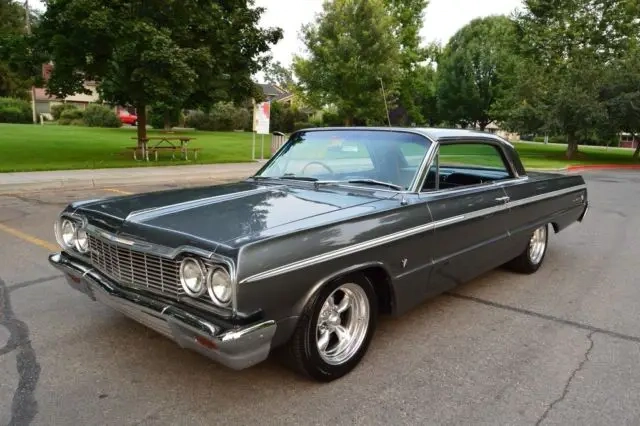
Table of Contents
- Overview and History
- The SS Becomes Its Own Model
- Body Styles
- SS Interior and Trim
- Engine Lineup
- The 409 Legend
- Transmissions and Drivetrain
- Chassis, Suspension, and Brakes
- Performance
- Production and Pricing
- Authentication and Buying
- Collectibility Today
- Key Features Summary
- Full Specifications Table
Overview and History
The Impala Super Sport had debuted for 1961 as an option package — a set of trim, badges, and sporty appointments that could be added to a standard Impala. It proved enormously popular, and by 1964 Chevrolet had sold the concept well enough to give it independent status. For the 1964 model year the SS was promoted from an option to a model in its own right, sitting just above the standard Impala and ranking as Chevrolet’s second-most-expensive offering that year.
Mechanically the 1964 full-size Chevrolet carried over from 1963, retaining the 119-inch wheelbase and the crisp, upright styling that 1965’s complete restyle would sweep away. That makes the ’64 SS the final Super Sport built on the beloved pre-1965 body — and, in 409 form, one of the last hurrahs for Chevrolet’s original big-block before the Mark IV 396 arrived and the performance spotlight shifted to the mid-size Chevelle.
The SS Becomes Its Own Model
The change from option package to standalone model is the defining fact of the 1964 SS, and it has real consequences for collectors today. From 1961 to 1963, an SS was simply a standard Impala with the Super Sport option added, which makes those cars comparatively difficult to authenticate decades later. From 1964, the Super Sport was built as a distinct model, carried the Impala series identification (13 for six-cylinder cars, 14 for V8s), and was offered in only two specific body styles — which together make genuine 1964 SS cars considerably easier to identify than their predecessors.
This does not make authentication automatic — trim, documentation, and build records still matter, and SS badging and interior pieces can be added to a plain Impala. But the 1964 model’s distinct identity is a meaningful advantage when evaluating a car, and it is one reason the year holds a special place in the Super Sport story.
Body Styles
Unlike the standard Impala, which came in five body styles, the 1964 Impala SS was offered in only two:
- 2-Door Sport Coupe — the pillarless two-door hardtop, with the era’s distinctive semi-fastback roofline
- 2-Door Convertible — the open-top model
There was no four-door SS and no SS wagon — the Super Sport was, by definition, a personal, sporty two-door. The Sport Coupe is the more common of the two and the body most associated with the SS image; the convertible is rarer and commands a premium, particularly with a desirable engine.
SS Interior and Trim
The Super Sport’s cabin was the heart of its appeal and the clearest way it distinguished itself from a standard Impala. Where the regular Impala used a front bench seat, the SS came with front bucket seats divided by a center console, giving it a sportier, more driver-focused character.
SS-specific trim included special door panels, unique interior appointments, Super Sport badging inside and out, and distinctive exterior brightwork with SS emblems. The 409-equipped cars came standard with a padded dash. The overall effect turned the comfortable, dignified Impala into something markedly more youthful and sporting, without sacrificing the full-size car’s space and ride — exactly the formula that made the Super Sport such a success.
Engine Lineup
The SS shared the full Impala engine range, from mild six to fire-breathing big-block. It could be optioned as gently or as aggressively as the buyer wished:
- 230 cu in six — 140 hp (rare in an SS, but available)
- 283 cu in V8 — 170 or 195 hp
- 327 cu in V8 — 250, 300, or 340 hp
- 409 cu in V8 — 340, 400, or 425 hp
A six-cylinder Super Sport sounds like a contradiction, but the SS was as much about looks and trim as outright speed, and plenty of buyers ordered the sporty package with a modest engine. That said, the SS is inextricably linked with the 409, and it is the big-block cars that define the model’s legend.
The 409 Legend
No engine is more central to the Impala SS story than the 409. The “W” big-block had been immortalized in 1962 by the Beach Boys’ hit song “409,” and by 1964 it had become shorthand for American full-size performance. For its final full year in the pre-1965 body, it was offered in three forms:
- 340 hp — single four-barrel carburetor, hydraulic lifters
- 400 hp — single four-barrel, high-lift camshaft (four-speed required)
- 425 hp — twin four-barrel carburetors, solid lifters, high-lift camshaft (four-speed required)
The 425 hp version was a serious piece of engineering: twin four-barrels atop a big-block with impact-extruded pistons, forged steel connecting rods, a five-main-bearing crankshaft, a cast alloy-iron camshaft, lightweight valves, mechanical lifters, dual exhausts, a special clutch, and heavy-duty radiator and suspension. The 1963 and 1964 425 hp 409s remained the most powerful 409s Chevrolet ever built; when 409 production ended early in 1965, its peak output had already dropped to 400 hp.
Crucially, 409 orders in 1964 fell to roughly half of the previous year’s, with approximately 8,684 built across all full-size models — and only a fraction of those were the dual-quad 425 hp cars. That combination of low original production and decades of attrition is exactly why a genuine, numbers-matching 409 SS is a true find today.
Transmissions and Drivetrain
The base transmission was a three-speed manual, but the SS — especially in 409 form — was most at home with the four-speed. Options were:
- 3-speed manual — standard
- 3-speed manual with overdrive — optional
- 4-speed manual — the enthusiast’s choice, and mandatory with the 400 and 425 hp 409 engines
- Powerglide two-speed automatic — optional
Buyers pairing the top 409 with the four-speed could choose low first-gear ratios and Positraction limited-slip high-performance axle ratios of 4.11:1 or 4.56:1. This was the “4-Speed, Dual Quad, Positraction 409” combination the Beach Boys sang about — and it made for a genuinely fast full-size car.
Chassis, Suspension, and Brakes
The SS used the same well-proven full-size chassis as the standard Impala: a 119-inch wheelbase, independent coil-spring front suspension, and a coil-sprung live rear axle, tuned for a smooth ride. The 425 hp 409 package added heavy-duty suspension and radiator components to cope with the extra performance.
Braking was by drums at all four wheels — the era’s norm, but a real limitation on a heavy car with 425 horsepower, and the single biggest dynamic weakness of a fast ’64 SS by modern standards. Power steering and power brakes were popular and worthwhile options given the car’s size and weight.
Performance
In its ultimate 409/425 form, the 1964 Impala SS was quick by any standard of the day, despite being large and heavy:
- 0–60 mph: approximately 7.5 seconds
- Quarter mile: approximately 15.3 seconds
These were formidable figures for a full-size car in 1964, and they explain why the 409 SS was a force at drag strips and stoplights alike. The lesser 327-powered cars were still pleasantly brisk while being far easier and cheaper to live with, which is why many SS buyers chose a small-block and enjoyed the looks and trim without the big-block’s demands.
Production and Pricing
Chevrolet built 185,325 Impala Super Sports for 1964 — a substantial number, reflecting how successful the SS formula had become, and a figure counted within the overall Impala production total of well over 880,000. Sales of the SS were up on the previous year even as 409 orders fell.
The SS was priced between roughly $2,840 and $3,200 depending on body style and equipment, making it Chevrolet’s second-most-expensive line for 1964. The top engines added significantly to that: the 400 hp 409 was a $428 option and the 425 hp dual-quad 409 was $484, both requiring the four-speed gearbox.
Authentication and Buying
Because the SS commands a strong premium — and the 409 cars a very large one — authentication is central to buying wisely. The 1964’s status as a separate model helps, but several points deserve attention:
- Engine authenticity. A genuine, numbers-matching 409 is worth far more than a car into which a 409 has been transplanted, or a small-block SS represented as a big-block. Verify engine casting numbers, suffix codes, and the block’s stamped pad against the car’s documentation.
- SS trim added to a plain Impala. SS badges, bucket seats, and console pieces are available, so a standard Impala can be dressed as an SS. Confirm the car’s identity through build documentation, trim tags, and correct details throughout.
- Documentation. As with all high-value 1960s Chevrolets, a documented history, matching numbers, and originality drive the majority of the value — particularly on 409 cars.
A well-documented, numbers-matching 409/425 SS is one of the blue-chip full-size American collector cars; an unverifiable one should be valued much more cautiously.
Collectibility Today
The 1964 Impala SS sits among the most desirable early-1960s Chevrolets, combining iconic styling, the prestige of the Super Sport badge, and — in 409 form — genuine muscle-car pedigree. The dual-quad 425 hp cars occupy the top of the market and are treated as serious collector pieces; documented examples in excellent condition are rare and valuable.
Below that, 327-powered SS cars offer the full Super Sport look, bucket-seat interior, and two-door style at more accessible prices, making them a popular and rewarding way into the model. Convertibles command a premium over Sport Coupes in any specification. As the last SS on the pre-1965 body and one of the final chapters of the 409 story, the 1964 Impala SS holds a secure and appreciating place in the collector world — provided, as always, the car is what it claims to be.
Key Features Summary
- Significance: First year the SS was a separate model, not an option package
- Layout: Front-engine, rear-wheel drive (FR)
- Wheelbase: 119 inches; overall length approx. 209.9 inches
- Body Styles: 2-door Sport Coupe (hardtop) and Convertible only
- Interior: Front bucket seats, center console, SS-specific trim
- Position: Chevrolet’s second-most-expensive line for 1964
- Engines: 230 six through 409 V8
- Top Engine: 409 cu in, 425 hp dual-quad — the most powerful 409 Chevrolet built
- Transmission: 4-speed manual mandatory with 400/425 hp 409
- Performance (409/425): 0–60 in approx. 7.5 sec; quarter mile approx. 15.3 sec
- Production: 185,325 SS built; approx. 8,684 full-size 409s (most were SS)
- Culture: The 409 immortalized by the Beach Boys’ 1962 hit “409”
- Collector Appeal: Blue-chip in documented 409 form; accessible with a 327
The 1964 Chevrolet Impala SS Specs
| BODY | |
| Body Maker | Fisher (General Motors) |
| Body Styles | 2-door Sport Coupe (hardtop); 2-door Convertible |
| Model Status | Separate model for the first time (previously an option package) |
| Series Identification | Impala series — 13 (6-cyl) / 14 (V8) |
| Platform | GM full-size (B-body) |
| Chassis | Separate body-on-frame |
| Position in Range | Chevrolet’s second-most-expensive line for 1964 |
| DIMENSIONS | |
| Wheelbase | 119.0 inches (3,023 mm) |
| Overall Length | 209.9 inches (5,331 mm) |
| Seating | Front bucket seats with console; rear bench |
| SS-SPECIFIC EQUIPMENT | |
| Seating | Front bucket seats and center console (standard) |
| Trim | SS badging inside and out; special door panels and interior appointments; unique exterior brightwork |
| 409 Cars | Padded dash standard |
| ENGINE — STANDARD (230 Six) | |
| Displacement | 230 cu in (3,769 cc / 3.8 L) |
| Horsepower | 140 hp |
| ENGINE — 283 V8 | |
| Displacement | 283 cu in (4,638 cc / 4.6 L) |
| Horsepower | 170 hp or 195 hp |
| ENGINE — 327 V8 | |
| Displacement | 327 cu in (5,359 cc / 5.4 L) |
| Outputs | 250 hp; 300 hp; 340 hp (solid lifters) |
| ENGINE — 409 “W” BIG-BLOCK V8 | |
| Displacement | 409 cu in (6,702 cc / 6.7 L) |
| 340 hp | Single 4-barrel, hydraulic lifters |
| 400 hp | Single 4-barrel, high-lift cam — $428, 4-speed required |
| 425 hp | Twin 4-barrel, solid lifters, high-lift cam — $484, 4-speed required |
| 425 hp Internals | Impact-extruded pistons, forged steel rods, 5-main crank, lightweight valves, dual exhaust, special clutch, HD radiator/suspension |
| Distinction | 1963–64 425 hp = most powerful 409 ever built |
| TRANSMISSION | |
| Standard | 3-speed manual |
| Optional | 3-speed with overdrive; Powerglide 2-speed automatic |
| 4-Speed Manual | Optional; mandatory with 400/425 hp 409 |
| DRIVETRAIN | |
| Drive Layout | Front engine, rear-wheel drive |
| Limited Slip | Positraction — optional |
| Performance Axle Ratios | 4.11:1 or 4.56:1 with top 409 |
| SUSPENSION, STEERING, BRAKES | |
| Front Suspension | Independent, coil springs (HD with 425 hp 409) |
| Rear Suspension | Live axle, coil springs |
| Steering | Recirculating ball; power steering optional |
| Brakes | Drums front and rear; power assist optional |
| PERFORMANCE (409/425) | |
| 0–60 mph | approx. 7.5 seconds |
| Quarter Mile | approx. 15.3 seconds |
| PRODUCTION AND PRICING (1964) | |
| Impala SS Built | 185,325 (counted within total Impala production) |
| 409-Equipped (all full-size) | approx. 8,684 (majority were SS) |
| SS Price Range | approx. $2,840–$3,200 |
| 400 hp 409 Option | $428 |
| 425 hp 409 Option | $484 |
| EXTERIOR COLORS (1964, selected) | |
| Tuxedo Black, Ermine White, Meadow Green, Bahama Green, Azure Aqua, Lagoon Aqua, Daytona Blue, Silver Blue, Almond Fawn, Saddle Tan, Ember Red, Palomar Red, Desert Beige, Goldenwood Yellow (2-door only, black interior only). Convertible top colors: black, white, or beige. | |
1964 Chevrolet Impala SS – Frequently Asked Questions
What made the 1964 Impala SS different from earlier Super Sports?
1964 was the first year the SS was a separate model rather than an option package added to a standard Impala. From 1961 to 1963 an SS was just a regular Impala with the Super Sport option; from 1964 it was built as its own model, offered only as a two-door Sport Coupe or convertible. This makes genuine 1964 SS cars easier to identify than their predecessors.
What body styles did the 1964 Impala SS come in?
Only two: the 2-door Sport Coupe (a pillarless hardtop) and the 2-door Convertible. There was no four-door SS and no SS station wagon — the Super Sport was, by design, a sporty personal two-door. The Sport Coupe is the more common body; the convertible is rarer and worth more.
How much horsepower does a 1964 Impala SS have?
It depends on the engine ordered — the SS shared the full Impala range. The standard six made 140 hp, the 283 V8 made 170 or 195 hp, the 327 V8 came in 250, 300, or 340 hp, and the top 409 big-block was offered at 340, 400, or 425 hp. The 425 hp 409 used twin four-barrel carburetors and was the most powerful 409 Chevrolet ever built.
How fast is a 1964 Impala SS 409?
In its top 409/425 form, the SS could reach 60 mph in about 7.5 seconds and run the quarter mile in roughly 15.3 seconds — very quick figures for a large, heavy full-size car in 1964, and the reason the 409 SS was a stoplight and drag-strip favorite.
How many 1964 Impala SS were built?
Chevrolet built 185,325 Impala Super Sports for 1964, a number counted within the overall Impala production total. Of all 1964 full-size Chevrolets, approximately 8,684 were fitted with a 409 engine, the majority of them Super Sports — and only a fraction of those were the dual-quad 425 hp cars, which is why genuine examples are so rare today.
Was the 409 the only engine in the Impala SS?
No. The SS was as much about looks and trim as speed, and it could be ordered with any engine from the 230 six up. Many SS cars were built with the 327 small-block, offering the full Super Sport appearance and bucket-seat interior at lower cost and with easier running. The 409 is the legendary choice, but it was always a minority of SS production.
How do I know if a 1964 Impala SS 409 is genuine?
Authentication is critical because 409 cars carry a large premium. Verify the engine through its casting numbers, suffix codes, and the stamped pad on the block, and check these against the car’s documentation. Be aware that SS trim, bucket seats, and consoles can be added to a standard Impala, and that a 409 can be transplanted into a car that never had one. A documented, numbers-matching car is worth far more than an unverifiable one — insist on paperwork before paying big-block money.
Why is the 1964 Impala SS 409 so collectible?
Several reasons converge. It was the last SS on the pre-1965 body; the 425 hp dual-quad 409 was the most powerful version of an already-legendary engine; original 409 production was low and fell by roughly half from 1963; and decades of attrition have made genuine survivors rare. Add the cultural weight of the Beach Boys’ “409,” and a documented dual-quad SS becomes a blue-chip American collector car.
What is the difference between a 1964 Impala SS and a standard Impala?
The SS was a separate, sportier model offered only as a two-door Sport Coupe or convertible, with standard front bucket seats, a center console, and unique SS trim and badging inside and out — where the standard Impala came in five body styles with a bench seat. Mechanically they shared the same chassis and engine options; the difference lay in the SS’s two-door-only lineup, sporting interior, trim, and higher price.
