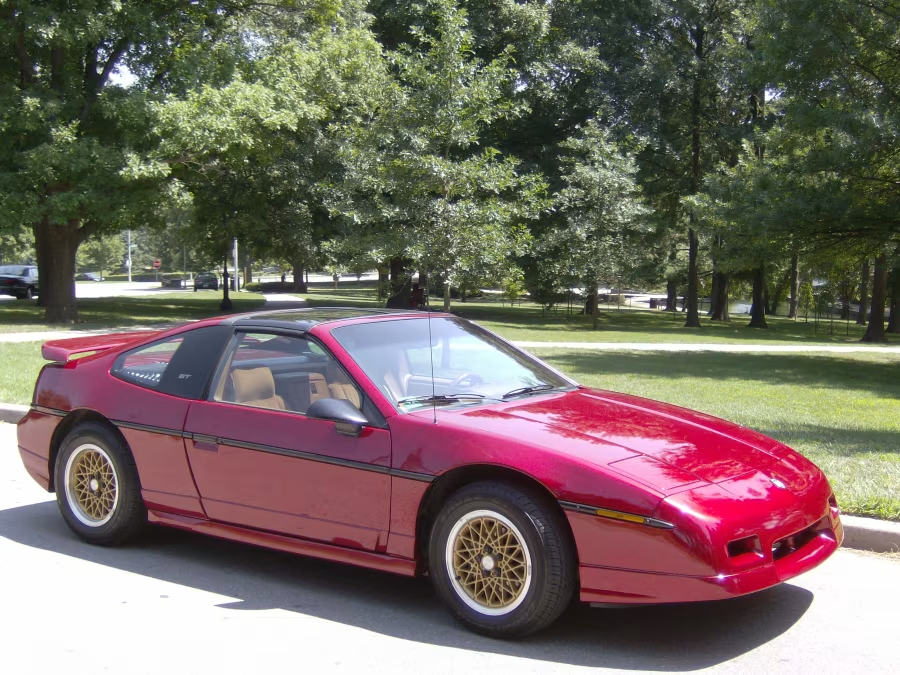
Imagine an engineer pouring five years of passion into a revolutionary American sports car – mid-engine layout, composite body, genuine GT pedigree – only for GM to cancel it the moment it finally got everything right. That’s the 1988 Pontiac Fiero GT. It wasn’t just the last Fiero. It was the first real one.
Origin Story: America’s Mid-Engine Dream
The Pontiac Fiero holds a distinction few American cars can claim: it was the first mass-produced mid-engine sports car built by a U.S. manufacturer. Designed by George Milidrag and Hulki Aldikacti, it was conceived as a true sports machine. The problem? GM’s bean counters had other ideas.
In the early 1980s, the gas crisis shaped everything Detroit built. GM launched the Fiero as a commuter car with parts-bin suspension – even though a purpose-built chassis had already been engineered for it. A sports car, hobbled at birth, with a development budget of just $400 million – a fraction of what GM typically spent on a new model.
The early years brought criticism: handling that didn’t match the looks, modest power, and – infamously -some 1984 models prone to engine fires. The Fiero was fighting for its life.
Then came 1988. And everything changed.
Engine & Performance: The Heart of a GT
The 1988 GT is powered by the L44 2.8L V6 – compact, torquey, and mid-mounted behind the driver. With 135 hp, a 5-speed Getrag manual, and a chassis finally tuned to match the engine’s potential, this was the Fiero as it was always meant to be driven.
But the real story is underneath. The 1988 model finally received the suspension originally designed for the car back in 1984 – four years overdue. Revised front control arms, a tri-link rear setup, staggered wheel sizes, and new vented disc brakes at all four corners transformed it from a looker into a genuine driver’s car.
GM had a 91% stake in Lotus at the time. The Fiero’s engineers had been paying close attention.
| Spec | Detail |
|---|---|
| Engine | 2.8L V6 OHV L44 |
| Power | 135 hp @ 4,900 RPM |
| Torque | 160 lb-ft @ 3,900 RPM |
| Transmission | 5-speed Getrag Manual |
| Layout | Mid-engine, Rear-wheel Drive |
| 0–60 mph | ~8.5 seconds |
| Top Speed | ~120 mph |
| Fuel Economy | 17 city / 27 hwy mpg |
| Weight | ~2,789 lbs |
| Original MSRP | ~$13,999 |
| Units Produced (1988) | 26,401 — rarest year |
Design & Features: Italian Name, American Soul
“Fiero” means “very proud” in Italian – and the 1988 GT wore that name honestly. The fastback roofline, flying-buttress C-pillars, and pop-up headlights gave it the silhouette of a European exotic at a fraction of the price.
The body itself was an engineering first: a steel spaceframe wrapped in non-structural composite plastic panels. Lightweight, corrosion-resistant, and ahead of its time – the same technology would later define Saturn and influence GM’s design language for a decade.
Collectors, take note: 1988 was the only year a factory yellow exterior was ever offered. A yellow mid-engine American sports car with Lotus-inspired suspension. That’s not just a car — that’s a unicorn.
Market & Collectibility: The Sleeper That Woke Up
For years the Fiero was dismissed. Today, the market is making up for lost time.
Values are up 17% according to Hagerty’s latest data, with the GT – and the 1988 model specifically – leading the charge. Only 26,401 Fieros were built in 1988, making it the rarest production year of the entire run.
The auction results say it all. At Mecum Kissimmee 2025, a 1988 Fiero GT with just 22 miles on the clock sold for $40,150. Black paint, tan interior, gold snowflake wheels, 5-speed manual. The only Fiero to sell higher is the very last one ever built, which fetched $90,000 in 2020.
On the open market today, expect to pay $10,000–$32,500 for a clean 1988 GT, with an average around $17,763. For a mid-engine, rear-wheel-drive American classic with a cult following and rising values, that’s still an entry point worth acting on – while it lasts.
What to watch for when buying: the 1988-specific suspension and brake components are the hardest parts to source. Fastback sail panels and the iconic “PONTIAC” tail lenses are sought-after and prone to delamination on older cars. Mechanically, the L44 V6 shares components with many period GM applications – parts availability is generally good.
The Fiero in Movies, TV & Pop Culture
Few forgotten cars have had this kind of screen life. The Fiero is everywhere — and it’s always the most interesting vehicle in the room.
| Show / Film | Role of the Fiero |
|---|---|
| How I Met Your Mother 2005–2014 |
Marshall’s beloved car, nicknamed “The Fiero.” Season 2, Episode 8 — “Arrivederci, Fiero” — dedicates a full episode to saying goodbye as it approaches 200,000 miles. |
| Breaking Bad / El Camino 2008–2019 |
Badger’s car in Breaking Bad. In El Camino, Jesse Pinkman uses it as a getaway vehicle. Skinny Pete calls it a “clown car” — yet it becomes the unlikely hero of the movie. |
| MythBusters 2003–2018 |
A 1988 GT appears heavily throughout the series as one of Adam Savage’s recurring vehicles. |
| Fast & Furious + Knight Rider 2001–2008 |
A custom 1988 Fiero GT — a McLaren F1-style 3-seater hand-built by Barris Kustom Industries — appeared in The Fast and the Furious, 2 Fast 2 Furious, Tokyo Drift, and the 2008 Knight Rider TV series. |
| The Fiero Mera 1987 |
A factory-approved Pontiac dealer conversion with a Pininfarina Ferrari 308-style body. Only 247 made before Ferrari sued to stop production. Ferrari suing you for looking too much like theirs is not an insult — it’s a standing ovation. |
And then there’s the Fiero Mera – the factory-approved conversion that replaced the body with a Pininfarina Ferrari 308-style shell, sold through Pontiac dealerships. Only 247 were made before Ferrari’s lawyers stepped in. Ferrari suing GM over your car looking too much like theirs isn’t an insult. It’s a standing ovation.
The Tragic Ending
Even after the 1988 model finally became the car it was always meant to be, GM killed it. Citing declining sales, they shut down the line at the Pontiac, Michigan plant on August 16, 1988. Four years of compromise. One perfect year. Then silence.
The 1988 Pontiac Fiero GT is proof that timing is everything – in the auto industry and in life. It took four years, one Lotus connection, and a complete redesign to become what it was always supposed to be. GM gave it one year to prove itself, then walked away. For anyone who loves American automotive history, understands what mid-engine really means, and appreciates a genuine underdog story – the ’88 GT isn’t just a collector car. It’s a statement. Find one. Drive it. Don’t let the story end in a garage.
