The 1949 Chevrolet Styleline Deluxe was the notchback, upper-trim half of Chevrolet’s first all-new postwar car – the model that ended three years of warmed-over 1942 designs when it was unveiled at New York’s Waldorf-Astoria in January 1949. Its four-door sedan was the best-selling Chevrolet of the year at 191,357 units, and the Styleline Deluxe line alone accounted for roughly 455,900 cars. It is also the purest year of the 1949–52 generation: one engine, the 90-hp 216.5 six, one transmission, a column-shifted three-speed, no hardtop and no automatic – and, for part of the year only, a genuine wood-bodied station wagon.
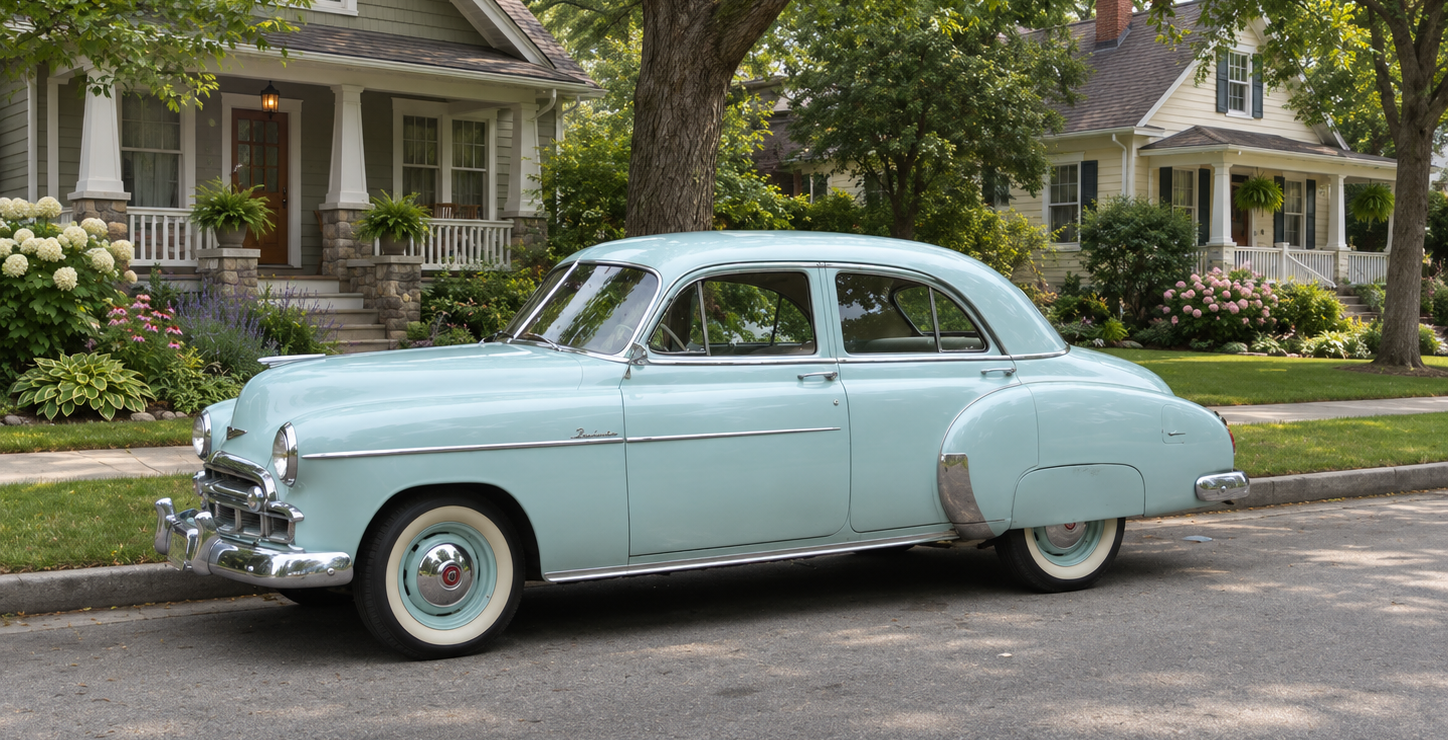
Table of Contents
- Overview and History
- Styleline, Fleetline, Special and Deluxe
- Body Styles, Prices and Production
- The New Postwar Body
- Styling and Identification
- The Woody-to-Steel Wagon Change
- The 216.5 Thriftmaster Six
- Transmission and Drivetrain
- Chassis, Suspension and Brakes
- Interior and Equipment
- What Changed After 1949
- Identification and Serial Numbers
- Collectibility and Buying
- Key Features Summary
- Full Specifications Table
Overview and History
Chevrolet resumed civilian production on 3 October 1945 and, like most of Detroit, spent the next three model years selling lightly revised versions of its 1942 cars. Demand was so strong that it hardly mattered. By 1948, though, the rest of General Motors had moved on: Cadillac, Oldsmobile and Buick introduced new postwar bodies for 1948, and Ford had shown its all-new 1949 car at the Waldorf-Astoria in June 1948. Chevrolet and Pontiac were the last GM divisions to get the new look.
When the 1949 Chevrolet appeared at the same hotel in January 1949, six months after the Ford, it was received with genuine enthusiasm. It was lower, sleeker and roomier than the car it replaced, and Chevrolet promoted it as the first truly new Chevrolet since the war. Total 1949 production passed one million cars – conceptcarz gives 1,010,013 – and Chevrolet kept its place as the country’s best-selling make.
The Styleline Deluxe was the volume heart of that success. It combined the more expensive of the two trim levels with the conventional notchback body, which suited buyers who wanted a proper trunk and the most upright, dignified shape. This article covers the 1949 car specifically; the 1952 Styleline Deluxe, the 1950 and 1951 Bel Air hardtops and the 1948 and 1950 Fleetlines have separate articles, and each is built around what changed in its year.
Styleline, Fleetline, Special and Deluxe
The 1949 naming system confuses many buyers, so it is worth setting out precisely. Chevrolet reorganised its lineup into two series by trim level:
- Special (Series 1500): the economy trim, with less bright work and fewer standard items.
- Deluxe (Series 2100): the upper trim and the series most buyers chose.
Within each series, cars came in two body lines:
- Styleline: notchback bodies with a separate trunk – sedans, a coupe, the convertible and the wagons.
- Fleetline: fastback two-door and four-door sedans, continuing the streamlined look of the 1942–48 Fleetline Aerosedan.
So “Styleline Deluxe” means a notchback body in Deluxe trim. The two lines shared the same chassis, engine and front sheet metal; only the roof and rear bodywork differed. The Deluxe series was by far the more popular, at roughly 86 percent of 1949 output by one estimate. The convertible and the wagons were Deluxe-only, and the cheapest model of all, the business coupe, was Special-only.
Body Styles, Prices and Production
The 1949 Styleline Deluxe was offered in six body styles. Prices are approximate list prices; production figures are the commonly published 1949 totals.
| Body style | Approx. price | Production |
| 4-door sedan | $1,540 | 191,357 |
| 2-door sedan | $1,490 | 147,347 |
| Sport Coupe (2-door) | $1,500 | 78,785 |
| Convertible | $1,857 | 32,392 |
| Station wagon, wood body (8-passenger) | $2,267 | 3,342 |
| Station wagon, steel body (8-passenger) | $2,267 | 2,664 |
Those figures total 455,887 Styleline Deluxes. The Fleetline Deluxe added 130,323 four-door and 180,251 two-door fastbacks, bringing the Deluxe series as a whole to 766,461.
The four-door sedan was the best-selling Chevrolet of 1949, just ahead of the Fleetline Deluxe two-door. That ranking matters because the Fleetline fastback had outsold notchbacks in the immediate postwar years; 1949 is the year the notchback took over, and the fastback went into a slow decline that ended with the Fleetline’s withdrawal after 1952.
The Sport Coupe deserves a clarification. In 1949 it was a pillared two-door coupe with a shorter roof and longer deck than the two-door sedan, not a hardtop. Chevrolet’s first pillarless hardtop, the Bel Air, did not arrive until 1950. Some listings describe the 1949 Sport Coupe as a four-door; that is an error copied between databases.
The New Postwar Body
The 1949 Chevrolet used GM’s new A-body, shared in concept with Pontiac. The design goals were familiar ones for the period: lower the car, widen the body to the full width of the wheels, integrate the fenders into the bodywork, and enlarge the glass.
The packaging changes were real. Chevrolet moved the engine forward in the chassis and the passenger compartment forward with it, so occupants sat within the wheelbase rather than over the rear axle. The result was more interior room in a car that was slightly shorter in wheelbase than the 116-inch 1948 model. Most references give the 1949 wheelbase as 115 inches; a few quote 114 or 116, which reflects measurement differences and sloppy copying rather than any variation between cars.
The body was lower than the 1948 car’s, with front fenders blended into the body sides. It is a transitional design: modern in its proportions and glass area, still prewar in details such as the split two-piece windscreen.
Styling and Identification
The 1949 front end is the easiest way to tell the year. Its grille has a horizontal bar with short vertical “teeth” and round parking lights set into it on each side. For 1950 the grille was simplified and the teeth reduced, and the 1951 and 1952 grilles changed again, the 1952 adding a row of prominent teeth across the centre bar.
A Deluxe is distinguished from a Special by its bright trim: chrome reveal mouldings around the windows, bright rocker and body-side trim, and Deluxe script on the front fenders. The Styleline notchback is distinguished from the Fleetline by its formal roof and separate trunk.
Two features date the car to the early postwar period and are easily overlooked. The windscreen is a two-piece flat-glass unit with a centre divider, and the emblems are specific to the year. Restorers working on a 1949 car need 1949 trim, not generic 1949–52 parts, and the differences are worth learning before buying.
The Woody-to-Steel Wagon Change
The 1949 Styleline Deluxe station wagon began the year as a traditional wood-bodied eight-passenger car. Partway through the model year Chevrolet replaced it with an all-steel body that imitated the look of wood with painted or applied trim. The price, $2,267, stayed the same, making the wagon the most expensive Chevrolet of 1949.
The figures most often published are 3,342 wood-bodied and 2,664 steel wagons, about 6,000 in total. These totals are sometimes reversed in secondary sources, which is worth knowing when a seller quotes a rarity figure.
The change matters to collectors. The wood-bodied 1949 is the last true woody Chevrolet, and wood bodies did not survive well: they rotted, they were expensive to maintain and many were scrapped once the wood failed. Surviving examples are rare, and a properly restored woody body is a specialist job in its own right. The steel wagon is the more practical car and the beginning of the modern Chevrolet wagon.
The 216.5 Thriftmaster Six
Every 1949 Chevrolet passenger car used the same engine: the 216.5-cubic-inch overhead-valve inline six, the “Stovebolt” that had powered Chevrolets in essentially this form since 1937.
- Output: 90 hp at 3,300 rpm
- Bore × stroke: 3.50 × 3.75 inches
- Compression: 6.5:1
- Main bearings: four
- Carburettor: Carter one-barrel
- Block: cast iron
The 216 was durable, simple and economical by the standards of its day, which is why it lasted so long. Its weak points are equally well known. It relied partly on splash lubrication, with dippers on the connecting rods picking up oil from troughs in the pan, and used poured babbitt rod bearings rather than modern inserts. Oil pressure readings that would alarm the owner of a later Chevrolet can be normal on a healthy 216, and sustained high speeds on modern motorways are not what it was designed for.
For 1950, cars ordered with the new Powerglide automatic received the larger 235.5-cubic-inch six with hydraulic lifters and full pressure lubrication, and manual-transmission cars gained a small increase to 92 hp. The 1949 car had neither development: one engine, one rating.
Transmission and Drivetrain
The only transmission was a three-speed synchromesh manual with a column-mounted shift lever, driving through a single dry-plate clutch to a rear axle enclosed by a torque tube. There was no automatic: Powerglide was a 1950 introduction, and a 1949 Chevrolet with one has been converted.
The torque-tube drive, inherited from earlier Chevrolets, encloses the driveshaft inside a tube bolted to the differential and uses it to locate the axle. It is quiet and robust, but it complicates gearbox removal and makes later conversions to open driveshafts a common modification on hot-rodded cars.
Gearing and the 90-hp six combined to give relaxed rather than brisk performance. The car would cruise comfortably at the speeds of 1949 roads, and owners who drive on modern roads often fit an overdrive or a taller axle ratio for that reason.
Chassis, Suspension and Brakes
The 1949 Chevrolet used a box-girder frame with independent front suspension and a leaf-sprung rear axle. The front suspension used coil springs. Steering was manual.
Brakes were hydraulic drums on all four wheels, with a mechanical parking brake. They were adequate for a 3,100-lb car at 1949 speeds and need to be kept in top condition today, because modern traffic asks more of them. A dual-circuit master cylinder conversion is one of the most common safety modifications owners make.
Curb weights for the 1949–52 Deluxe cars range from roughly 3,100 to 3,600 lb depending on body, with the convertible and wagons at the heavy end. Overall length is commonly given as about 197 inches.
Interior and Equipment
The Deluxe interior was a clear step above the Special. Where the cheaper car had a single sun visor and a manually switched dome lamp, the Deluxe added a second visor, armrests, better upholstery, and more bright trim on the dashboard and doors. The steering wheel and horn ring were also upgraded.
The dashboard grouped the instruments ahead of the driver in a symmetrical layout with a large speedometer. A seven-day, manually wound clock could be fitted in the glovebox door. A radio, heater and defroster were extra-cost items, as were many of the accessories now considered essential, such as backup lamps, outside mirrors and windscreen washers.
Accessory content varies widely between surviving cars, because dealers fitted most of it. Period accessories in good condition – a correct radio, a factory spotlight, a sun visor, fog lamps – add both value and authenticity to a 1949 restoration.
What Changed After 1949
The 1949 car is the baseline of a four-year generation, and almost everything collectors value about the later cars arrived after it:
- 1950: the Powerglide automatic and the 235.5 six that came with it; the Bel Air two-door hardtop; a revised grille with fewer teeth.
- 1951: revised front-end styling and a new dashboard.
- 1952: a grille with prominent teeth across the bar, and the last year of the Fleetline fastback.
For a buyer this means the 1949 is the simplest and most original expression of the design, but also the one with the fewest options. A 1949 cannot be had with an automatic or as a hardtop. It can, however, be had as a woody wagon, which none of the later years can.
Identification and Serial Numbers
A 1949 Chevrolet carries a serial number rather than a modern VIN. Deluxe cars of 1949–52 belong to Series 2100, coded GK for 1949, followed in later years by HK (1950), JK (1951) and KK (1952). The GK code appears in the serial along with an assembly-plant prefix and a sequence number. A 1949 convertible sold at auction, for example, carries serial 14GKH59428.
Points to check:
- Serial plate and body tag. Confirm GK coding for a 1949 Deluxe, and check the body number against the claimed body style.
- Engine. A 216 is correct. Many cars now have a 235 or a 261 from a later car or truck, which is a common and practical upgrade but not original.
- Transmission. Column-shift three-speed. An automatic means a conversion.
- Grille and trim. Make sure 1949-specific pieces have not been replaced with 1950–52 parts.
- Wagon body. Confirm whether a wagon is a wood-bodied or steel-bodied car, and how much of the wood is original.
Collectibility and Buying
The 1949 Styleline Deluxe is one of the more affordable ways into early postwar American motoring. Four-door and two-door sedans make up most of the surviving population and are reasonably priced. Limited auction data compiled by conceptcarz shows a median sale of about $8,900 for the Styleline Sport Coupe and about $26,700 for the convertible; dealer asking prices for well-restored convertibles run considerably higher. Treat these as a guide only, because few cars change hands at auction.
The convertible is the most sought-after body style, followed by the Sport Coupe. The wood-bodied wagon is rare enough that values depend almost entirely on the condition of the wood. Many 1949 cars have been modified, and a well-built resto-mod can sell for more than a stock car, but originality is what holds value among enthusiasts of this period.
Be realistic about what the car is. It is a 90-hp family car designed for 1949 roads, with drum brakes and a babbitt-bearing six. As a weekend cruiser it is charming and easy to live with; as a daily driver in modern traffic it needs attention to brakes, cooling and lighting.
Inspection priorities specific to the 1949 Styleline Deluxe:
- Rust in the lower body. Rocker panels, the bottoms of doors, the trunk floor and the rear fenders where they meet the body.
- Floor pans and body mounts. Check under the carpets and around the body mounts.
- Engine condition. Listen for rod knock on the 216; get an oil pressure reading and understand what is normal for a splash-lubricated engine.
- Torque tube and rear axle. Check for leaks and play.
- Brakes. Single-circuit drums should be fully rebuilt; consider a dual-circuit master cylinder.
- Windscreen seals. The two-piece screen leaks when seals age, rusting the cowl and floor.
- Year-correct trim. Grille and emblems should be 1949 pieces.
- Wagon wood. On a woody, assess the wood structure, not just the varnish.
Key Features Summary
- Significance: Notchback Deluxe version of Chevrolet’s first all-new postwar car
- Introduced: January 1949 at the Waldorf-Astoria, New York
- Series: Deluxe, Series 2100 (code GK for 1949)
- Body styles: 4-door sedan, 2-door sedan, Sport Coupe, convertible, wood and steel 8-passenger wagons
- Best seller: 4-door sedan, 191,357 – the most popular Chevrolet of 1949
- Styleline Deluxe production: 455,887 (sum of published body-style figures)
- Deluxe series total: 766,461 including Fleetlines
- Prices: about $1,490 (2-door sedan) to $2,267 (wagon)
- Engine: 216.5 cu in OHV six, 90 hp at 3,300 rpm, 6.5:1 compression
- Transmission: 3-speed column-shift manual only; no Powerglide until 1950
- Wheelbase: 115 in (most references)
- One-year feature: wood-bodied wagon, replaced mid-year by an all-steel body
- Not available: hardtop (the Bel Air arrived in 1950) or automatic transmission
- Most collectable: convertible, then Sport Coupe and woody wagon
The 1949 Chevrolet Styleline Deluxe Specs
| BODY | |
| Manufacturer | Chevrolet (General Motors) |
| Model year | 1949 |
| Series | Deluxe, Series 2100 (GK) |
| Body line | Styleline (notchback) |
| Platform | GM A-body |
| Body styles | 4-door sedan, 2-door sedan, Sport Coupe, convertible, 8-passenger station wagon (wood, then steel) |
| DIMENSIONS | |
| Wheelbase | 115 in (some sources quote 114 or 116 in) |
| Overall length | Approx. 197 in |
| Curb weight | Approx. 3,100–3,600 lb depending on body |
| ENGINE – 216.5 THRIFTMASTER SIX | |
| Type | Inline six, overhead valves, cast-iron block |
| Displacement | 216.5 cu in (3.5 litres) |
| Bore × stroke | 3.50 × 3.75 in |
| Compression | 6.5:1 |
| Output | 90 hp at 3,300 rpm |
| Main bearings | Four |
| Carburettor | Carter one-barrel |
| Lubrication | Pressure and splash (rod dippers); babbitt rod bearings |
| TRANSMISSION | |
| Type | 3-speed synchromesh manual, column shift |
| Drive | Torque tube to live rear axle |
| Automatic | Not available (Powerglide from 1950) |
| SUSPENSION AND BRAKES | |
| Front | Independent, coil springs |
| Rear | Live axle, leaf springs |
| Brakes | Hydraulic drums all round |
| Steering | Manual |
| PRODUCTION | |
| 4-door sedan | 191,357 |
| 2-door sedan | 147,347 |
| Sport Coupe | 78,785 |
| Convertible | 32,392 |
| Wood-body wagon | 3,342 |
| Steel-body wagon | 2,664 |
| Styleline Deluxe total | 455,887 |
| All 1949 Deluxe (incl. Fleetline) | 766,461 |
| PRICES (APPROXIMATE) | |
| 2-door sedan / Sport Coupe / 4-door sedan | $1,490 / $1,500 / $1,540 |
| Convertible | $1,857 |
| Station wagon | $2,267 (wood or steel) |
| IDENTIFICATION | |
| Series code | GK (1949 Deluxe) |
| Year features | Toothed grille with round parking lamps; two-piece windscreen |
1949 Chevrolet Styleline Deluxe – Frequently Asked Questions
What is the difference between Styleline and Fleetline?
Body shape. Styleline cars were notchbacks with a separate trunk; Fleetline cars were fastbacks with a sloping roof that ran to the rear bumper. Both were offered in Special and Deluxe trim, and both used the same chassis, engine and front sheet metal. The convertible, the coupe and the wagons were Styleline-only; the Fleetline came only as two- and four-door sedans.
Is the 1949 Styleline Deluxe Sport Coupe a hardtop?
No. The 1949 Sport Coupe is a pillared two-door coupe with a shorter roof and longer deck than the two-door sedan. Chevrolet’s first pillarless hardtop was the 1950 Bel Air. Some online databases list the 1949 Sport Coupe as a four-door body, which is a copying error; it has two doors.
Could you get a 1949 Chevrolet with an automatic?
No. Every 1949 Chevrolet passenger car used a three-speed column-shift manual gearbox. The Powerglide automatic arrived for 1950, together with the larger 235.5-cubic-inch six used with it. A 1949 car with an automatic has been converted, usually with a later Chevrolet drivetrain.
How many 1949 Styleline Deluxe convertibles were built?
The published figure is 32,392. That makes the convertible far more common than its value suggests – it was the fourth most popular Styleline Deluxe body – but survival rates for open cars are low, and good, original examples are much scarcer than the production figure implies.
Was the 1949 Chevrolet wagon a woody?
At first. The 1949 Styleline Deluxe wagon began the year with a wood body and was replaced partway through the model year by an all-steel body at the same $2,267 price. The commonly published figures are 3,342 wood-bodied and 2,664 steel wagons. The wood-bodied 1949 is the last true Chevrolet woody, and few survive.
How much horsepower does the 1949 Chevrolet six make?
90 hp at 3,300 rpm from 216.5 cubic inches, with a 6.5:1 compression ratio and a one-barrel Carter carburettor. It was the only engine offered in 1949. For 1950 the manual-transmission version was rated at 92 hp, and Powerglide cars received the 105-hp 235.5 six.
Why do sources disagree on the 1949 wheelbase?
Most references, and Chevrolet’s own figures for the 1949–52 cars, give 115 inches. Some sources quote 114 inches and others 116, the latter usually carried over from the 1948 car. The difference reflects inconsistent measurement and copying between databases; all 1949 Styleline Deluxe bodies share the same chassis and wheelbase.
Is a 1949 Styleline Deluxe a good first classic car?
Yes, with realistic expectations. It is simple, well supported by parts suppliers and inexpensive in sedan form. It is also slow by modern standards, with drum brakes and an engine designed for 1949 roads. Check for rust in the floors and rockers, confirm the engine is healthy, and plan on bringing the brakes up to standard before driving it in traffic.
