The 1965 Cadillac Fleetwood Sixty Special was the chauffeur-class sedan of the range, the car Cadillac built for owners who wanted more rear-seat room than a De Ville offered but did not need a Series 75 limousine. It sat on a 133-inch wheelbase, 3.5 inches longer than the 129.5 inches of the Calais and De Ville, and cost $6,479. Cadillac built 18,100, up 24 percent on 1964 and about 10 percent of the year’s 181,435 Cadillacs. It used the new perimeter frame, the 340 hp, 429 cubic inch V8 and the improved Turbo Hydra-Matic, and its option list included a $199 Brougham package.
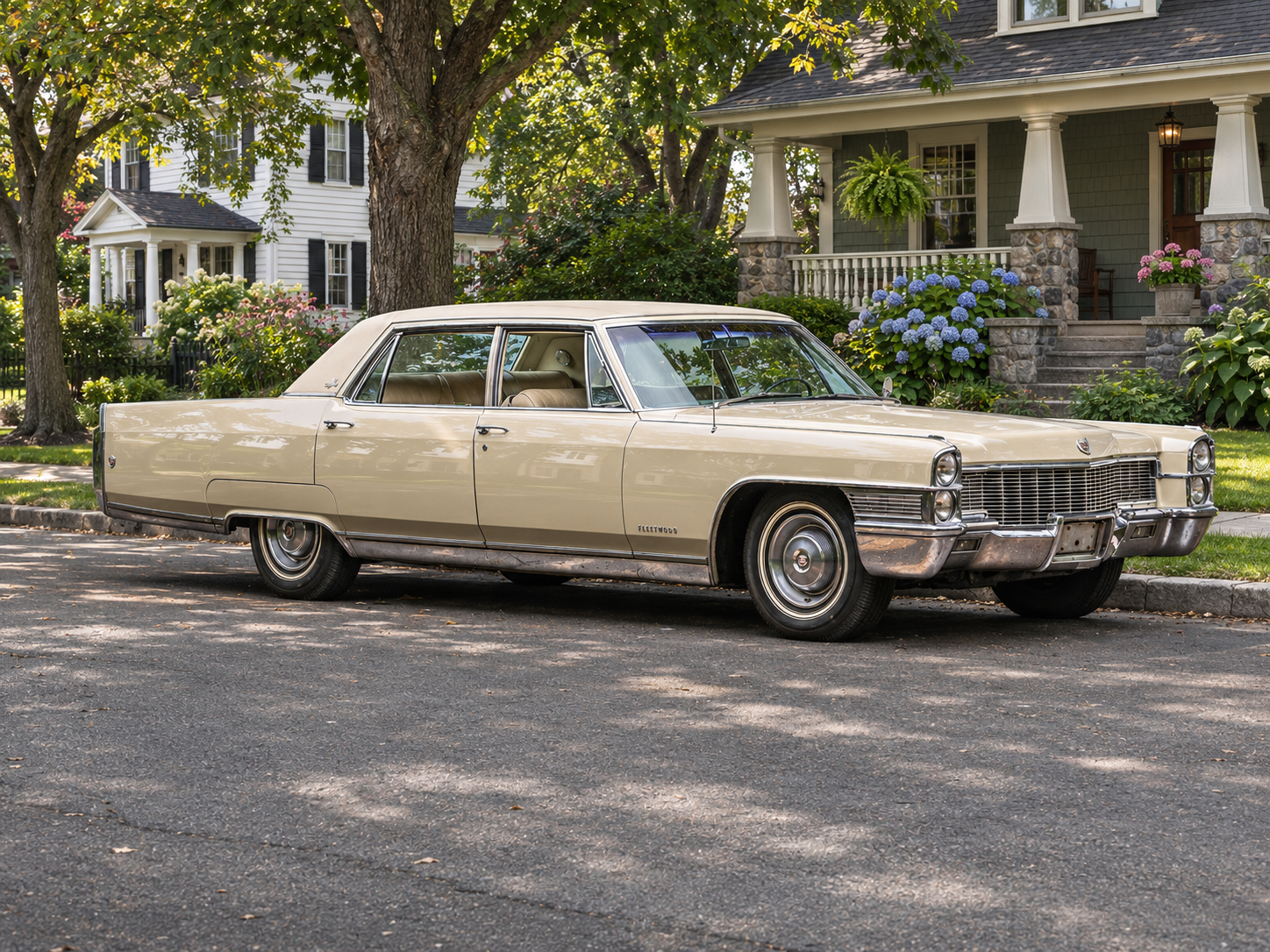
Table of Contents
- Overview and History
- The Fleetwood Banner
- Body and Wheelbase
- Interior and Upholstery
- Options and Price List
- Engine, Transmission and Performance
- Frame, Suspension and Brakes
- Production and Price
- Against 1964, the De Ville and the Series 75
- Authentication and VIN
- Collectibility and Buying
- Key Features Summary
- Full Specifications Table
Overview and History
The Sixty Special name dates from the late 1930s, and by 1965 it stood for a particular idea: a Cadillac sedan with extra room in the back. From 1959 to 1964 the car had shared the 129.5-inch chassis used by the rest of the range, so it was no longer than its siblings. In 1965 that ended. The Sixty Special was given a wheelbase of 133 inches and an overall length of 227.5 inches, and for the first time in several years it was visibly longer than the cars beneath it.
It was also built in greater numbers than in 1964. The 1965 figure was 18,100, up from 14,550, a rise of 3,550 cars or about 24 percent. Hagerty notes that this came within 310 cars of the output of the entire Imperial line, which gives a sense of how well the Sixty Special sold against the Chrysler Corporation’s prestige marque.
Today the car is one of the more affordable big Cadillacs of its era and, in plain form, one of the least fashionable. That is part of its attraction. It offers a long wheelbase, the new frame and the Fleetwood name, and in good condition it stands out from the more common De Villes.
The Fleetwood Banner
For 1965 Cadillac grouped its top models under the Fleetwood name: the Sixty Special, the Eldorado and the Series 75. Below them came the De Ville series and the Calais. The Eldorado lost its Biarritz name in the process and became simply the Fleetwood Eldorado, and the Sixty Special is likewise the Fleetwood Sixty Special.
The positioning is worth understanding, because it explains the price. The Sixty Special at $6,479 cost about $814 more than a Sedan de Ville at $5,665, and $1,232 more than a Calais sedan at $5,247. It sat just below the Eldorado at about $6,630 and a long way below the Series 75 sedan at $9,746 to $9,750. The buyer was paying for the extra wheelbase and the Fleetwood name, not for a different engine.
The Sixty Special was also a sedan only. There was no coupe and no convertible, which sets it apart from the De Ville series and makes the body style simple to identify: a long four-door car.
Body and Wheelbase
The 133-inch wheelbase and 227.5-inch overall length are the defining dimensions. The extra 3.5 inches over the Calais and De Ville went mostly into the rear compartment, and the longer body gave the car a more formal profile than its siblings. The width of the range was about 79.9 inches, and the 1965 styling theme applied: planed-flat fins, stacked dual headlamps either side of a flat grille, a straight rear bumper and curved side glass.
The roof is a matter on which sources disagree. Most describe the 1965 Sixty Special as a pillared sedan, with the B-pillar returning after being absent since 1957. Hagerty, however, calls the body a four-door hardtop. The safe approach is to look at the car itself and at the style number on the body plate, 68069, instead of relying on a published description.
Because the Sixty Special was a sedan of a single body style, its identification is easy. The risk is in distinguishing it from the Brougham version, which added a padded vinyl roof and a richer interior. That option package is covered in detail in its own article, but it is worth knowing that a plain Sixty Special with no vinyl roof and no C-pillar badge is the standard car.
Interior and Upholstery
The interior was built around rear-seat room. The extra 3.5 inches of wheelbase went mostly into the back, which was the reason for the car’s existence, and the Fleetwood name set it above the closed Calais and De Ville cars.
Leather was an option at about $141, so a car with a leather interior has had the upholstery specified by its first owner. A six-way power seat cost about $85, and power door locks about $70. These prices come from a Sixty Special price list, and they show how much of the specification was left to the buyer’s choice.
Across the 1965 range, Comfort Control, Cadillac’s automatic climate system, went on 83 percent of cars, and more than 90 percent of buyers ordered air conditioning. For a buyer today, the equipment on a particular car matters more than the badge, because a car with a full specification and working accessories is worth more than a bare one.
Options and Price List
A published 1965 price list for the Sixty Special gives a good picture of what buyers could add. Air conditioning cost $495 (and $624 on the Series 75). Cruise control was $97, a controlled differential about $54, Soft Ray tinted glass $52 and an AM/FM radio $191. An AM radio alone was $165.
The same list shows leather at $141, a six-way power seat at $85, power door locks at $70, a vent window regulator at $73 and a remote trunk lock at $53. Twilight Sentinel, the automatic headlamp control, was $57, Guide-Matic $51 and an adjustable steering wheel $91. Whitewall tyres in 9.00 × 15 size were a $57 exchange. One database wrongly lists the adjustable steering wheel as standard, so treat the price list as the better guide.
Automatic level control, which kept the rear of the car at a constant height regardless of load, is listed as standard equipment on the Sixty Special. The Brougham package, introduced for 1965, cost $199 on one source and $194 on another, and is discussed separately in the Brougham article. Air conditioning ($495) and leather ($141) alone take the $6,479 list price to $7,115.
Engine, Transmission and Performance
The 429 cubic inch V8 (bore 4.13 in, stroke 4.00 in, compression ratio 10.5:1, hydraulic valve lifters, five main bearings) produced 340 bhp at 4,600 rpm and 480 lb-ft of torque at 3,000 rpm. It was fed by a Carter AFB four-barrel carburettor, model 3903S according to one source. Like the Calais and De Ville, the Sixty Special had the improved Turbo Hydra-Matic with a variable stator and a dual driving range.
The standard rear axle was 2.94:1, or 3.21:1 on cars with air conditioning, and a limited-slip differential was the only powertrain option. The Cadillac Database lists a top speed of 120–125 mph, 0–80 mph in 15.5 seconds and fuel economy of 12–15 mpg for the 1965 range. At 4,670 lb the Sixty Special sat in the upper half of that weight range.
No separate road-test figures for the Sixty Special turned up in the sources used for this article. The Motor Trend test of a De Ville convertible, which recorded 0–60 mph in 9.5 seconds, is the nearest published reference, but it is a different body, so the range figures above are the safer guide.
Frame, Suspension and Brakes
The perimeter frame replaced the X-frame used since 1957 and, according to one account, saved roughly 300 lb over the 1964 car. The Sixty Special used the long-wheelbase version, 133 inches against 129.5 for the Calais and De Ville and 149.8 for the Series 75. Track was 62.5 inches for the range, and the Cadillac Database gives 4,390–4,725 lb for the 1965 line; the Sixty Special’s 4,670 lb sits at the upper end.
Front suspension was independent with coil springs, and the rear used coil springs with tube shock absorbers and a live axle. Power steering and power brakes were standard, and the brakes were drums at all four wheels. With a longer car, a heavier car and a rear seat often occupied by two or three passengers, brake and suspension condition matters more than on a coupe.
When looking at a car, check the frame and the rear suspension carefully. A long-wheelbase sedan that has spent decades carrying passengers or sitting outdoors can have tired shock absorbers, sagging springs and rust in the rear frame rails and floor.
Production and Price
Cadillac built 18,100 Fleetwood Sixty Specials in 1965 (style 68069, VIN letter M). That is about 10.0 percent of the 181,435 Cadillacs built for the year and 14.7 percent of the 123,080 De Villes. The 1965 total is the sum of the model-by-model figures; one source quotes 182,435, which does not reconcile.
The price was $6,479. The 1964 Sixty Special listed at about $6,390, with sources giving $6,366 to $6,400, so the 1965 car cost roughly $90 more. Late in the 1965 model year Cadillac cut prices on all models by about $100. For 1966 the plain Sixty Special sedan listed at $6,378 and the Brougham, by then a separate model, at $6,695.
The 1965 figure of 18,100 includes every Sixty Special, with or without the Brougham option. No separate 1965 production count exists for Brougham-equipped cars. In 1966, when the Brougham became its own model, Cadillac built 13,630 Broughams and 5,445 plain sedans (Hagerty gives 5,455), a combined 19,075. Because the two years are counted differently, the 1965 figure cannot be split into plain and Brougham cars.
Against 1964, the De Ville and the Series 75
Against the 1964 Sixty Special (14,550, about $6,390) the 1965 car was longer by 3.5 inches of wheelbase, built on a new frame and produced in 24 percent greater numbers. The 1964 car shared the 129.5-inch chassis with the rest of the range and used the X-frame.
Against the Sedan de Ville ($5,665, 60,535 built across two bodies) the Sixty Special offered more wheelbase and the Fleetwood finish for about $814 more, in far smaller numbers. Against the Eldorado ($6,630, 2,125 built), it was a sedan with more room and a lower price, where the Eldorado was a convertible with rarity.
Against the Series 75 (455 sedans and 795 limousines, with prices of about $9,750 and $9,960) it was a far more affordable car. The Series 75 retained fins and a wraparound windshield, which Hagerty calls a one-year anomaly, and sat on a 149.8-inch wheelbase. The Sixty Special was the largest car that most private buyers needed.
Authentication and VIN
A 1965 Cadillac VIN has eight characters: a letter for the series and body style, the digit “5” for the model year, and a six-digit sequence beginning at 100001. The Fleetwood Sixty Special carries the letter M, and its style number is 68069, with a “0” in the third place for the Sixty Special.
The wheelbase is the simplest check. A 1965 Sixty Special measures 133 inches between the axles, against 129.5 for a Calais or De Ville, and its overall length is 227.5 inches against about 224. A De Ville sedan carrying Fleetwood badges would be 3.5 inches shorter between the wheels, and that is difficult to disguise.
The other point to check is Brougham status. Because the Brougham was an option package rather than a separate model in 1965, a Brougham carries the same VIN letter and style number as a plain Sixty Special. The features that identify it are the padded vinyl roof, the Brougham script on the C-pillar and the richer interior, and these are discussed in the separate Brougham article.
Collectibility and Buying
The 1965 Sixty Special is a relatively inexpensive way into a long-wheelbase Cadillac. Classic.com’s benchmark for the 1965–70 Sixty Special is about $24,684, and Hagerty’s records for the same years show a highest sale of $79,200 and a lowest of $220. Brougham-equipped cars have comparables from about $28,093 to $52,291, which puts the plain car below them.
The spread says that condition and originality drive prices. These are large cars with large repair bills, and a poor example costs more to put right than it is worth. Check current figures, because all of these are snapshots. Inspection priorities:
- Frame and floors: check the perimeter frame, rear frame rails, floor pans and trunk for rust and repair.
- Wheelbase and length: confirm 133 inches between the axles; a shorter car is not a Sixty Special.
- Rear suspension: check springs, shocks and the automatic level control, which was standard.
- Interior: rear seats and door panels take the most use in a chauffeur-class car; leather was optional, so check what was original.
- Power windows, locks and seats: test every power accessory, including the six-way seat and door locks if fitted.
- Comfort Control and air conditioning: complex and costly; test heating, cooling and the automatic functions.
- Brougham status: if the car has a vinyl roof, look for the C-pillar script and check whether the roof is original.
- Drivetrain: check the Turbo Hydra-Matic and the 429 for leaks, shifting problems and overheating.
Key Features Summary
- Significance: The long-wheelbase Fleetwood sedan; first Sixty Special on the new perimeter frame
- Production: 18,100, about 10.0 percent of 181,435 Cadillacs and up 24 percent on 1964
- Price: $6,479, roughly $90 above the 1964 car; about $100 cut late in the year
- Wheelbase: 133 inches, against 129.5 inches for the Calais and De Ville
- Length: 227.5 inches; weight about 4,670 lb
- Engine: 429 cu in OHV V8, 340 bhp at 4,600 rpm, 480 lb-ft at 3,000 rpm
- Transmission: Improved Turbo Hydra-Matic with variable stator and dual driving range
- Rear axle: 2.94:1, or 3.21:1 with air conditioning
- Frame: New perimeter frame, replacing the X-frame
- Standard equipment: Automatic level control; power steering and brakes
- Options: Air conditioning $495; leather $141; six-way seat $85; Brougham package $199
- Body: Four-door sedan only; sources disagree on whether it was pillared or a hardtop
- VIN letter: M, after a “5” year digit; body plate 68069
- Market: Classic.com benchmark about $24,684 for 1965–70 Sixty Specials
The 1965 Cadillac Fleetwood Sixty Special Specs
| BODY | |
| Manufacturer | Cadillac (General Motors) |
| Model | Fleetwood Sixty Special |
| Body style | 4-door sedan, six passengers (68069); roof described as pillared by most sources and as a hardtop by Hagerty |
| Frame | Perimeter frame (replacing the X-frame) |
| DIMENSIONS | |
| Wheelbase | 133 in |
| Overall length | 227.5 in |
| Width | About 79.9 in (1965 range) |
| Track | 62.5 in front and rear (1965 range) |
| Weight | About 4,670 lb; 4,390–4,725 lb for the whole 1965 line |
| ENGINE | |
| Type | 429 cu in OHV V8, cast-iron block, hydraulic lifters, five main bearings |
| Bore and stroke | 4.13 × 4.00 in |
| Compression ratio | 10.5:1 |
| Fuel system | Carter AFB four-barrel carburettor (model 3903S per one source) |
| Power | 340 bhp at 4,600 rpm (SAE gross) |
| Torque | 480 lb-ft at 3,000 rpm |
| TRANSMISSION AND DRIVETRAIN | |
| Transmission | Turbo Hydra-Matic with variable stator, dual driving range |
| Rear axle | 2.94:1; 3.21:1 with air conditioning |
| Differential | Controlled (limited-slip) optional, about $54 |
| SUSPENSION AND BRAKES | |
| Front | Independent coil springs |
| Rear | Coil springs with tube shock absorbers; live axle |
| Steering and brakes | Power steering; power drum brakes |
| PERFORMANCE (range figures) | |
| Top speed | 120–125 mph (Cadillac Database) |
| 0–80 mph | 15.5 seconds (Cadillac Database) |
| Fuel economy | 12–15 mpg |
| PRODUCTION AND PRICE | |
| Sixty Special production | 18,100 (1964: 14,550) |
| Total Cadillac production | 181,435 (sum of model figures; one source gives 182,435) |
| Launch price | $6,479; cut by about $100 late in the model year |
| OPTIONAL EQUIPMENT (1965 price list) | |
| Air conditioning | $495 |
| Fleetwood Brougham package | $199 (another source: $194) |
| Cruise control | $97 |
| Leather upholstery | $141 |
| Six-way power seat | $85 |
| AM/FM radio | $191 (AM radio $165) |
| Adjustable steering wheel | $91 |
| Power door locks | $70 |
| Twilight Sentinel | $57 |
| Soft Ray glass | $52 |
| AUTHENTICATION | |
| VIN format | Series letter + “5” + six-digit sequence from 100001 |
| Series letter | M (Fleetwood Sixty Special) |
| Body plate | 68069 |
| BUYING NOTES | |
| Market benchmark | About $24,684 for 1965–70 Sixty Specials (Classic.com) |
| Recorded range | $220–$79,200 for 1965–70 cars (Hagerty) |
| Watch for | Frame and floor rust, rear suspension, Comfort Control, interior wear, Brougham claims |
1965 Cadillac Fleetwood Sixty Special – Frequently Asked Questions
How many 1965 Fleetwood Sixty Specials were built?
Cadillac built 18,100, about 10.0 percent of the 181,435 Cadillacs made for 1965. That was 3,550 more than the 14,550 of 1964, a rise of about 24 percent. The figure includes every Sixty Special, whether or not it had the Brougham option, because no separate 1965 count for Brougham-equipped cars exists.
What is the wheelbase of the 1965 Sixty Special?
133 inches, against 129.5 for the Calais and De Ville and 149.8 for the Series 75. The overall length is 227.5 inches. From 1959 to 1964 the Sixty Special had shared the 129.5-inch chassis of the rest of the range, so the 1965 car was the first in several years to be visibly longer than its siblings.
How much did a 1965 Sixty Special cost?
The launch price was $6,479, about $814 more than a Sedan de Ville at $5,665 and $1,232 more than a Calais sedan at $5,247. The 1964 Sixty Special had listed at about $6,390. Cadillac cut prices by about $100 late in the model year, and a well-equipped car cost considerably more once options were added.
Was the 1965 Sixty Special a hardtop or a pillared sedan?
Sources disagree. Most describe it as a pillared sedan, with the B-pillar returning after the pillarless look of earlier years, while Hagerty calls it a four-door hardtop. The body plate style number is 68069, and a physical inspection of the car is the safest guide to how a particular example is constructed.
What engine did the 1965 Sixty Special have?
The 429 cubic inch V8, producing 340 bhp at 4,600 rpm and 480 lb-ft of torque at 3,000 rpm, paired with the improved Turbo Hydra-Matic. It was the same powertrain used in the Calais and De Ville. The standard rear axle was 2.94:1, or 3.21:1 with air conditioning, and a limited-slip differential was the only powertrain option.
What was the Brougham option in 1965?
In 1965 the Brougham was a trim package on the Sixty Special, priced at $199 on one source and $194 on another. It added a padded vinyl roof with Brougham script on the C-pillar and a richer interior. It became its own model for 1966, when 13,630 were built, so 1965 Broughams carry the same VIN letter as plain cars.
How do I identify a genuine 1965 Sixty Special?
Check the VIN, which should begin with M followed by a “5” for the year, and the body plate, which should read 68069. Then measure the wheelbase: a Sixty Special has 133 inches between the axles, against 129.5 for a De Ville. A shorter car carrying Fleetwood badges is not a genuine Sixty Special.
What is a 1965 Sixty Special worth today?
Classic.com’s benchmark for the 1965–70 Sixty Special is about $24,684, and Hagerty’s records for those years run from $220 to $79,200. Brougham-equipped cars have comparables from about $28,093 to $52,291. Condition and originality decide the price, so check current figures before buying or selling.
