The 1969 Chevrolet Nova SS is the compact that could be ordered with a 375-horsepower big-block – and, through a side door, with a 427. The second-generation Chevy II Nova had been redesigned for 1968 on a semi-unibody structure with a front subframe shared with the Camaro, and by 1969 the Super Sport was a performance option package offering the 350 small-block or the 396 big-block in two states of tune. Above them, the COPO system allowed a handful of dealers to order the L72 427 at 425 hp – bypassing the corporate rule that restricted these cars to engines under 400 cubic inches. Nothing on the outside gave any of it away.
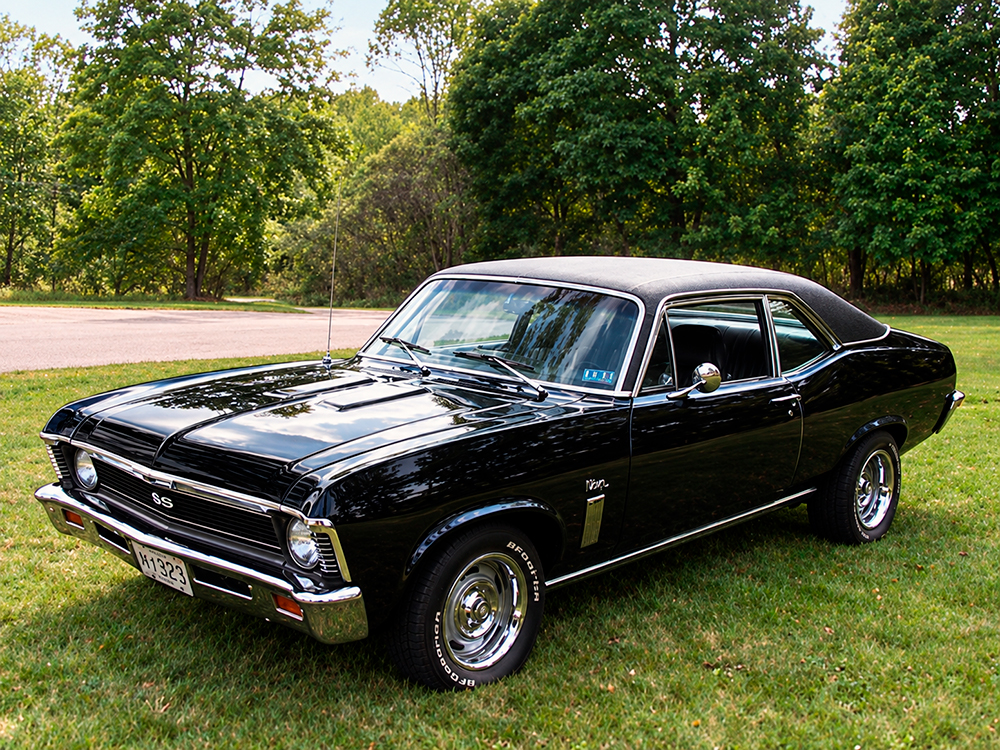
Table of Contents
- Overview and History
- Chevy II, Nova, and the Name Change
- The Camaro Connection
- The SS as an Option Package
- Engine Lineup
- The L78 375 hp
- COPO and the 427 Novas
- Transmissions and Drivetrain
- Chassis, Suspension, and Brakes
- The Sleeper Appeal
- Authentication
- Collectibility and Buying
- Key Features Summary
- Full Specifications Table
Overview and History
The Chevy II had been created in a hurry – developed in roughly eighteen months and entering production in August 1961 as Chevrolet’s conventional answer to the compact market after the rear-engined Corvair proved too unorthodox.
Performance came gradually. A V8 did not appear until 1964, the 327 arrived for 1965, and the L79 327 at 350 hp transformed the car for 1966 – a one-year-only option in that body that put a 3,000-pound compact on level terms with the GTO.
For 1968 the car was comprehensively redesigned on a new structure, and by 1969 the formula had matured. The Super Sport was now a performance option package offering the 350 or the 396 big-block, and above that sat the COPO 427 cars ordered outside the regular option book.
1969 is therefore the Nova at its most potent in the regular catalogue, and the year the compact Chevrolet reached parity with the intermediates.
Chevy II, Nova, and the Name Change
The naming causes persistent confusion and is worth setting out plainly.
Chevy II was the model line. Nova was the top trim series within it. SS was the performance and appearance package applied to the Nova.
By 1969 the Nova name had become dominant in usage, and the Chevy II name was dropped after 1968 – from which point the car was simply the Nova. A 1969 car therefore sits exactly on that transition, and both descriptions appear in period material.
A related quirk worth knowing from the earlier car: the 1966 Chevy II SS carried no “Nova” badging anywhere, despite the brochures using the name. By 1969 the badging conventions had settled.
The Camaro Connection
The 1968 redesign brought a structural change that matters for both engineering and parts.
The redesigned Chevy II Nova used a semi-unibody design with a front subframe – and the Camaro shared that subframe and semi-unibody design with the 1968 Chevy II Nova. The two cars are closely related beneath the skin.
The practical consequences are significant. Suspension components, subframe parts, and a good deal of hardware interchange between the Nova and the first-generation Camaro, which is why the Nova has such strong aftermarket support and why it became a favoured platform for performance builds.
It also explains how a compact could accommodate a 396 or a 427: the structure was engineered to take big-block loads because its sibling had to as well.
The SS as an Option Package
By 1969 the Super Sport on the Nova was a performance option package rather than a separate series – the same arrangement the Camaro used, and the same one the Chevelle SS 396 adopted that year.
SS content centred on the engine and supporting hardware rather than on dramatic appearance. Typical package elements:
- The 350 or 396 V8
- Uprated suspension components
- Power front disc brakes
- A 12-bolt rear axle on big-block cars
- Specific wheels and wider tyres
- SS badging and modest exterior identification
- A black-accented grille and rear panel treatment
The visual restraint is the point. A 1969 Nova SS does not announce itself with stripes or scoops in the way a Chevelle or Camaro does, which is precisely the appeal.
Because the SS was an option package, it does not appear in the VIN, and verification depends on documentation and physical evidence – a point covered below.
Engine Lineup
The 1969 Nova SS could be ordered with:
- 350 cu in V8 – the base SS engine, a strong and well-supported small-block
- 396 cu in L34 – 350 hp, the mid-range big-block
- 396 cu in L78 – 375 hp, with solid lifters and rectangular-port heads
The 396 had entered production in mid-1965 as the Mark IV “Turbo-Jet”, phasing out the first-generation W-series big-block. Later versions of this engine family measured 402 cubic inches while still being badged as a 396, which is a frequent source of confusion.
Dropping a big-block into a compact produced a dramatic weight distribution shift, and a 396 Nova is noticeably nose-heavy compared with a 350 car. The small-block Nova is the better-balanced machine; the big-block is the faster one in a straight line.
For reference on how rare these cars are, L78 installation figures across Chevrolet’s ranges in 1968 were: Chevelle and El Camino 4,751, Camaro 4,575, and Chevy II Nova just 667 – the smallest application by a wide margin, and a pattern that continued into 1969.
The L78 375 hp
The L78 is the engine that makes a 1969 Nova SS significant. Between 1966 and 1969 it was the highest-horsepower engine available in Chevrolet’s intermediate line via a Regular Production Option, and in the Nova it carried the same status.
It used solid lifters, a high-lift camshaft, high compression, and large rectangular-port cylinder heads, rated at 375 hp – a figure generally considered conservative. The engine remained in production through 1970, its final year.
In a compact weighing around 3,000 pounds the L78 is a genuinely formidable combination, and it is why Novas were so successful in Super Stock drag racing. The car’s low weight relative to its power placed it favourably in NHRA classification – a pattern established with the 1966 L79 cars and intensified with the big-blocks.
Given the small installation numbers, a documented L78 Nova is a rare car and commands a substantial premium over a 350 SS.
COPO and the 427 Novas
Above the L78 sat something the catalogue never mentioned.
General Motors maintained a rule restricting these models to engines with displacements under 400 cubic inches. For 1969 that rule was bypassed through the Central Office Production Order system, which allowed an L72 427 cu in engine rated at 425 hp to be ordered outside the regular option book.
The same mechanism produced the COPO Chevelles and the COPO Camaros – including, in the Camaro’s case, the all-aluminium ZL1. In the Nova it produced a compact with a 427, and the cars were ordered principally by performance dealers, with Don Yenko the most prominent.
These are among the most valuable and most heavily cloned American cars in existence. The combination of a small, unremarkable body and an enormous engine is exactly what makes them desirable – and exactly what makes them easy to fake.
Any car presented as a COPO or Yenko Nova requires documentation of an entirely different order from an ordinary SS: the COPO order trail, VIN records, engine codes, and specialist verification.
Transmissions and Drivetrain
The SS could be ordered with:
- Three-speed manual – standard
- Four-speed manual – the enthusiast’s choice and what most big-block cars carry
- Turbo Hydra-Matic automatic – available with the appropriate engines
- Powerglide – with the smaller engines
Big-block cars used the stronger 12-bolt rear axle rather than the 10-bolt fitted to lesser Novas – a useful supporting authenticity check. Positraction limited-slip was available and is close to essential on an L78 car, which otherwise struggles badly for traction.
Chassis, Suspension, and Brakes
The Nova used the semi-unibody structure with a front subframe shared with the Camaro, carrying independent coil-spring front suspension. The rear used a live axle on leaf springs.
That leaf-sprung rear is the car’s known weakness under power. Axle tramp is a real problem on a short-wheelbase car with a big-block, which is why traction bars were such a common period addition and why Positraction matters so much.
Power front disc brakes were part of the SS specification, which is a meaningful advantage over earlier drum-braked Novas and makes a 1969 considerably more usable. Rear brakes remained drums.
The SS package added uprated suspension components appropriate to the engine fitted, with big-block cars receiving further reinforcement.
The Sleeper Appeal
The Nova SS belongs to a specific American tradition: maximum engine in minimum body, with minimum visual announcement.
The lineage runs clearly. Fuel-injected 1957 Chevrolet 150 sedans. 409-powered Biscaynes in the early 1960s. The 1966 L79 Nova, which NHRA placed in A/Stock against the 426 Hemi because of its power-to-weight ratio. And then the 1969 SS with a 396 or, through COPO, a 427.
What distinguishes the Nova from a Chevelle or Camaro of the same year is restraint. No stripes, no cowl induction hood, no spoilers – just SS badging, a blacked-out grille, and a compact body that looks like transport.
For buyers today that understatement is the appeal, and it is why clean 1969 Nova SS cars have appreciated steadily while remaining more affordable than equivalent Camaros.
Authentication
Because the SS was an option package rather than a separate model, it does not appear in the VIN, and badging alone proves nothing.
Key references:
- The cowl tag, carrying body style, paint, trim, and build date
- Engine suffix codes and casting numbers, which distinguish the 350, L34, and L78
- The 12-bolt rear axle and its code on big-block cars
- Power front disc brakes, consistent with SS specification
- A surviving build sheet or Protect-O-Plate
On any COPO or Yenko claim, the burden is entirely different: the COPO order trail, VIN records, and specialist verification are mandatory, since these are among the most cloned American cars in existence and the value difference runs into six figures.
Be aware too that the Nova’s enormous popularity as a performance platform means a great many cars have been modified over the decades. An original, unmolested 1969 SS is less common than the production figures might suggest.
Collectibility and Buying
The 1969 Nova SS has appreciated steadily as enthusiasts have recognized what it is: a genuine muscle car in a compact body, with big-block availability and real competition history.
Values run: documented COPO 427 cars in a category of their own, then L78 375 hp cars, then L34 350 hp, then 350 SS cars as the accessible entry. Four-speed cars command more than automatics throughout.
Buying priorities:
- Verify the SS through the cowl tag and engine codes, not badging
- Check the 12-bolt rear axle on any big-block claim
- Confirm power front discs, consistent with SS specification
- Treat COPO claims with maximum scepticism absent complete documentation
- Inspect for rust in floors, trunk, rear frame rails, and lower quarters – the unibody weak points
- Assess how much of the car is original, given the platform’s popularity with modifiers
Parts support is outstanding, helped both by the Nova’s own following and by the extensive interchange with first-generation Camaro components.
Key Features Summary
- Structure: Semi-unibody with front subframe, shared with the 1968-onward Camaro
- Naming: Chevy II was the line, Nova the top series, SS the package; the Chevy II name was dropped after 1968
- SS Status: Performance option package, not a separate model – does not appear in the VIN
- Engines: 350 V8; 396 L34 at 350 hp; 396 L78 at 375 hp
- L78 Status: Highest-horsepower RPO available, 1966–1969; final production year 1970
- L78 Rarity: The Nova took the smallest share – 667 Chevy IIs in 1968 against 4,575 Camaros and 4,751 Chevelles
- COPO 427: L72 427 at 425 hp available outside the option book, bypassing the under-400 cu in corporate rule
- Engine Note: Later Mark IV engines measured 402 cu in but remained badged as 396
- Brakes: Power front discs part of SS specification; rear drums
- Rear Axle: 12-bolt on big-block cars; Positraction optional and close to essential
- Known Weakness: Axle tramp from the leaf-sprung rear end
- Appearance: Deliberately restrained – SS badging and blacked-out grille, no stripes or scoops
- Heritage: Continues the 1957 150 and 409 Biscayne sleeper tradition
- Parts Support: Outstanding, with extensive Camaro interchange
The 1969 Chevrolet Nova SS Specs
| MODEL AND STRUCTURE | |
| Manufacturer | Chevrolet (General Motors) |
| Class | Compact |
| Model Line | Chevy II / Nova – Chevy II name dropped after 1968 |
| Series | Nova – top series |
| Package | Super Sport (SS) – performance option package |
| Structure | Semi-unibody with front subframe |
| Shared Design | Subframe and semi-unibody shared with the Camaro from 1968 |
| Generation | Second generation, redesigned for 1968 |
| Line Origin | Chevy II developed in roughly 18 months; production from August 1961 |
| ENGINE – 350 (base SS) | |
| Displacement | 350 cu in (5.7 L), small-block |
| Character | Better balanced than the big-block cars |
| ENGINE – 396 L34 | |
| Displacement | 396 cu in (6.5 L), Mark IV Turbo-Jet |
| Horsepower | 350 hp |
| ENGINE – 396 L78 (top regular option) | |
| Displacement | 396 cu in (6.5 L) |
| Horsepower | 375 hp |
| Valve Lifters | Solid (mechanical) |
| Cylinder Heads | Rectangular port |
| Status | Highest-horsepower RPO, 1966–1969 |
| Final Production Year | 1970 |
| Chevy II Installation (1968, for scale) | 667 – against Camaro 4,575 and Chevelle/El Camino 4,751 |
| ENGINE FAMILY NOTE | |
| Family | Mark IV, in production from mid-1965 |
| Replaced | First-generation W-series big-block |
| Displacement Quirk | Later versions measured 402 cu in but remained badged as 396 |
| COPO 427 | |
| Engine | L72 427 cu in (7.0 L) |
| Horsepower | 425 hp |
| Order Route | Central Office Production Order – outside the regular option book |
| Rule Bypassed | Corporate restriction to engines under 400 cu in |
| Associated Dealer | Don Yenko, most prominently |
| Related Cars | COPO Chevelles and COPO Camaros, including the aluminium ZL1 |
| Market Caution | Among the most heavily cloned American cars |
| TRANSMISSION AND DRIVETRAIN | |
| Standard | 3-speed manual |
| Optional | 4-speed manual – the big-block choice |
| Optional | Turbo Hydra-Matic automatic |
| Optional | Powerglide with smaller engines |
| Rear Axle | 12-bolt on big-block cars; 10-bolt on lesser Novas |
| Limited Slip | Positraction – close to essential on an L78 |
| SUSPENSION, STEERING, BRAKES | |
| Front Suspension | Independent, coil springs, on front subframe |
| Rear Suspension | Live axle, leaf springs |
| Known Weakness | Axle tramp under hard acceleration |
| Front Brakes | Power discs – part of SS specification |
| Rear Brakes | Drums |
| SS Suspension | Uprated components, further reinforced on big-block cars |
| SS APPEARANCE | |
| Badging | SS emblems, modest |
| Grille | Black accented |
| Rear Panel | Black accented |
| Wheels and Tyres | Specific wheels, wider tyres |
| Stripes / Scoops / Spoilers | None – deliberately restrained |
| NOVA PERFORMANCE LINEAGE | |
| 1964 | First V8 in the Chevy II |
| 1965 | 327 introduced |
| 1966 | L79 327 at 350 hp – one year only; NHRA A/Stock against the 426 Hemi |
| 1968 | Redesign; 396 big-block arrives |
| 1969 | SS option package with 350 and 396; COPO 427 outside the option book |
| AUTHENTICATION | |
| SS in VIN | No – option package |
| Primary References | Cowl tag; engine suffix codes and casting numbers |
| Supporting Checks | 12-bolt rear axle and code; power front discs |
| Best Evidence | Build sheet or Protect-O-Plate |
| COPO Claims | Require order trail, VIN records, and specialist verification |
| Rust Areas | Floors, trunk, rear frame rails, lower quarters |
| Originality Note | Platform heavily modified over the decades; unmolested cars less common than figures suggest |
1969 Chevrolet Nova SS – Frequently Asked Questions
What engines could a 1969 Nova SS have?
From the regular option book: the 350 cu in V8 as the base SS engine, the 396 L34 at 350 hp, and the top 396 L78 at 375 hp with solid lifters and rectangular-port heads. Above those, the COPO system allowed a handful of dealers to order the L72 427 at 425 hp outside the catalogue entirely.
How could a compact get a 427 when GM banned engines over 400 cubic inches?
Through the Central Office Production Order system. GM maintained a rule restricting these models to engines under 400 cu in, but COPO was an administrative channel intended for fleet and special orders rather than a Regular Production Option – so an L72 427 at 425 hp could be ordered through it without breaching the letter of the rule. The same mechanism produced the COPO Chevelles and Camaros, including the aluminium ZL1.
Is the Nova related to the Camaro?
Closely. The Camaro shared its subframe and semi-unibody design with the 1968 Chevy II Nova, so the two cars are related beneath the skin. Suspension components, subframe parts, and a good deal of hardware interchange between them – which is why the Nova has such strong aftermarket support, and how a compact could accommodate a big-block in the first place.
Why is the L78 Nova so rare?
Because the compact took the smallest share of the engine. Installation figures for 1968 give the scale: Chevelle and El Camino 4,751, Camaro 4,575, and Chevy II Nova just 667. The pattern continued into 1969, so a documented L78 Nova is a genuinely scarce car and commands a substantial premium over a 350 SS.
When did the Chevy II name disappear?
After 1968. From 1969 the car was simply the Nova, so a 1969 sits exactly on that transition and both descriptions appear in period material. For reference, the naming structure had been: Chevy II as the model line, Nova as the top trim series within it, and SS as the package applied to the Nova.
Did the 1969 Nova SS have disc brakes?
Yes – power front disc brakes were part of the SS specification, with drums at the rear. That is a meaningful advantage over earlier drum-braked Novas and makes a 1969 considerably more usable on the road. The car’s remaining dynamic weakness is the leaf-sprung rear axle, which is prone to axle tramp under hard acceleration.
How do I know an SS is genuine?
Not from the badges. The SS was an option package and does not appear in the VIN, so verification depends on the cowl tag, engine suffix codes and casting numbers, the 12-bolt rear axle on big-block cars, the presence of power front discs, and ideally a surviving build sheet or Protect-O-Plate. On any COPO or Yenko claim the burden is far higher – these are among the most cloned American cars in existence.
Why do collectors like the Nova SS?
Because of the restraint. Unlike a Chevelle or Camaro of the same year, a Nova SS has no stripes, no cowl induction hood, and no spoilers – just badging, a blacked-out grille, and a compact body that looks like ordinary transport. It belongs to a specific American tradition running from fuel-injected 1957 150 sedans through 409 Biscaynes to the 1966 L79 Nova that NHRA classified against the 426 Hemi. That understatement is exactly the appeal.
