The 1970 Chevrolet Chevelle SS 454 was the high-water mark of the American muscle car era. When General Motors finally lifted its long-standing internal ban on engines larger than 400 cubic inches in intermediate cars, Chevrolet answered immediately with a 454 cu in Mark IV big-block — offered in a docile 360-horsepower LS5 form and in the ferocious solid-lifter LS6, rated at 450 hp, the highest factory horsepower figure ever advertised on a production car during the classic muscle era.
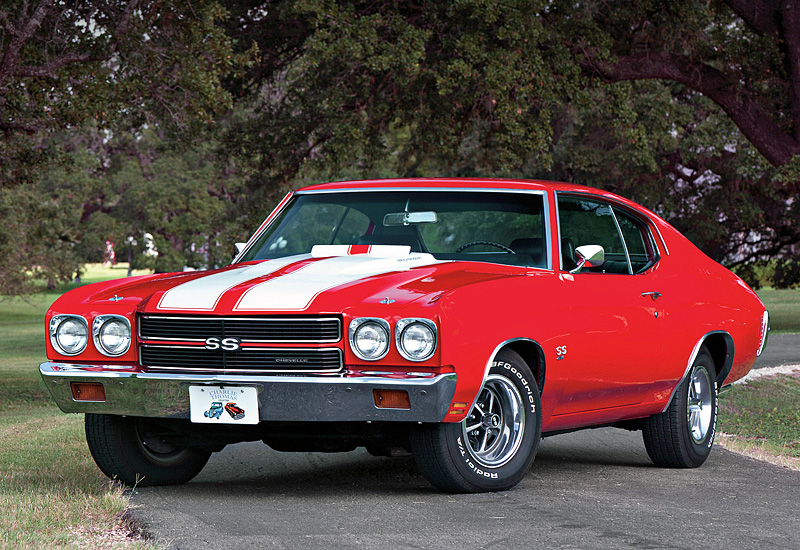
Table of Contents
- Overview and History
- Body Styles and Design
- Standard Engine — LS5 454 V8
- The LS6 454 — 450 Horsepower
- The Z15 SS 454 Equipment Package
- Transmission and Drivetrain
- Suspension, Steering, and Brakes
- Cowl Induction and Appearance Options
- Performance Test Data
- Production Numbers and Assembly
- Collectibility and Current Market
- Key Features Summary
- Full Specifications Table
Overview and History
Through the second half of the 1960s, General Motors held roughly half the American car market, and its executives were genuinely worried that an antitrust action might break the corporation apart. One consequence of that anxiety was a self-imposed corporate rule capping engine displacement in intermediate and pony-car bodies at 400 cubic inches. Pontiac had already found ways around the letter of the rule with the 1964 GTO, and by the end of the decade the restriction looked increasingly indefensible while Chrysler was selling 440s and Hemis in mid-size Road Runners and Chargers.
For the 1970 model year GM abandoned the policy. Buick answered with the 455 Stage 1, Oldsmobile with the W-30 455, and Pontiac with the 455 in the GTO. Chevrolet’s response was the largest and, on paper, the most extreme of the four. The division took its 427 cu in Mark IV big-block, lengthened the stroke to four inches, and arrived at 454 cubic inches. Two versions were released for the Chevelle: the hydraulic-lifter LS5 at 360 hp, and the solid-lifter LS6 at 450 hp.
The LS6 rating deserves emphasis. At 450 advertised horsepower it was the highest figure any American manufacturer put on a window sticker during the original muscle car period — higher than the 426 Hemi’s 425 hp, higher than Ford’s Boss 429, and, notably, higher than any Corvette of the year. It remains the only occasion in GM history where the corporation’s top horsepower rating belonged to something other than the Corvette.
The car underneath was thoroughly new for 1970. The second-generation A-body Chevelle had been introduced for 1968, but the 1970 restyle abandoned most of the earlier sheet metal language in favor of a squarer, more sharply creased shape with a split grille, quad headlights set into the leading edge of the fenders, and prominent bulges over the wheel arches. It is a shape that has aged extraordinarily well, and it is a substantial part of why the 1970 Chevelle SS is among the most recognizable American cars ever built.
It also sold. For the second consecutive year, the Chevelle SS was Detroit’s best-selling muscle car, having displaced the Pontiac GTO from that position in 1969. Total Chevelle production for 1970 ran to roughly 442,000 units across all series and body styles; of those, 62,372 carried the Super Sport option.
Body Styles and Design
The Super Sport was an option package, not a separate model — an important distinction that has significant implications for authentication today. In 1970 the SS could be ordered on two Malibu body styles only:
- 2-door Sport Coupe (pillarless hardtop) — VIN body code 37
- 2-door Convertible — VIN body code 67
Both rode the shorter 112-inch wheelbase version of the GM A-body platform; four-door sedans and station wagons used a 116-inch wheelbase and could not be ordered with the SS package. The El Camino, mechanically an A-body pickup, could also be ordered with SS 454 equipment under its own RPO structure, and the new-for-1970 Monte Carlo offered the LS5 in SS 454 form on a 116-inch wheelbase.
The 1970 restyle gave the Chevelle a distinctly more aggressive face. A split grille divided by a body-color center bar replaced the previous single-opening design, with the outer edges of the grille flowing into round headlamp bezels recessed into the fender ends. On SS-equipped cars the grille was blacked out and carried a large SS badge in the center. Along the flanks, the beltline was flat and high, with a shallow crease running the length of the body and a pronounced hip over the rear wheel opening.
The rear was equally reworked, with four round tail lamps mounted in a body-colored valance panel — a Chevrolet performance motif shared with the Corvette and Camaro of the period. SS cars received a black-painted rear panel that framed the lamps and emphasized the width of the car.
The standard SS hood was a twin-domed unit with two raised power bulges. The far more famous ZL2 cowl induction hood was a separate $147 option; it added a rearward-facing scoop at the base of the windshield with a vacuum-operated flap that opened only at full throttle, drawing cool, high-pressure air from the area at the base of the glass. Hood pins and the wide twin “dorsal” stripes over the hood and deck lid were part of the cowl induction option package rather than standard SS equipment — a detail routinely misrepresented in tribute cars.
Inside, the SS did not fundamentally change the Malibu interior, but SS buyers commonly specified Strato-bucket seats with a center console, a floor shifter, and the optional round-dial instrument cluster with a tachometer. The standard SS instrumentation included an ammeter and temperature gauge in place of warning lamps.
Standard Engine — LS5 454 V8
Ordering the Z15 SS 454 package brought the LS5 454 cu in V8 as standard equipment; it was not a separate extra-cost option in 1970 in the way it would become in later years. Chevrolet marketed it under the Turbo-Jet name.
The LS5 was a genuinely large but comparatively civilized engine. It used a cast-iron block with five main bearings, cast-iron cylinder heads with Chevrolet’s canted-valve “porcupine” arrangement, a hydraulic camshaft, and a Rochester Quadrajet four-barrel carburetor on a cast-iron intake manifold. Compression was set at 10.25:1, requiring premium fuel but stopping well short of the LS6’s demands.
Output was quoted at 360 horsepower at 4,400 rpm and 500 lb-ft of torque at 3,200 rpm, both SAE gross figures. The torque number is the significant one: 500 lb-ft arriving barely above idle speed made the LS5 Chevelle enormously flexible in ordinary driving, and it required no unusual maintenance discipline from its owner. A great many buyers who wanted the SS 454 look and effortless acceleration without the LS6’s temperament chose exactly this engine, and roughly half of all 454-equipped Chevelles in 1970 left the factory with it.
Bore and stroke measured 4.125 × 4.00 inches. The LS5 shared its bottom-end architecture with the LS6 but used cast pistons, a two-bolt main-bearing block in most applications, and a considerably milder camshaft profile with long duration figures measured on the ramps rather than at conventional checking lift.
The LS6 454 — 450 Horsepower
The LS6 was a separate $263.30 option on top of the Z15 package, and it was a different engine in every way that mattered. Chevrolet built it as a street-legal drag racing powerplant and made almost no concessions to comfort.
The specification list is remarkable for a mass-produced 1970 passenger car:
- Four-bolt main-bearing block to cope with the loads
- Forged steel crankshaft and forged steel connecting rods
- Forged aluminum pistons
- 11.25:1 compression ratio, demanding high-octane leaded premium
- Solid (mechanical) lifter camshaft — 0.5197 inch lift on both intake and exhaust
- Aluminum intake manifold with a Holley four-barrel carburetor
- Closed-chamber rectangular-port cylinder heads with larger valves
- Deep-groove accessory pulleys to prevent belt throw at high rpm
- Transistorized ignition and a low-restriction dual exhaust system
Rated output was 450 hp at 5,600 rpm and 500 lb-ft at 3,600 rpm. The torque figure matches the LS5 on paper, but it arrives 400 rpm higher and the LS6 keeps pulling to well past 6,000 rpm where the LS5 has long since given up. Period and modern dynamometer work has repeatedly suggested the 450 hp rating was conservative and that genuine output was meaningfully higher.
The trade-offs were real. Solid lifters required periodic valve lash adjustment. The compression ratio made the engine effectively incompatible with the unleaded, lower-octane fuel that arrived within a few years of its introduction — a problem that still complicates LS6 ownership today. Air conditioning was not available in combination with the LS6, and the aggressive camshaft produced an idle quality that Chevrolet made no attempt to disguise.
All 454 engines for 1970 were assembled at Chevrolet’s Tonawanda, New York plant, and it is the surviving Tonawanda engine records — rather than any vehicle assembly data — that give us the LS6 production figure that circulates today.
The Z15 SS 454 Equipment Package
Regular Production Option Z15 was the SS 454 package, priced at $503.45. Its sibling, RPO Z25, was the SS 396 package at $445.55, which carried the 402 cu in engine that Chevrolet continued to badge and market as a 396.
Z15 included, as standard:
- LS5 454 cu in V8, 360 hp
- F41 special performance suspension — heavier springs, larger front and rear stabilizer bars, revalved shock absorbers
- Power front disc brakes (11-inch rotors) with rear drums
- Heavy-duty three-speed manual transmission with floor shifter
- Dual exhaust with bright tips
- Twin-domed hood with hood insulation
- Blacked-out grille and rear panel, SS badging, bright wheel-opening and rocker moldings
- 14 × 7-inch sport wheels with F70 × 14 white-lettered bias-belted tires
- Instrumentation upgrade including ammeter and temperature gauge
Because the SS was an option package applied to a Malibu, no 1970 Chevelle VIN identifies a car as a Super Sport. Verification depends on the cowl tag, the engine and transmission stamping codes, and — decisively — a surviving factory build sheet or Protect-O-Plate. This is the single most important fact for anyone evaluating a 1970 SS 454 today.
Transmission and Drivetrain
The Z15 package’s standard transmission was a heavy-duty floor-shifted three-speed manual, but this is rarely what buyers took. The realistic choices were:
- M20 wide-ratio four-speed manual
- M21 close-ratio four-speed manual
- M22 close-ratio heavy-duty four-speed manual — the “Rock Crusher,” with straighter-cut gear teeth for strength, which produced the distinctive gear whine that gave it the nickname. Priced at $221.80.
- M40 Turbo Hydra-Matic 400 three-speed automatic — $290.40 behind the LS6, $221.80 behind lesser engines
The M22 was the specified choice behind the LS6 for buyers with serious intentions, though a substantial number of LS6 cars were built with the TH400. The two-speed Powerglide was not available with the 454.
All 454 cars used the corporate 12-bolt rear axle, a considerably stronger unit than the 10-bolt fitted to smaller-engined Chevelles. Available final drive ratios ranged from 3.31:1 through 3.55:1, 3.73:1, and 4.10:1, with Positraction limited-slip available and near-universal on performance-ordered cars. Ratios were coded on a stamping at the flange end of the axle tube.
Suspension, Steering, and Brakes
The Chevelle used a conventional and well-proven full-perimeter frame chassis. The front suspension was independent, with unequal-length control arms, coil springs, and an anti-roll bar. The rear used a four-link coil-sprung live axle — two lower trailing arms and two upper control arms — a layout that gave the Chevelle noticeably better axle location and ride quality than the leaf-sprung Mopar and Ford intermediates it competed against.
The F41 suspension included with Z15 stiffened this considerably without ruining it. Contemporary road testers were consistently surprised that a car with well over 3,800 pounds and a huge iron big-block over the front axle handled as competently as it did; Motor Trend’s comparison test against a Road Runner 440 Six Pack and a Torino Cobra 429 rated the Chevelle the best of the three both in a straight line and in corners.
Steering was recirculating-ball. Manual steering was standard and, at roughly 24:1, extremely slow; power steering was an option almost every 454 buyer selected, bringing the ratio down and making the car usable at parking speeds.
Brakes were the weak point, as they were on every muscle car of the period. Z15 made power front discs standard — 11-inch rotors with single-piston calipers — paired with 9.5-inch rear drums. This was a meaningful improvement over four-wheel drums, but repeated hard stops from speed would still overwhelm the system. There was no factory rear disc option.
Cowl Induction and Appearance Options
The ZL2 cowl induction hood is probably the single most recognizable feature of the 1970 Chevelle SS, and it was an extra-cost option on both the SS 396 and SS 454. At the base of the windshield, air pressure rises at speed and the air itself is cooler and cleaner than what sits above a hot engine. Chevrolet exploited this with a hood scoop that faced rearward toward the windshield and was sealed to the air cleaner.
The scoop’s flap was held closed by engine vacuum. At wide-open throttle, manifold vacuum collapses, a solenoid releases, and the flap springs open — so the scoop functions only under full power, and the visible flap movement was as much a piece of theater as an engineering feature. It was, nonetheless, genuinely functional.
The wide twin stripes over the hood and deck lid, along with the hood pins, were bundled with the cowl induction option rather than sold separately or included with the SS package. A car with SS badging, dorsal stripes, and a flat non-cowl hood is therefore internally inconsistent — a useful quick check when evaluating a car’s originality.
Performance Test Data
Published figures for the LS6 vary widely depending on tire preparation, axle ratio, and how much abuse the test driver was willing to inflict on the clutch, but the consistent picture is of a car quick enough to embarrass most things sold at any price in 1970.
- Motor Trend (December 1969), LS6 four-speed: 0–60 mph in 6.0 seconds, quarter mile in 13.8 seconds — more than half a second clear of both the Road Runner 440 Six Pack and the Torino Cobra 429 in the same comparison
- Hot Rod (May 1970), LS6: quarter mile in 13.44 seconds at 108.17 mph, with the tester noting that the engine’s low-end torque made a clean launch essentially impossible
- LS5 454: typically 0–60 mph in the low-to-mid 6-second range and quarter-mile times of approximately 14.4 seconds at around 99 mph
- Top speed: approximately 125 mph, limited primarily by gearing and aerodynamics rather than power
With drag slicks, open exhaust, and correct tuning, contemporary drag racers ran LS6 Chevelles well into the twelve-second bracket essentially as delivered, which is why the cars appeared immediately and successfully in NHRA and AHRA Stock and Super Stock classes.
Production Numbers and Assembly
Chevrolet lost most of its detailed 1970 assembly records decades ago, so precise breakdowns by engine, body style, transmission, and color do not exist. The figures below are the ones the collector community treats as reliable:
- Total 1970 Chevelle production (all series): approximately 442,000
- Total Chevelle SS (RPO Z15 + Z25): 62,372
- SS with 396/402 cu in V8: 53,599
- SS with 454 cu in V8: 8,773
- LS6 454 engines built at Tonawanda in 1970: 4,475
The 4,475 figure requires a caveat that is frequently omitted. It is an engine plant number, not a Chevelle number. Those engines went into Chevelle Sport Coupes, Chevelle convertibles, and El Caminos, and the split between them is unknown. Registry researchers who have spent decades on the question estimate that only around a dozen convertibles and a similar number of El Caminos received the LS6, which — if approximately correct — makes an LS6 convertible one of the rarest American production cars of the era.
1970 Chevelles were assembled at five U.S. plants — Atlanta, Baltimore, Flint, Kansas City, and Arlington — plus Oshawa in Canada. Each plant assigned sequence numbers to all Chevelle-family cars without regard to series, so an SS 454 and a six-cylinder four-door sedan built on the same day carry consecutive numbers.
Convertible production across the entire 1970 Chevelle line was 7,511 units, which puts the scarcity of any drop-top SS 454 into perspective before the engine option is even considered.
Collectibility and Current Market
The 1970 SS 454, and the LS6 in particular, sits at the very top of the American muscle car market and has done so for thirty years. It is one of a small handful of cars — alongside the Hemi Cuda and the ZL1 Camaro — that define the category’s ceiling.
Broad current ranges, which vary considerably with documentation quality:
- LS5 Sport Coupe, driver quality: roughly $45,000–$70,000
- LS5 Sport Coupe, well restored: roughly $80,000–$120,000
- LS6 Sport Coupe, good condition (Hagerty #3): around $98,000
- LS6 Sport Coupe, concours restored and documented: $180,000–$250,000 and upward
- LS6 convertible, documented: substantially higher; individual results have exceeded $225,000
Documentation is not a nice-to-have in this market — it is the majority of the value. Because the SS was an option package with no VIN identifier, and because the drivetrain components are all readily available, a convincing LS6 clone can be assembled by anyone with money and patience. A car with two build sheets, a Protect-O-Plate, and a documented ownership chain can be worth three or four times an otherwise identical car without paperwork.
Notably, the LS6’s five-year appreciation has been relatively modest compared with other segments of the classic market — Hagerty recorded roughly 10% growth over a recent five-year window for the #3-condition LS6 Sport Coupe, well behind the appreciation seen in 1960s Chevrolet trucks over the same period. The car remains blue-chip, but it is no longer the runaway performer it was in the 2000s.
Key Features Summary
- Layout: Front-engine, rear-wheel drive (FR)
- Platform: GM A-body, 112-inch wheelbase (2-door)
- Body Styles: 2-door Sport Coupe (hardtop), 2-door Convertible
- SS 454 Package: RPO Z15, $503.45
- Standard Engine: LS5 454 cu in V8 — 360 hp, 500 lb-ft, hydraulic lifters, 10.25:1
- Optional Engine: LS6 454 cu in V8 — 450 hp, 500 lb-ft, solid lifters, 11.25:1, $263.30
- Significance: Highest advertised factory horsepower of the classic muscle car era
- Transmission: 3-speed manual standard; M20/M21/M22 4-speed or TH400 automatic optional
- Rear Axle: 12-bolt, 3.31 to 4.10 ratios, Positraction optional
- Brakes: Power front discs standard with Z15; rear drums
- Suspension: F41 heavy-duty; independent front, four-link coil-sprung live rear axle
- Signature Option: ZL2 cowl induction hood with vacuum-actuated flap, $147
- Quarter Mile (LS6): 13.44 seconds at 108.17 mph (Hot Rod, 1970)
- Production: 8,773 SS 454 Chevelles; 4,475 LS6 engines built
- Authentication: No SS identifier in the VIN — build sheet and cowl tag are essential
The 1970 Chevrolet Chevelle SS 454 Specs
| BODY | |
| Body Maker | Fisher (General Motors) |
| Body Styles Available | 2-door Sport Coupe (pillarless hardtop); 2-door Convertible |
| Series | Chevelle Malibu, series 136 (V8) |
| SS Package RPO | Z15 (SS 454); Z25 was SS 396 |
| Platform | GM A-body (second generation intermediate) |
| Chassis | Full perimeter frame, separate body |
| No. of Doors | 2 |
| Seating Capacity | 5 (bench) or 4 (Strato-bucket seats with console) |
| Standard SS Hood | Twin-domed with insulation |
| DIMENSIONS | |
| Wheelbase | 112.0 inches (2,845 mm) |
| Overall Length | 197.2 inches (5,009 mm) |
| Overall Width | 75.4 inches (1,915 mm) |
| Overall Height (Sport Coupe) | 53.2 inches (1,351 mm) |
| Overall Height (Convertible) | 52.9 inches (1,344 mm) |
| Front Track | 60.0 inches (1,524 mm) |
| Rear Track | 59.8 inches (1,519 mm) |
| Curb Weight (SS 454 Sport Coupe) | approx. 3,900 lbs (1,769 kg) |
| Curb Weight (SS 454 Convertible) | approx. 4,000 lbs (1,814 kg) |
| Weight Distribution | approx. 57 / 43 front-to-rear |
| ENGINE 1 — STANDARD (LS5 454 Turbo-Jet V8) | |
| Engine Type | OHV 90° V8, Mark IV big-block, naturally aspirated |
| Displacement | 454 cu in (7,440 cc / 7.4 L) |
| Bore × Stroke | 4.125 × 4.00 inches |
| Compression Ratio | 10.25:1 |
| Horsepower (SAE Gross) | 360 hp @ 4,400 RPM |
| Torque (SAE Gross) | 500 lb·ft @ 3,200 RPM |
| Carburetor | Rochester Quadrajet 4-barrel |
| Intake Manifold | Cast iron |
| Valve Lifters | Hydraulic |
| Main Bearings | 5 |
| Cylinder Head / Block Material | Cast iron / cast iron |
| Pistons | Cast aluminum |
| Fuel Requirement | Premium leaded |
| Option Price (as separate RPO) | $163.40 |
| ENGINE 2 — OPTIONAL (LS6 454 Turbo-Jet V8) | |
| Engine Type | OHV 90° V8, Mark IV big-block, naturally aspirated |
| Displacement | 454 cu in (7,440 cc / 7.4 L) |
| Bore × Stroke | 4.125 × 4.00 inches |
| Compression Ratio | 11.25:1 |
| Horsepower (SAE Gross) | 450 hp @ 5,600 RPM |
| Torque (SAE Gross) | 500 lb·ft @ 3,600 RPM |
| Carburetor | Holley 4-barrel (P/N 3967479 manual; 3969894 automatic) |
| Intake Manifold | Aluminum |
| Valve Lifters | Mechanical (solid) |
| Camshaft Duration | Intake 316°, Exhaust 302°, Overlap 80° |
| Camshaft Lift | 0.5197 inch intake and exhaust |
| Main Bearing Caps | Four-bolt |
| Crankshaft | Forged steel |
| Connecting Rods | Forged steel |
| Pistons | Forged aluminum |
| Cylinder Heads | Closed-chamber, rectangular port, cast iron |
| Air Conditioning Compatibility | Not available |
| Option Price | $263.30 (in addition to Z15) |
| Engine Assembly Plant | Tonawanda, New York |
| TRANSMISSION | |
| Standard | Heavy-duty 3-speed manual, floor shift |
| Optional — M20 | Wide-ratio 4-speed manual |
| Optional — M21 | Close-ratio 4-speed manual |
| Optional — M22 | Close-ratio heavy-duty 4-speed manual (“Rock Crusher”) — $221.80 |
| Optional — M40 | Turbo Hydra-Matic 400 3-speed automatic — $290.40 with LS6 |
| Not Available | 2-speed Powerglide (not offered with 454) |
| DRIVETRAIN / REAR AXLE | |
| Drive Layout | Front engine, rear-wheel drive |
| Rear Axle | GM 12-bolt |
| Available Ratios | 3.31:1, 3.55:1, 3.73:1, 4.10:1 |
| Limited Slip | Positraction — optional |
| Axle Code Location | Stamped on flange end of right axle tube |
| SUSPENSION AND STEERING | |
| Front Suspension | Independent; unequal-length control arms, coil springs, anti-roll bar |
| Rear Suspension | Live axle; four-link (two lower trailing arms, two upper control arms), coil springs |
| Performance Suspension | F41 — standard with Z15; heavier springs, larger front and rear stabilizer bars |
| Steering Type | Recirculating ball |
| Steering Ratio (manual) | approx. 24:1 |
| Power Steering | Optional |
| BRAKES | |
| Front Brakes | 11-inch vented discs, single-piston calipers — standard with Z15 |
| Rear Brakes | 9.5-inch drums |
| Power Assist | Standard with Z15 |
| Rear Disc Option | Not offered |
| WHEELS AND TIRES | |
| Wheels | 14 × 7-inch sport wheels; Magnum 500 style widely fitted |
| Tires | F70 × 14 raised-white-letter bias-belted (Goodyear Polyglas) |
| PERFORMANCE | |
| 0–60 mph (LS6) | approx. 6.0 seconds (Motor Trend) |
| Quarter Mile (LS6) | 13.44 sec @ 108.17 mph (Hot Rod); 13.8 sec (Motor Trend) |
| 0–60 mph (LS5) | approx. 6.1–6.5 seconds |
| Quarter Mile (LS5) | approx. 14.4 sec @ 99 mph |
| Top Speed | approx. 125 mph (201 km/h) |
| Fuel Economy (period) | approx. 8–11 mpg |
| CAPACITIES | |
| Fuel Tank | 20 gallons |
| Engine Oil | 5 quarts (with filter) |
| Cooling System | approx. 22 quarts (454 with heavy-duty radiator) |
| VIN / VEHICLE IDENTIFICATION | |
| VIN Example | 136370K100001 |
| Total VIN Digits | 13 |
| Digits 1–2 | Chevrolet Division / Chevelle series (13) |
| Digit 3 | Series and engine family (6 = Malibu, V8) |
| Digits 4–5 | Body Style (37 = 2-dr Sport Coupe, 67 = Convertible) |
| Digit 6 | Model Year (0 = 1970) |
| Digit 7 | Assembly Plant (A = Atlanta GA, B = Baltimore MD, F = Flint MI, K = Kansas City MO, R = Arlington TX, 1 = Oshawa ON) |
| Digits 8–13 | Sequential Production Number |
| SS Identifier in VIN | None — the Super Sport was an option package, not a series |
| VIN Plate Location | Left side of dash, visible through windshield, rosette rivets |
| Cowl Tag Location | Firewall — contains body style, paint, trim, and build date codes |
| Engine Stamp Location | Pad on right-hand side of block, forward of cylinder head |
| PRODUCTION (1970) | |
| Total Chevelle Production (all series) | approx. 442,000 |
| Total Chevelle SS (Z15 + Z25) | 62,372 |
| SS with 396 / 402 cu in V8 | 53,599 |
| SS with 454 cu in V8 | 8,773 |
| LS6 454 Engines Built (Tonawanda) | 4,475 |
| Total Chevelle Convertibles (all series) | 7,511 |
| LS6 Convertibles (estimated) | approx. a dozen — no factory record survives |
| Assembly Plants | Atlanta, Baltimore, Flint, Kansas City, Arlington, Oshawa (Canada) |
| PRICING (1970) | |
| Base Chevelle Malibu Sport Coupe | approx. $2,809 |
| Z15 SS 454 Equipment Package | $503.45 |
| Z25 SS 396 Equipment Package | $445.55 |
| LS6 454 Engine Option | $263.30 |
| M22 Heavy-Duty 4-Speed | $221.80 |
| Turbo Hydra-Matic 400 (with LS6) | $290.40 |
| ZL2 Cowl Induction Hood | approx. $147 |
| Typical LS6 As-Delivered Price | approaching $5,000 |
| EXTERIOR COLORS (1970, with paint codes) | |
| 10 Classic White, 14 Cortez Silver, 17 Shadow Gray, 19 Tuxedo Black, 25 Astro Blue, 28 Fathom Blue, 34 Misty Turquoise, 45 Green Mist, 48 Forest Green, 50 Gobi Beige, 55 Champagne Gold, 58 Autumn Gold, 63 Desert Sand, 75 Cranberry Red, 78 Black Cherry | |
| OPTIONAL EQUIPMENT (SELECTED) | |
| LS6 454 V8, 450 hp | Opt. — $263.30, requires Z15 |
| ZL2 Cowl Induction Hood | Opt. — includes hood stripes and hood pins |
| Positraction Limited-Slip Differential | Opt. |
| Power Steering | Opt. |
| Strato-Bucket Seats with Console | Opt. |
| Round-Dial Instrumentation with Tachometer | Opt. |
| Air Conditioning | Opt. — LS5 only, not available with LS6 |
| Tilt Steering Wheel | Opt. |
| Power Windows | Opt. |
| Power Convertible Top | Opt. (convertible only) |
| Vinyl Roof Cover | Opt. (Sport Coupe) |
| AM/FM Radio | Opt. |
| 8-Track Stereo Tape Player | Opt. |
| Rear Window Defogger | Opt. |
| Heavy-Duty Radiator | Opt. |
| Special Paint (RPO ZP3) | Opt. |
1970 Chevrolet Chevelle SS 454 – Frequently Asked Questions
How much horsepower does the 1970 Chevelle SS 454 have?
It depends on which 454 was ordered. The standard LS5 was rated at 360 hp at 4,400 rpm with 500 lb-ft of torque. The optional LS6 was rated at 450 hp at 5,600 rpm, also with 500 lb-ft. Both figures are SAE gross, measured without accessories or exhaust restriction, so they are not directly comparable to modern net ratings. The 450 hp LS6 figure was the highest advertised horsepower on any American production car during the classic muscle era.
What is the difference between the LS5 and the LS6?
They share displacement, bore, and stroke but differ in nearly everything else. The LS5 uses a hydraulic camshaft, cast pistons, a cast-iron intake manifold, a Rochester Quadrajet carburetor, and 10.25:1 compression. The LS6 uses a solid-lifter camshaft, forged aluminum pistons, a forged steel crank and rods, four-bolt main caps, an aluminum intake, a Holley carburetor, rectangular-port heads, and 11.25:1 compression. In practical terms the LS5 is a relaxed torque engine and the LS6 is a street-legal race engine that requires periodic valve adjustment and high-octane fuel.
How many 1970 Chevelle SS 454s were built?
8,773 Chevelle SS cars were built with the 454 engine in 1970, out of 62,372 Chevelle SS units in total. Of the 454s, Tonawanda engine plant records show 4,475 LS6 engines were produced — but that number covers all applications, including El Caminos, and no factory breakdown by body style survives.
How fast is the 1970 Chevelle SS 454 LS6?
Hot Rod recorded a quarter mile of 13.44 seconds at 108.17 mph in May 1970. Motor Trend measured 0–60 mph in 6.0 seconds and a 13.8-second quarter in a December 1969 comparison against a Road Runner 440 Six Pack and a Torino Cobra 429, beating both by more than half a second. Top speed was roughly 125 mph, limited by gearing rather than power.
What did a 1970 Chevelle SS 454 cost new?
A base Malibu Sport Coupe started at approximately $2,809. The Z15 SS 454 package added $503.45. Adding the LS6 engine at $263.30 and the M22 four-speed at $221.80 brought the total close to $5,000 before any other options — Corvette territory in 1970, which goes some way toward explaining why so few were sold.
Is there a way to identify an SS 454 by its VIN?
No. This is the most important thing to understand about the car. In 1970 the Super Sport was an option package (RPO Z15) applied to a Malibu, not a separate model or series, so the VIN of a genuine SS 454 is identical to that of a base V8 Malibu of the same body style. Verification requires the cowl tag, matching engine and transmission stamping codes, and ideally an original build sheet or Protect-O-Plate. Clones are common and can be extremely convincing.
Was the cowl induction hood standard on the SS 454?
No. The ZL2 cowl induction hood was a roughly $147 option on both the SS 396 and SS 454. The standard SS hood was a twin-domed unit without the rear-facing scoop. The wide hood and deck stripes and the hood pins were included with the ZL2 option rather than with the SS package itself, so a car showing stripes but no cowl hood is not configured as the factory would have built it.
Could you get air conditioning with the LS6?
No. Air conditioning was available on LS5-equipped SS 454s but was not offered with the LS6. The solid-lifter camshaft produced an idle unsuited to compressor loads, and the engine’s cooling and accessory drive arrangements were configured for performance rather than comfort. Any LS6 car presented with factory air is misrepresented.
What is a 1970 Chevelle SS 454 worth today?
Values are wide and driven almost entirely by documentation. Driver-quality LS5 Sport Coupes generally run $45,000–$70,000, with well-restored examples reaching $80,000–$120,000. A good-condition LS6 Sport Coupe sits around $98,000 by Hagerty’s guide, while concours-restored and fully documented LS6 cars trade in the $180,000–$250,000 range and beyond. Documented LS6 convertibles are in a category of their own, with individual results exceeding $225,000.
Why is the LS6 considered the peak of the muscle car era?
Three reasons converge. Its 450 hp rating was the highest ever advertised on an American production car of the period. It was available for one model year only, in a mid-size body, before insurance costs, emissions regulations, and the shift to low-lead fuel ended engines of this kind. And it was the only time GM’s top horsepower figure belonged to something other than the Corvette. Within twelve months compression ratios had fallen across the industry and the LS5 was left as the Chevelle’s big-block flagship.
Can a 1970 LS6 run on modern pump gas?
Not without modification. The 11.25:1 compression ratio was designed around high-octane leaded premium that no longer exists. Owners typically address this in one of three ways: running race fuel or an octane additive, retarding ignition timing and accepting reduced output, or rebuilding with lower-compression pistons — the last of which preserves drivability but compromises originality and therefore value. It is a genuine ownership consideration rather than a theoretical one.
