The 1967 Chevrolet C10 is the first year of the generation that most people picture when they imagine a classic American pickup. General Motors named it the “Action-Line” series, and it replaced the 1960–1966 trucks with a cleaner, lower, far more car-like design that the division described as its most significant truck restyle. The C10 kept the coil-sprung rear axle that made it ride better than anything from Ford or Dodge, and gained a lower cab with much more glass. It is the only year of the generation with the small rear window and no side marker lights – the purest version of the shape.
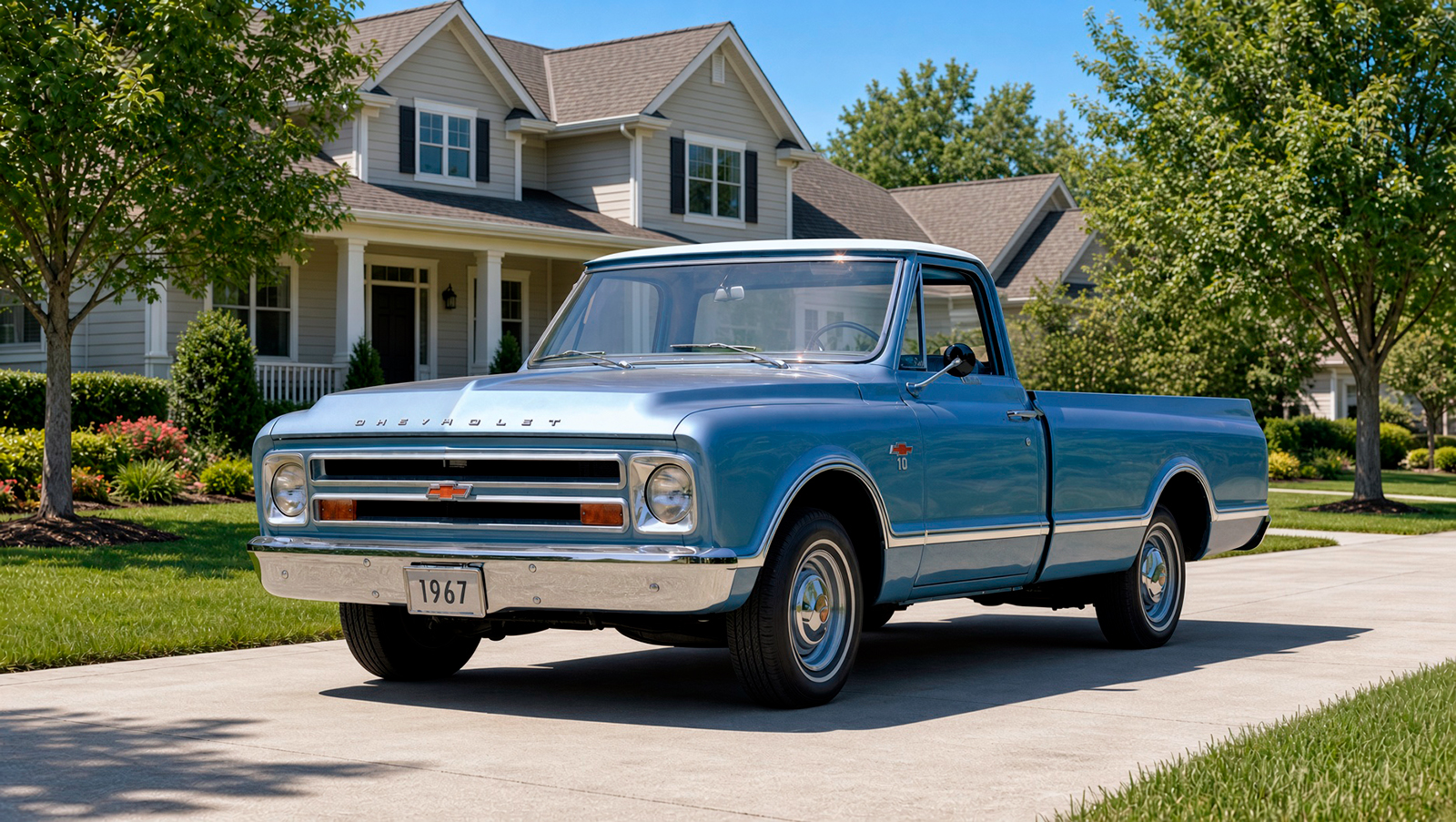
Table of Contents
- Overview and History
- What C10 Means
- What Makes 1967 Distinct
- The Coil-Sprung Rear Axle
- Fleetside and Stepside
- Trim Levels and the CST
- Engine Lineup
- Transmissions and Drivetrain
- Brakes
- How the Generation Changed
- Identifying a 1967
- Collectibility and Buying
- Key Features Summary
- Full Specifications Table
Overview and History
The first-generation C/K had launched in the autumn of 1959 as a 1960 model, bringing a major departure of design precedent in light trucks: independent front suspension on torsion bars, a drop-centre frame, and a coil-sprung rear axle. That generation ran to 1966, with coil springs replacing the torsion bars for 1963.
For 1967 General Motors introduced the second generation, named the “Action-Line” series. It was a comprehensive restyle rather than a facelift, and the division promoted it as its most significant truck redesign.
The generation ran from 1967 through 1972 and introduced a succession of genuine improvements: a lower cab with greater glass area, a wide trim range extending well up-market, and – from 1969 – the K5 Blazer built on the same architecture.
1967 is the first year, and it is also the purest. Several details that define the generation visually were present only in that first season, which makes it the year collectors increasingly seek.
What C10 Means
The naming convention had arrived with the 1960 trucks and would serve for four decades:
- C – two-wheel drive
- K – four-wheel drive
- 10 – half-ton
- 20 – three-quarter-ton
- 30 – one-ton
So a C10 is the half-ton, two-wheel-drive pickup – the lightest, most car-like, and by far the most popular model with collectors. A K10 is its four-wheel-drive equivalent, a C20 the three-quarter-ton two-wheel drive, and so on.
The C10 receives most attention from restorers and custom builders, principally because its lighter chassis and coil-sprung rear suspension make it the best-riding and most usable of the range.
Note that the weight-class names Chevrolet had used earlier – Apache, Viking, Spartan – had been retired by this point. A 1967 is simply a C10.
What Makes 1967 Distinct
Several features were unique to the first year of the generation, and together they make a 1967 immediately identifiable to anyone who knows the trucks.
The most noticeable is the small rear window. The 1967 cab used a narrower rear glass than the 1968-onward trucks, which received a larger opening. A big-window 1967 exists as a factory option but is unusual; the standard small window is the year’s signature.
Side marker lights were absent in 1967. Federal requirements brought them in for 1968, and every subsequent year of the generation carries them on the front fenders and rear bed sides. Their absence gives the 1967 flanks a notably cleaner appearance.
Other 1967-only details include specific grille and trim treatments, and interior items that changed for 1968.
That combination – small rear window, no side markers – is why many enthusiasts consider the 1967 the best-looking of the generation, and why it commands a premium over otherwise identical later trucks.
The Coil-Sprung Rear Axle
The engineering feature that defines the light-duty C-series carried over from the previous generation and remained its greatest practical advantage.
The C10 used independent coil-spring front suspension paired with a coil-sprung rear axle, where heavier models and the four-wheel-drive K-series used leaf springs at the back.
That arrangement produced a ride quality that was genuinely car-like by the standards of the period, and it remains the main reason a C10 is so much more pleasant to drive than contemporary Fords and Dodges. On a vehicle sixty years old, a comfortable ride matters considerably more than it might in theory.
The trade is load capacity. A coil-sprung rear is softer under weight than a leaf-sprung one, which is why the heavier C20 and C30 models kept leaves. For a C10 used as a classic rather than a working truck, that is no limitation at all.
Construction was body-on-frame with a ladder chassis, as throughout the C/K line.
Fleetside and Stepside
Two bed designs continued, and the distinction affects both appearance and value.
Fleetside – the smooth-sided bed with flush body panels running the full width of the truck. It gives a cleaner profile and more usable cargo width, and it is the more popular choice both then and now.
Stepside – the traditional arrangement with a narrow bed, external rear fenders, and running boards between the cab and the rear fender.
Two wheelbases were available, giving short-bed and long-bed versions. The short-bed Fleetside is the most sought-after combination by a considerable margin – its proportions are the best of the range and it is the configuration most associated with the generation.
The smooth-sided bed traces directly to the 1955 Cameo Carrier, which created the world’s first smooth cargo box using fibreglass panels before the all-steel Fleetside arrived for 1958.
Trim Levels and the CST
One of the Action-Line generation’s defining achievements was how far up-market Chevrolet took the pickup, and 1967 established that direction.
The Custom Sport Truck (CST) package arrived with the new generation, bringing a level of interior and exterior finish that pickups had not previously offered: upgraded upholstery, additional interior trim, bright exterior mouldings, and a fuller equipment list.
Below it sat the base Custom trim and the Custom Deluxe, with the hierarchy expanding further later in the generation – the Cheyenne nameplate debuted in 1971 and the Cheyenne Super topped the range by 1972.
Comfort options were extensive by truck standards. Air conditioning, power steering, power brakes, a tilt steering wheel, bucket seats with a console, and full instrumentation in place of warning lights were all available.
A genuine CST commands a premium, and because the badging is easily added, verifying the complete specification rather than trusting emblems is worth doing.
Engine Lineup
The 1967 range covered sixes and small-block V8s:
- 250 cu in inline-six – the base engine, durable and economical
- 292 cu in inline-six – the larger six, with strong low-end torque; a favourite for working trucks
- 283 cu in V8 – the base V8
- 327 cu in V8 – the step-up small-block
The 327 had joined the C/K range for 1965 on the heavier series and extended to the 10-30 series for 1966, carrying into the new generation. In a half-ton it gives genuinely strong performance.
The big-block arrived later in the generation. The 396 and subsequently the 402 – which Chevrolet badged and marketed as a 400 – became available as the years progressed, with 1972 the last year of the body with big-block power.
Note that all 1967 figures are SAE gross, the standard until the industry switched to SAE net for 1972. Figures from this period are not directly comparable with later ones.
Transmissions and Drivetrain
Transmission choices covered:
- Three-speed manual – standard, column-shifted
- Four-speed manual – optional, with a granny-low first gear on work-oriented trucks
- Powerglide two-speed automatic
- Turbo Hydra-Matic three-speed automatic – the better unit, and what most surviving trucks carry
Drive was to the rear wheels on C-series trucks. A limited-slip differential was available, and a range of axle ratios allowed the truck to be geared for towing or for relaxed cruising.
The K-series four-wheel-drive models used a different arrangement, being leaf-sprung at both ends – a genuinely different vehicle beneath a shared cab.
Brakes
An important limitation of the early Action-Line trucks, and one that affects usability directly.
The 1967 used hydraulic drum brakes at all four wheels, with power assist optional. That was standard practice and adequate for the period, but it is the clearest dynamic weakness on a truck being driven in modern traffic.
Front disc brakes became standard on all light-duty C/K trucks for 1971, part of that year’s chassis upgrade – four years into the generation.
Front disc conversion is therefore among the most common and most worthwhile modifications made to a 1967, and the aftermarket supports it thoroughly. A converted truck loses a little originality and gains a great deal of usability.
How the Generation Changed
The Action-Line ran six model years, and the pattern of change is worth understanding because it dates a truck:
- 1967 – generation introduced; small rear window; no side marker lights
- 1968 – side marker lights added to meet federal requirements; larger rear window becomes standard
- 1969 – K5 Blazer added on the same architecture
- 1971 – front disc brakes standard on light-duty models; Cheyenne nameplate debuts
- 1972 – Cheyenne Super tops the range; final year of the generation; last year of the body with big-block power; industry switches to SAE net ratings
For 1973 GM introduced the third-generation “Rounded Line” trucks – larger, squarer, and more aerodynamic, with a run continuing into the late 1980s. They are perfectly good vehicles but lack the compact proportions that make the 1967–72 generation so admired.
Identifying a 1967
Separating a 1967 from the rest of the generation is unusually easy, which is helpful given the premium it carries.
The decisive checks:
- No side marker lights on the front fenders or rear bed sides – 1967 only
- Small rear window as standard, where 1968 onward used a larger opening
- 1967-specific grille and trim details
Be aware that both features can be altered. Side markers can be removed and holes filled; a small-window cab can be fitted to a later truck, or a big-window cab to a 1967. The VIN and cowl data plate are the reliable references rather than appearance alone.
Given that a genuine 1967 commands a premium over an otherwise identical 1968, confirming the year through documentation rather than sheet metal is worth the effort.
Collectibility and Buying
The 1967–1972 C10 is one of the most collected and most customized classic vehicles in America, and values have risen sharply over the past decade. Within the generation the 1967 carries additional appeal as the first year and the only one with the cleanest exterior detailing.
The desirability hierarchy runs roughly: short-bed Fleetside at the top, particularly in CST trim; then short-bed Stepside; then long-bed Fleetside; with long-bed Stepside work trucks the most accessible.
The market is split between restorations and restomods. These trucks are extremely popular as custom builds – lowered, fitted with modern drivetrains, air suspension, and disc brakes all round – and a well-executed restomod frequently exceeds the value of an equivalent original truck.
Buying priorities:
- Cab corners, cab mounts, floors, and the area below the rear window – the classic rust points for this generation
- Bed floor and inner fenders, particularly on trucks that were actually worked
- Frame condition, especially at the rear crossmember
- Verify the model year through the VIN rather than the absence of side markers
- Verify CST trim rather than accepting badging
- Plan for the brakes – four-wheel drums are original, and front disc conversion is the usual upgrade
- Check whether it is a C or a K, since a K10 is leaf-sprung at both ends
Parts support is outstanding. The aftermarket for this generation is one of the largest for any classic vehicle.
Key Features Summary
- Status: First year of the second-generation C/K “Action-Line” (1967–1972)
- 1967-Only Details: No side marker lights; small rear window as standard
- Designation: C = two-wheel drive, K = four-wheel drive; 10 = ½-ton, 20 = ¾-ton, 30 = 1-ton
- Suspension: Independent coil-spring front with coil-sprung rear axle on the light-duty C10 – car-like ride
- Heavier Models and K-Series: Leaf springs at the rear
- Beds: Fleetside (smooth) and Stepside (external fenders), short and long
- Most Desirable: Short-bed Fleetside
- Trim: Custom, Custom Deluxe, and the new Custom Sport Truck (CST)
- Engines: 250 and 292 sixes; 283 and 327 V8s – all SAE gross
- Transmissions: 3- and 4-speed manuals; Powerglide and Turbo Hydra-Matic automatics
- Brakes: Drums all round – front discs did not become standard until 1971
- Related Vehicles: K5 Blazer added for 1969 on the same architecture
- Successor: “Rounded Line” third generation from 1973
- Parts Support: Among the best of any classic vehicle
The 1967 Chevrolet C10 Specs
| MODEL AND GENERATION | |
| Manufacturer | Chevrolet (General Motors) |
| Generation | Second generation C/K, “Action-Line” (1967–1972) |
| 1967 Status | First year of the generation |
| Predecessor | First-generation C/K (1960–1966) |
| Successor | “Rounded Line” third generation, from 1973 |
| Designation – C | Two-wheel drive |
| Designation – K | Four-wheel drive |
| Designation – 10 | ½-ton |
| Related Models | C20 (¾-ton), C30 (1-ton), K10/K20, Suburban, K5 Blazer from 1969 |
| Construction | Body-on-frame, ladder chassis |
| 1967-ONLY IDENTIFICATION | |
| Side Marker Lights | None – added for 1968 under federal requirements |
| Rear Window | Small as standard – larger opening from 1968 |
| Grille and Trim | 1967-specific details |
| Reliable Reference | VIN and cowl data plate – both features can be altered |
| BODY AND BED | |
| Fleetside | Smooth-sided bed with flush panels – most popular |
| Stepside | Narrow bed with external rear fenders and running boards |
| Bed Lengths | Short and long, on two wheelbases |
| Most Desirable Combination | Short-bed Fleetside |
| Fleetside Origin | Traces to the 1955 Cameo Carrier’s fibreglass smooth bed; all-steel Fleetside from 1958 |
| TRIM LEVELS | |
| Custom | Base, work-oriented |
| Custom Deluxe | Step up |
| Custom Sport Truck (CST) | New with the generation – upgraded upholstery, interior trim, bright exterior mouldings |
| Later Additions | Cheyenne from 1971; Cheyenne Super by 1972 |
| ENGINES (SAE gross) | |
| 250 cu in I6 | Base engine |
| 292 cu in I6 | Larger six, strong low-end torque |
| 283 cu in V8 | Base V8 |
| 327 cu in V8 | Step-up small-block – in the C/K range from 1965 |
| Big-Blocks | 396 and later 402 (marketed as a 400) arrived later in the generation |
| Rating Standard | SAE gross – industry switched to net for 1972 |
| TRANSMISSION AND DRIVETRAIN | |
| Standard | 3-speed manual, column shift |
| Optional | 4-speed manual with granny-low first gear |
| Optional | Powerglide 2-speed automatic |
| Optional | Turbo Hydra-Matic 3-speed automatic |
| Limited Slip | Available |
| Drive Layout | Rear-wheel drive (C-series) |
| SUSPENSION, STEERING, BRAKES | |
| Front Suspension | Independent, coil springs |
| Rear Suspension (C10) | Coil springs – car-like ride |
| Rear Suspension (heavier / K-series) | Leaf springs |
| Brakes | Hydraulic drums front and rear |
| Power Brakes | Optional |
| Front Disc Brakes | Standard from 1971 on light-duty C/K |
| Power Steering | Optional |
| INTERIOR AND EQUIPMENT | |
| Cab | Lower than the previous generation with greater glass area |
| Seating | Bench standard; bucket seats with console available |
| Instrumentation | Full gauges available in place of warning lights |
| Comfort Options | Air conditioning, tilt steering wheel, AM/FM radio |
| GENERATION TIMELINE | |
| 1967 | Action-Line introduced – no side markers, small rear window |
| 1968 | Side marker lights added; larger rear window |
| 1969 | K5 Blazer added on the same architecture |
| 1971 | Front disc brakes standard; Cheyenne nameplate debuts |
| 1972 | Cheyenne Super tops the range; final year; last big-block year; SAE net ratings arrive |
| 1973 | “Rounded Line” third generation introduced |
| BUYING NOTES | |
| Rust Areas | Cab corners, cab mounts, floors, below rear window, bed floor, inner fenders |
| Frame Check | Rear crossmember particularly |
| Year Verification | VIN – side markers can be removed and cabs swapped |
| Trim Verification | CST badging is easily added; verify full specification |
| Common Upgrade | Front disc conversion |
| C vs K | A K10 is leaf-sprung at both ends, not coil-sprung at the rear |
| Parts Support | Outstanding – one of the largest aftermarkets for any classic |
| Market Split | Strong restomod demand alongside original restorations |
1967 Chevrolet C10 – Frequently Asked Questions
What was new for 1967?
An entirely new generation. GM introduced the “Action-Line” series, replacing the 1960–1966 trucks with a cleaner, lower, far more car-like design that the division promoted as its most significant truck restyle. The cab was lower with considerably more glass area, and the trim range extended well up-market with the new Custom Sport Truck package.
How do I spot a 1967 specifically?
Two details unique to the first year. A 1967 has no side marker lights – those arrived for 1968 under federal requirements – and it uses the small rear window as standard, where 1968 onward received a larger opening. Both can be altered, however: markers can be removed and holes filled, and cabs can be swapped between years, so verify through the VIN and cowl data plate rather than appearance alone.
Why does a C10 ride better than other trucks of the period?
Because of the rear suspension. The light-duty two-wheel-drive C10 used independent coil-spring front suspension paired with a coil-sprung rear axle, where heavier models and the four-wheel-drive K-series used leaf springs at the back. The result was a genuinely car-like ride by the standards of the day, and it remains the main reason these trucks are so much more pleasant to drive than contemporary Fords and Dodges.
What does C10 mean?
C indicates two-wheel drive and K four-wheel drive, while the number gives capacity: 10 is half-ton, 20 three-quarter-ton, and 30 one-ton. So a C10 is the half-ton, two-wheel-drive pickup – the lightest and most car-like of the range, and by far the most popular with collectors. The earlier Apache, Viking, and Spartan weight-class names had been retired by this point.
Did the 1967 C10 have disc brakes?
No. The 1967 used hydraulic drum brakes at all four wheels, with power assist optional. Front disc brakes became standard on all light-duty C/K trucks for 1971 – four years into the generation. Front disc conversion is among the most common and worthwhile modifications made to an early Action-Line truck, and the aftermarket supports it thoroughly.
What is a CST?
The Custom Sport Truck package, which arrived with the new generation and took the pickup considerably up-market: upgraded upholstery, additional interior trim, bright exterior mouldings, and a fuller equipment list. It sat above the base Custom and Custom Deluxe trims. The hierarchy expanded later – the Cheyenne debuted in 1971 and Cheyenne Super topped the range by 1972. Because CST badging is easily added, verify the complete specification.
Which configuration is most valuable?
The short-bed Fleetside by a considerable margin, particularly in CST trim. Below that come short-bed Stepside, then long-bed Fleetside, with long-bed Stepside work trucks the most accessible. A genuine 1967 carries an additional premium over an otherwise identical 1968 because of the cleaner exterior detailing.
What should I check when buying one?
Inspect the cab corners, cab mounts, floors, and the area below the rear window – the classic rust points for this generation – along with the bed floor and inner fenders on trucks that were actually worked. Check the frame carefully, particularly at the rear crossmember. Verify the model year through the VIN, confirm CST specification rather than trusting badging, and plan for a front disc conversion if you intend to drive it regularly.
