The 1937 Chevrolet Master Deluxe is the year the division got the engine it would keep for two decades. The 216.5 cu in “Blue Flame” six arrived for 1937, replacing the older 206.8 unit, and it would power Chevrolets into the 1950s. The bodies were all new, the wheelbase grew, and the Master Deluxe sat at the top of the range with GM’s “Knee-Action” independent front suspension – a feature the cheaper Master did without. Buyers responded decisively: the Master Deluxe outsold the base car by roughly two to one, with 302,728 built against 162,430.
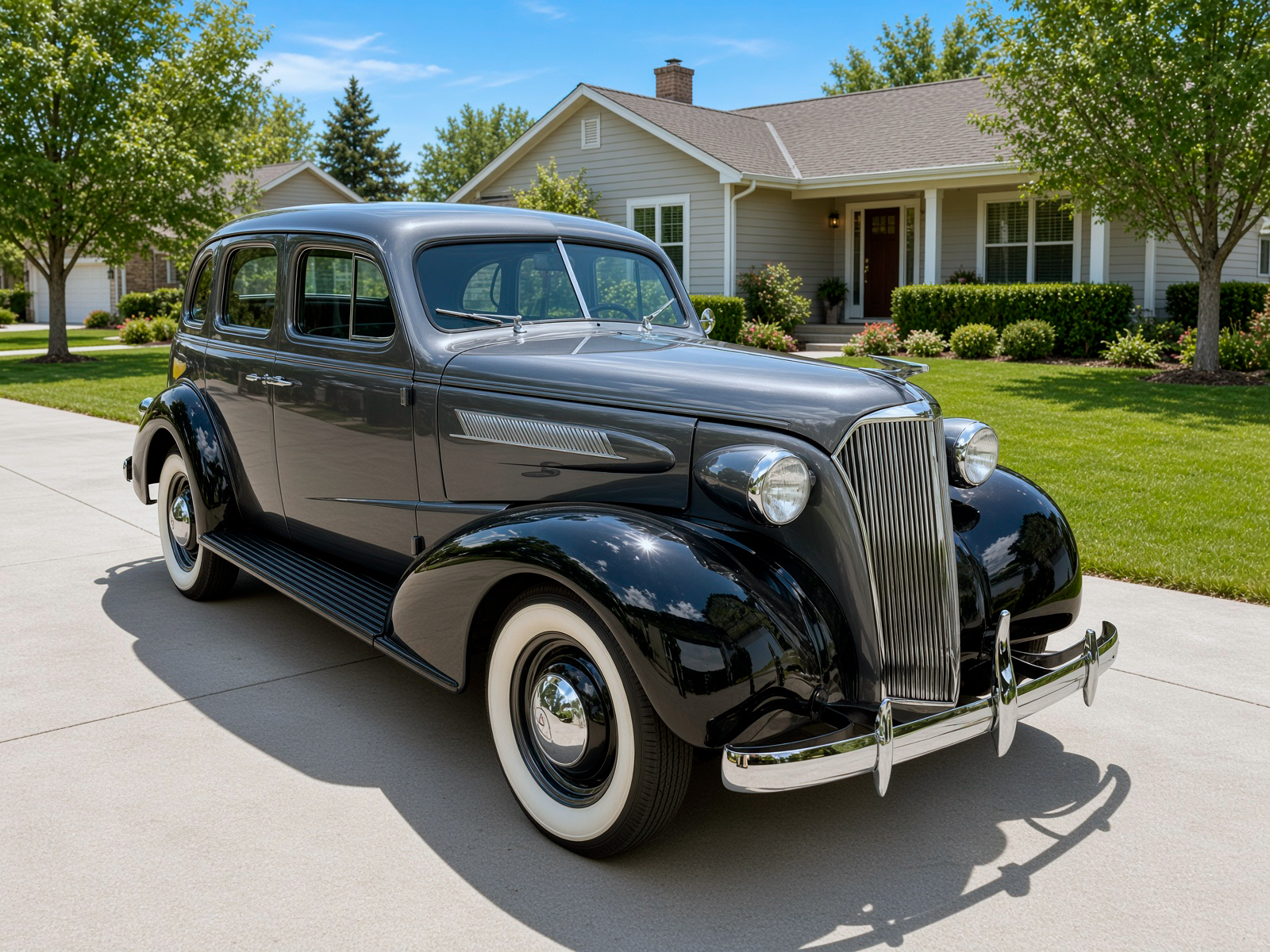
Table of Contents
- Overview and History
- The Master Name
- Master Against Master Deluxe
- Knee-Action Suspension
- The 216.5 Blue Flame Six
- Styling and Body Styles
- Transmission and Drivetrain
- Chassis and Brakes
- Interior and Equipment
- Production
- What Followed
- Collectibility and Buying
- Key Features Summary
- Full Specifications Table
Overview and History
By the mid-1930s Chevrolet was competing with Ford for the title of America’s best-selling marque, and its strategy was to offer more car for the money. Where Ford sold a flathead V8, Chevrolet sold an overhead-valve six – a configuration that breathed better per cubic inch and gave strong low-speed torque.
1937 is a pivotal year in that story. The bodies were all new, the wheelbase grew, and – most consequentially – the 216.5 cu in overhead-valve six arrived to replace the older 206.8 unit.
That engine would prove extraordinarily long-lived. The same 216.5 displacement carried through the 1940 Special Deluxe, the 1941 and 1942 cars, the postwar Fleetline and Styleline models, and on into the early 1950s before the 235 replaced it.
The Master Deluxe was the upper of Chevrolet’s two series that year, and it carried the division’s most visible technical selling point.
The Master Name
The naming history is worth setting out because it is genuinely confusing and the codes change year to year.
The Master line began with the 1933 Series CA, which began production as the “Eagle” but was renamed “Master” midway through the model year when the 1933 Standard model (Series CC) was introduced.
From there the range ran as two series – a cheaper one and a better-equipped one – under names that shifted:
- Standard Six as the entry model, with the higher-equipment Master Deluxe edging the range upwards
- By 1938 the Master Deluxe was the JA and the base model was renamed the Master 85 (JB)
- For 1939 the range continued as Master 85 (KB) and the more upscale Master Deluxe (KA)
- From 1940 a more expensive version based on the Master Deluxe was launched, called the Special Deluxe
The Master and Master Deluxe were eventually succeeded by the Chevrolet Deluxe.
For a buyer the practical point is that “Master Deluxe” means the upper series throughout, and the letter codes identify the model year rather than anything about specification.
Master Against Master Deluxe
The distinction between Chevrolet’s two 1937 series is more than trim, and it matters when assessing a car.
The Master Deluxe received:
- “Knee-Action” independent front suspension
- A longer wheelbase
- Richer upholstery and interior appointments
- More extensive exterior brightwork
- A fuller body-style range
The base Master did without the independent front suspension, using a conventional beam axle instead, and rode a shorter wheelbase with plainer trim.
Wheelbase figures for the era record 109 inches for the Standard and 113 inches for the Master Deluxe – a four-inch difference that affects both ride and interior space.
Buyers understood the value proposition. The Master Deluxe outsold the cheaper car by roughly two to one, which is unusual in a period when most ranges sold heavily at the bottom.
Knee-Action Suspension
The Master Deluxe’s headline feature was its front suspension, and the name is pure marketing for a genuinely advanced arrangement.
The independent front suspension was something GM called “Knee-Action”, using trailing arms and coil springs in what is properly known as the Dubonnet system.
The Dubonnet arrangement is unusual. Rather than mounting the springs and dampers to the chassis in the conventional way, each wheel is carried on a trailing arm within a sealed oil-filled housing that contains both the coil spring and the damping – the whole assembly moving with the wheel.
It gave a ride noticeably better than the beam-axle front ends still used on cheaper cars, and it was a significant selling point at a time when independent front suspension was new to the mass market.
There is a practical consideration for owners. The Dubonnet units are sealed and depend on their oil fill; when they leak or run dry the suspension deteriorates and the housings themselves are specialist items to rebuild. On a car being assessed, the condition of the Knee-Action units is a genuine concern rather than a detail.
Chevrolet later applied the Knee-Action name to the more conventional independent coil-spring arrangement used on the 1940 Special Deluxe and the postwar cars, so the name alone does not identify the Dubonnet system.
The 216.5 Blue Flame Six
The engine that arrived for 1937 is the Master Deluxe’s most consequential feature, because it outlived everything else about the car.
The 216.5 cu in overhead-valve inline-six belonged to the family known universally as the Stovebolt, marketed variously as the Blue Flame and later the Victory Six and Thrift-Master. It replaced the earlier 206.8 cu in unit and produced 85 hp.
Its architecture was Chevrolet’s competitive argument. Overhead valves on a six breathe better per cubic inch than Ford’s flathead V8 and give strong low-speed torque, which suited the heavy, tall-geared cars of the period.
The engine’s defining characteristic – and a genuine consideration when buying – is its lubrication. The 216 uses a splash-and-dip system with poured babbitt bearings rather than full-pressure lubrication to insert bearings. Dippers on the connecting rods fling oil from troughs in the sump.
Treated properly, with disciplined oil changes and moderate speeds, it is durable and long-lived. What it will not tolerate is sustained high revolutions, because the splash system cannot maintain an oil film at speed. This is not a car for extended motorway use.
Its successor is worth knowing about because it is a common retrofit. The 235, introduced on Powerglide passenger cars in 1953 and in the trucks for 1954, has insert bearings and high-pressure lubrication – far more robust and much better suited to modern driving.
Styling and Body Styles
The 1937 bodies were all new, and the styling moved decisively toward the rounded, integrated forms that would define the late 1930s.
The headlamps were faired into the front fenders rather than mounted separately, the grille was a prominent vertical-barred design, running boards remained, and the bonnet was rear-hinged. The overall effect is considerably more modern than the 1936 cars.
Body styles across the Master Deluxe range covered sedans, coaches, coupes, and a station wagon, with the range expanding through the decade. By 1938 the listing ran to a four-door Sport Sedan, a two-door Coach, a two-door Business Coupe, a two-door Four-Passenger Coupe, and a Station Wagon – with the Master 85 offering a slightly narrower selection.
A useful identification note carried through this era: Chevrolet distinguished the series with nameplates, and the economy model could be told from the better-trimmed one by the absence of a series nameplate on the engine cover.
The coupes and the station wagon are the bodies that carry the strongest premiums today; four-door sedans are the most accessible.
Transmission and Drivetrain
A three-speed manual was the only transmission, floor-shifted in this period before the column shift became standard practice later in the decade.
There was no automatic. Chevrolet’s Powerglide did not arrive until 1950, when it became the first automatic offered by any manufacturer in the low-priced field. A 1937 presented with a period automatic has been modified.
The drivetrain used a torque tube arrangement with a conventional live rear axle, standard Chevrolet practice of the era.
Gearing was tall and the engine’s torque low-revving, producing the characteristic unhurried driving experience of a 1930s American car.
Chassis and Brakes
The car used a separate ladder frame with a steel body, with the Knee-Action independent front suspension on the Master Deluxe and a leaf-sprung live rear axle.
Braking was by hydraulic drums at all four wheels – another area where Chevrolet had a competitive argument, since Ford retained mechanical brakes until 1939. Chevrolet had adopted hydraulics in 1936, so a 1937 benefits from the then-new system.
The electrical system was 6-volt, as Chevrolet used through 1954. On a car of this age that matters practically: 6-volt systems are far more sensitive to corroded connections and undersized cables than modern ones, and starting difficulties are usually electrical rather than mechanical.
A thorough clean-up of earths, connections, and battery cables resolves most complaints. Conversion to 12 volts is a common modification on a car intended to be driven, though it costs originality.
Interior and Equipment
The Master Deluxe interior was the better of Chevrolet’s two 1937 treatments: upgraded upholstery fabrics, additional interior brightwork, a better-finished instrument panel, and more complete standard equipment than the base Master.
Options were modest by later standards but meaningful at the time: a heater, a radio, a clock, a passenger-side windscreen wiper, bumper guards, fog lamps, wheel trim rings, and whitewall tyres.
Accessory catalogue items from the period are themselves collectible and add real appeal to a correctly presented car.
Production
The sales split is the clearest indicator of how buyers valued the two series.
The Master and Master Deluxe sold well, with 162,430 and 302,728 respectively – the better-equipped car outselling the cheaper one by close to two to one.
That pattern is unusual for the period. In most ranges the entry model dominated; here buyers were willing to pay for the independent front suspension, the longer wheelbase, and the better trim.
Combined, those figures put Chevrolet comfortably in contention with Ford for the volume crown, which was the point of the strategy.
What Followed
The structure Chevrolet established in the mid-1930s evolved steadily:
- 1938 – Master Deluxe becomes the JA; base model renamed Master 85 (JB)
- 1939 – Master 85 (KB) and Master Deluxe (KA) continue
- 1940 – the Special Deluxe launched as a more expensive version based on the Master Deluxe, becoming the new top series
- 1941–1942 – the Fleetline fastback appears within the Special Deluxe series; the Aerosedan two-door fastback arrives in 1942
- Early 1942 – civilian production halted for war work
- 1946–1948 – production resumes with essentially prewar designs; Fleetline becomes a sub-series of the Fleetmaster
- 1949 – the first genuinely new postwar Chevrolet
The Master and Master Deluxe names were succeeded by the Chevrolet Deluxe, and the two-series structure continued until the 1953 reorganization produced the 150, 210, and Bel Air.
Collectibility and Buying
Prewar Chevrolets occupy a quieter corner of the market than the postwar cars, and the 1937 Master Deluxe is affordable relative to its quality and completeness. It is a genuine piece of 1930s America that can still be driven and enjoyed, provided the owner accepts its performance envelope.
Values follow body style closely. Coupes and the station wagon lead, with four-door sedans the most accessible. The sedans are genuinely good value and, in the hot rod community, a favoured basis for period builds – 1937 Chevrolets are a long-established rodding platform.
Buying priorities:
- Knee-Action unit condition – the Dubonnet housings are sealed and oil-filled, and rebuilding them is specialist work
- Rust in floors, rockers, lower doors, rear quarters, and running board supports
- Engine oil pressure and bearing noise, given the splash lubrication and babbitt bearings
- The 6-volt electrical system, assessed on its own terms
- Series authenticity – confirm the car is genuinely a Master Deluxe rather than a base Master with better trim
- Originality of the drivetrain, since later engine swaps are common
Mechanical parts for the Stovebolt six are reasonably available thanks to the engine’s long production life, but prewar-specific body trim, glass, and interior materials are considerably harder to source than for 1949-and-later cars.
Key Features Summary
- Position: Upper of Chevrolet’s two series, above the base Master
- Key Feature: “Knee-Action” independent front suspension – trailing arms and coil springs, the Dubonnet system
- Base Master: Conventional beam front axle, shorter wheelbase, plainer trim
- Wheelbase: 113 inches for the Master Deluxe against 109 for the Standard
- New Engine: 216.5 cu in overhead-valve six at 85 hp, replacing the 206.8 unit
- Engine Legacy: The 216.5 carried into the 1940s and early 1950s
- Engine Note: Splash-and-dip lubrication with poured babbitt bearings
- Transmission: Three-speed manual only – Powerglide did not arrive until 1950
- Brakes: Hydraulic drums all round, adopted by Chevrolet in 1936
- Electrics: 6-volt, as used through 1954
- Name Origin: The 1933 Series CA began as the “Eagle” and was renamed “Master” midway through the year
- Production: Master 162,430; Master Deluxe 302,728
- Later Changes: Master 85 from 1938; Special Deluxe launched 1940; succeeded by the Chevrolet Deluxe
- No V8: Chevrolet’s first passenger-car V8 arrived in 1955
The 1937 Chevrolet Master Deluxe Specs
| SERIES AND BODY | |
| Manufacturer | Chevrolet (General Motors) |
| Series Position | Upper series, above the base Master |
| Construction | Separate ladder frame, steel body |
| Name Origin | 1933 Series CA began as the “Eagle”, renamed “Master” midway through the model year |
| Successor Name | Chevrolet Deluxe |
| Series Identification | Economy model lacked the series nameplate on the engine cover |
| MASTER vs MASTER DELUXE | |
| Front Suspension | Master Deluxe: Knee-Action independent. Master: beam axle |
| Wheelbase | 113 inches (Master Deluxe) against 109 inches (Standard) |
| Trim | Richer upholstery, more brightwork, fuller equipment on the Master Deluxe |
| Body Range | Wider on the Master Deluxe |
| KNEE-ACTION SUSPENSION | |
| GM Name | “Knee-Action” |
| Proper Name | Dubonnet suspension |
| Design | Trailing arms with coil springs |
| Arrangement | Spring and damping contained in a sealed oil-filled housing moving with the wheel |
| Benefit | Ride noticeably better than beam-axle front ends |
| Ownership Caution | Sealed units depend on oil fill; rebuilding is specialist work |
| Name Note | Knee-Action later applied to the more conventional coil-spring IFS of 1940 onward |
| ENGINE – 216.5 SIX (new for 1937) | |
| Engine Type | OHV inline-6, “Stovebolt” family |
| Displacement | 216.5 cu in (3.5 L) |
| Horsepower | 85 hp |
| Replaced | 206.8 cu in unit |
| Marketing Names | Blue Flame; later Victory Six and Thrift-Master |
| Carburettor | 1-barrel |
| Lubrication | Splash and dip, with poured babbitt bearings |
| Character | Strong low-speed torque; intolerant of sustained high revolutions |
| Longevity | 216.5 displacement continued into the 1940s and early 1950s |
| Successor | 235 with insert bearings and high-pressure lubrication, from 1953–54 |
| V8 Option | None – Chevrolet’s first passenger-car V8 arrived in 1955 |
| TRANSMISSION AND DRIVETRAIN | |
| Transmission | 3-speed manual – the only choice |
| Automatic | Not available; Powerglide arrived in 1950 |
| Driveshaft | Torque tube |
| Drive Layout | Front engine, rear-wheel drive |
| CHASSIS, SUSPENSION, BRAKES | |
| Front Suspension | Knee-Action independent (Master Deluxe) |
| Rear Suspension | Live axle, leaf springs |
| Brakes | Hydraulic drums, front and rear |
| Brake Context | Chevrolet adopted hydraulics in 1936; Ford retained mechanical brakes until 1939 |
| Electrical System | 6-volt (used by Chevrolet through 1954) |
| Other Features | Running boards; rear-hinged bonnet |
| STYLING | |
| Bodies | All new for 1937 |
| Headlamps | Faired into the front fenders |
| Grille | Prominent vertical-barred design |
| Body Styles | Sedans, coaches, coupes, and a station wagon |
| 1938 Listing (for reference) | Master Deluxe: 4dr Sport Sedan, 2dr Coach, 2dr Business Coupe, 2dr Four-Passenger Coupe, Station Wagon |
| INTERIOR AND EQUIPMENT | |
| Trim Level | Better of Chevrolet’s two 1937 treatments |
| Seating | Bench |
| Options | Heater, radio, clock, passenger-side wiper, bumper guards, fog lamps, wheel trim rings, whitewall tyres |
| PRODUCTION | |
| Master | 162,430 |
| Master Deluxe | 302,728 |
| Ratio | Close to two to one in favour of the better-equipped car |
| MODEL SUCCESSION | |
| 1938 | Master Deluxe becomes JA; base model renamed Master 85 (JB) |
| 1939 | Master 85 (KB) and Master Deluxe (KA) |
| 1940 | Special Deluxe launched, based on the Master Deluxe |
| 1941–1942 | Fleetline fastback within the Special Deluxe; Aerosedan from 1942 |
| Early 1942 | Civilian production halted for war work |
| 1946–1948 | Prewar designs resume; Fleetline a Fleetmaster sub-series |
| 1949 | First genuinely new postwar Chevrolet |
| 1953 | Range reorganized into 150, 210, and Bel Air |
| BUYING NOTES | |
| Primary Concern | Knee-Action unit condition – sealed, oil-filled, specialist rebuild |
| Rust Areas | Floors, rockers, lower doors, rear quarters, running board supports |
| Engine Check | Oil pressure and bearing noise on the 216.5 |
| Electrical | 6-volt system sensitive to poor connections; 12-volt conversion common |
| Series Verification | Confirm a genuine Master Deluxe rather than an up-trimmed Master |
| Parts | Stovebolt mechanicals reasonable; prewar body trim and glass harder to source |
| Value Order | Coupes and station wagon → four-door sedans |
| Market Note | Long-established hot rod platform alongside the original-car market |
1937 Chevrolet Master Deluxe – Frequently Asked Questions
What is the difference between the Master and the Master Deluxe?
More than trim. The Master Deluxe received GM’s “Knee-Action” independent front suspension, a longer wheelbase – 113 inches against the Standard’s 109 – richer upholstery, more brightwork, and a fuller body-style range. The base Master used a conventional beam front axle. Buyers valued the difference: the Master Deluxe outsold the cheaper car by close to two to one.
What is Knee-Action suspension?
GM’s marketing name for the Dubonnet independent front suspension, using trailing arms and coil springs. Unusually, each wheel is carried on a trailing arm within a sealed oil-filled housing containing both spring and damping, the whole assembly moving with the wheel. It gave a ride noticeably better than the beam axles on cheaper cars – but the sealed units depend on their oil fill, and rebuilding them is specialist work, which makes their condition a genuine concern when buying.
What engine does a 1937 Master Deluxe have?
The 216.5 cu in overhead-valve inline-six producing 85 hp, new for 1937 and replacing the earlier 206.8 unit. It belongs to the family known as the Stovebolt, marketed as the Blue Flame and later the Victory Six and Thrift-Master. The same 216.5 displacement carried into the 1940s and early 1950s – it is one of the longest-serving engines Chevrolet built.
Is the splash lubrication a problem?
It is a consideration rather than a flaw. The 216 uses splash-and-dip lubrication with poured babbitt bearings rather than full-pressure lubrication to insert bearings – dippers on the connecting rods fling oil from troughs in the sump. Treated properly, with disciplined oil changes and moderate speeds, it is durable. What it will not tolerate is sustained high revolutions, so this is not a car for extended motorway use.
Could you get an automatic?
No. A three-speed manual was the only transmission. Chevrolet’s Powerglide did not arrive until 1950, when it became the first automatic offered by any manufacturer in the low-priced field. Any 1937 presented with a period automatic has been modified.
Why is the Master name confusing?
Because it changed repeatedly. The line began with the 1933 Series CA, which began production as the “Eagle” and was renamed “Master” midway through the model year. By 1938 the Master Deluxe was the JA and the base model was renamed the Master 85; for 1939 those became KA and KB. From 1940 a more expensive version based on the Master Deluxe was launched as the Special Deluxe, and the Master names were eventually succeeded by the Chevrolet Deluxe.
How many were built?
The Master and Master Deluxe sold 162,430 and 302,728 respectively – the better-equipped car outselling the cheaper one by close to two to one. That pattern is unusual for the period, when entry models normally dominated, and it shows buyers were willing to pay for the independent front suspension and longer wheelbase.
What should I check when buying one?
Start with the Knee-Action units, since the sealed Dubonnet housings are specialist items to rebuild and a leaking or dry unit ruins the ride. Then inspect for rust in the floors, rockers, lower doors, rear quarters, and running board supports. Check engine oil pressure and listen for bearing noise. Assess the 6-volt electrical system on its own terms – starting trouble is usually corroded connections. And confirm the car is genuinely a Master Deluxe rather than an up-trimmed base Master.
