The 1986 Chevrolet Monte Carlo SS is the year NASCAR forced Chevrolet to build a road car it did not really want to sell. The Aerocoupe – with its dramatically sloped rear window and shortened deck lid – existed because the sanctioning body required that at least 200 be sold to the public to homologate the shape for superspeedway racing. Chevrolet built exactly that number. Being 1 of 200 makes this the rarest Monte Carlo SS built, and the contrast with what followed is stark: in 1987 production jumped to 6,052. Under the hood sat a 305 cu in V8 with a high-output four-barrel at 180 hp.
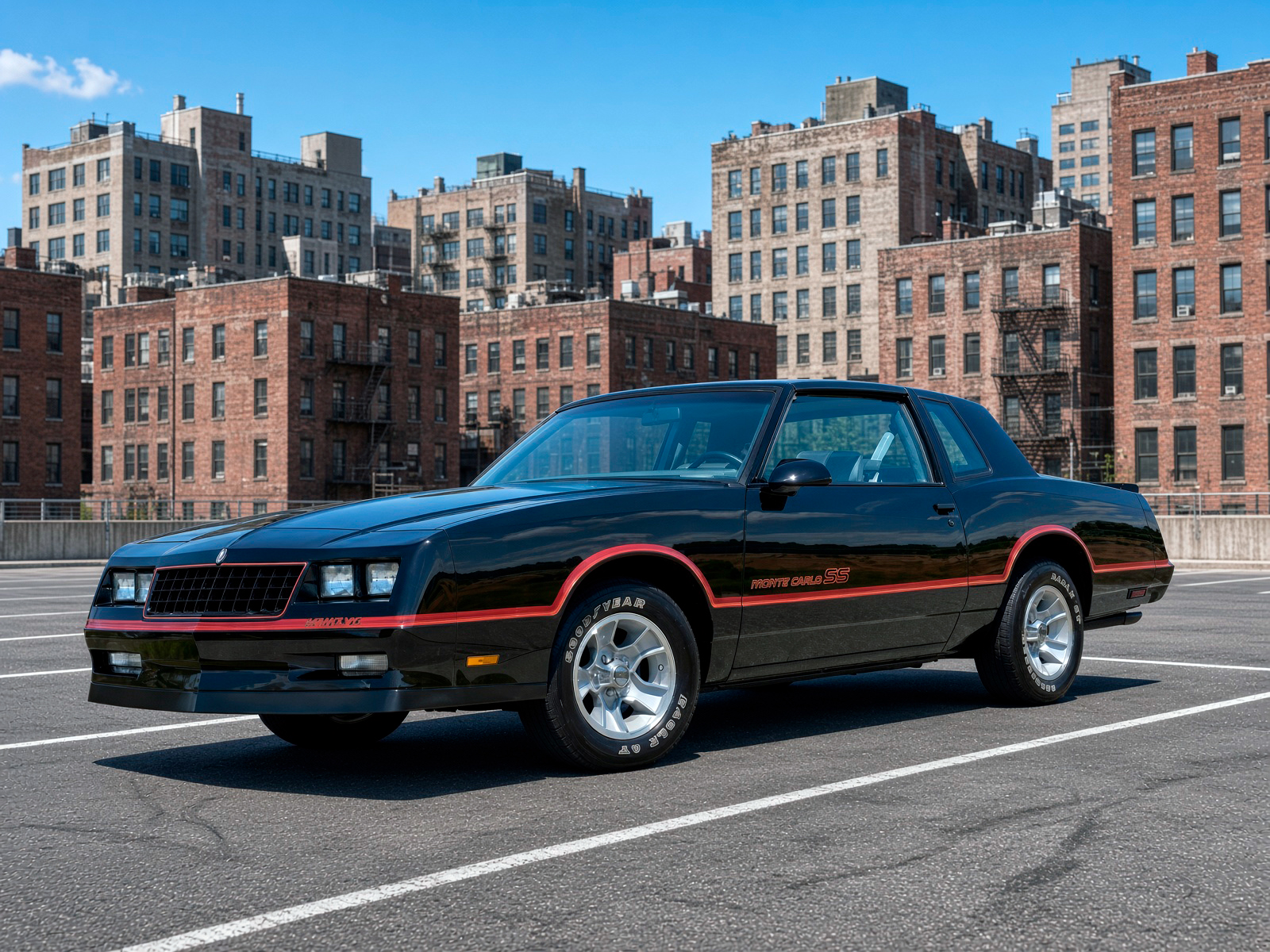
Table of Contents
- Overview and History
- The Aerocoupe and NASCAR
- Why Exactly 200
- The Rarest Monte Carlo SS
- The Standard Monte Carlo SS
- The 305 V8
- Transmission and Drivetrain
- Chassis, Suspension, and Brakes
- Identifying an Aerocoupe
- The SS Name on the Monte Carlo
- Collectibility and Buying
- Key Features Summary
- Full Specifications Table
Overview and History
The Monte Carlo had arrived for 1970 as Chevrolet’s first personal luxury coupe, built on a stretched A-body with the longest hood the division had fitted. Its SS 454 package ran for 1970 and 1971 only, with 3,823 and 1,919 cars respectively, before being dropped.
The nameplate continued through the 1970s as a comfort-oriented car, and by the fourth generation it had moved to GM’s rear-wheel-drive G-body platform – the architecture shared with the Buick Regal, Oldsmobile Cutlass, and Pontiac Grand Prix.
The SS designation returned to the Monte Carlo in the early 1980s, and this time the reason was racing. Buick had reshaped its Regal for 1981 specifically to cut aerodynamic drag on NASCAR superspeedways, and the approach worked so well that every manufacturer followed.
By the mid-1980s the aerodynamic arms race had escalated again, and Chevrolet needed something more extreme than a facelift. The answer was the Aerocoupe.
The Aerocoupe and NASCAR
The Aerocoupe exists for one reason, and it is worth stating plainly: the Aerocoupe was a NASCAR design.
Winston Cup cars of the period were built from production body shapes, which meant aerodynamic advantages had to be engineered into the car customers could buy. A slipperier showroom model meant a faster race car – exactly the logic Buick had applied to the 1981 Regal.
The notchback Monte Carlo SS had a near-vertical rear window that created substantial drag and lift at superspeedway speeds. The Aerocoupe addressed it directly with:
- A dramatically sloped compound-curve rear window, far larger and shallower than the standard glass
- A shortened deck lid to suit the new glass
- A revised rear spoiler
The effect on the race cars was significant, and the shape became the basis of Chevrolet’s superspeedway effort for the remainder of the G-body era.
On the road car the benefit is essentially nil – a 180 hp personal coupe does not reach speeds where the difference matters. The Aerocoupe is a homologation special in the purest sense: a road car built solely so a race car could be legal.
Why Exactly 200
The production figure is not a coincidence and it explains everything about the car.
NASCAR required that at least 200 be sold to the public. So, that’s exactly how many Chevy made.
Homologation rules of the period set minimum production numbers for a body configuration to be eligible, and manufacturers had no commercial reason to exceed them when the car in question was expensive to build and difficult to sell.
The same logic had produced the 1969 Camaro ZL1, where Fred Gibb ordered 50 cars to meet NHRA’s Super Stock minimum, and the Camaro Z/28 itself, created so Chevrolet could contest SCCA Trans-Am racing.
In the Aerocoupe’s case the number was 200, and Chevrolet built 200. Not 201, not 500 – the precise minimum required to go racing.
That is why a 1986 Aerocoupe is a genuinely rare car rather than merely an uncommon one, and why its production figure is one of the most frequently quoted in 1980s American motoring.
The Rarest Monte Carlo SS
The scarcity claim is specific and it holds up.
Being 1 of 200 built makes this the rarest Monte Carlo SS built. The Aerocoupe was only built for two years, and 1986 was the lowest production by far.
The comparison with 1987 makes the point starkly. In 1987 the production jumped to 6,052, making the 1986 much rarer – a thirtyfold increase in a single year.
The reason for that jump is straightforward. Once the shape was homologated and the tooling existed, Chevrolet could sell the Aerocoupe as a regular model rather than a compliance exercise, and buyers who liked the look bought it.
So the 1986 is the compliance run and the 1987 is the production car. Both are Aerocoupes; only one was built because NASCAR said so.
Against the Monte Carlo SS’s own history, 200 cars is remarkable. Even the two-year SS 454 of 1970–71, long considered scarce, totalled 5,742 cars across both seasons.
The Standard Monte Carlo SS
It is important to distinguish the Aerocoupe from the ordinary Monte Carlo SS of the same year, because the two are very different propositions.
The standard Monte Carlo SS was a regular production model built in substantial numbers through the mid-1980s. It carried the same 305 V8 and the same running gear, with the conventional notchback roofline and near-vertical rear window.
Mechanically the two are essentially identical. The Aerocoupe’s differences are confined to the rear glass, deck lid, and spoiler.
For a buyer that creates a clear value split: a standard 1986 Monte Carlo SS is an affordable, characterful 1980s coupe, while an Aerocoupe is a documented homologation special worth a multiple of it.
Because the mechanical content is the same, there is no performance reason to pay the Aerocoupe premium – the reason is rarity and provenance, and both need verifying.
The 305 V8
The powertrain is modest by any muscle-era standard, which is characteristic of the period rather than a criticism of the car.
Under the hood sat an 8-cylinder, 305-cubic-inch engine with a high-output 4-barrel carburettor, generating 180 horsepower – the 5.0-litre small-block in its high-output carburetted form.
That figure is SAE net, the standard since 1972, and it should not be compared with pre-1972 gross ratings. 180 hp net in 1986 was a respectable output for a mid-size American coupe; emissions equipment and low compression had reduced everything.
For context within Chevrolet’s own range that year, the Camaro IROC-Z offered the 305 with Tuned-Port Injection at 190 and 215 hp, and from 1987 the 350 L98 TPI at 225 hp. The Monte Carlo SS kept the carburettor throughout.
The carburetted high-output 305 is a simple, robust engine with excellent parts support, and it suits the Monte Carlo’s relaxed character. It is not fast, and it was never meant to be.
Transmission and Drivetrain
The Monte Carlo SS was an automatic car. Documented examples record an automatic transmission paired with a 3.73 rear axle – a notably short ratio that improves acceleration at the cost of highway economy, and a clear signal of the car’s sporting intent within its limits.
No manual gearbox was offered. That is consistent with the model’s positioning as a personal coupe rather than a sports car, and it mirrors the 1970–71 SS 454, which was likewise automatic-only.
Drive was to the rear wheels, with a limited-slip differential available.
The 3.73 axle is worth noting on a car being assessed: it is part of the SS specification rather than a later modification, and its presence supports an authenticity claim.
Chassis, Suspension, and Brakes
The fourth-generation Monte Carlo used GM’s rear-wheel-drive G-body platform with body-on-frame construction, independent coil-spring front suspension, and a coil-sprung live rear axle located by trailing arms.
That architecture was shared with the Buick Regal, Oldsmobile Cutlass Supreme, and Pontiac Grand Prix, and it is one of the most heavily supported platforms in the American aftermarket – a practical advantage for an owner.
The SS package brought uprated suspension components, specific wheels, and tyres appropriate to the car’s intent.
Brakes were power front discs with rear drums, standard practice for the period and adequate for 180 horsepower.
The G-body’s combination of body-on-frame durability, rear-wheel drive, and a simple small-block is why these cars became so popular with modifiers – and why finding an unmolested original takes patience.
Identifying an Aerocoupe
The Aerocoupe is unmistakable once you know what to look for, but verification should go beyond the glass.
Visual checks:
- The sloped compound-curve rear window, far larger and shallower than the notchback’s
- The shortened deck lid
- The specific rear spoiler
- Aerocoupe-specific badging
Documentary checks matter more. The VIN and build documentation should confirm the body configuration, and given that only 200 were built for 1986, the car should be traceable.
Note the distinction from 1987: both years are Aerocoupes and both share the glass and deck lid, so the shape alone does not establish a 1986. The model year must be confirmed separately – and since 1987 production was 6,052 against 1986’s 200, the difference in value is enormous.
Surviving examples are frequently low-mileage, since many were bought as investments and stored. Documented cars with very low mileage appear on the market periodically.
The SS Name on the Monte Carlo
The Monte Carlo SS has an unusual history, running in two distinct eras separated by more than a decade.
The first era (1970–1971): the SS 454 package, carrying the same 365 hp LS5 engine and driveline as the Chevelle SS 454, with Automatic Level Control and heavy-duty chassis components. It was identified only by emblems on the lower fenders. Production ran 3,823 in 1970 and 1,919 in 1971 before the package was dropped.
The second era (1980s): the SS returned on the G-body as an aerodynamically driven, NASCAR-motivated model with a 305 V8 – a completely different proposition, defined by homologation rather than by engine.
The common thread is that both were built for reasons other than volume sales: the first because Chevrolet could put a 454 in anything on the A-body, the second because NASCAR required it.
Both are also, in their different ways, discreet cars. Neither announced itself the way a Chevelle SS did.
Collectibility and Buying
The 1986 Aerocoupe occupies a specific and well-defined position: a documented homologation special with a production figure of exactly 200, in a decade that produced few genuinely rare American cars.
Values reflect that. A documented 1986 Aerocoupe trades at a substantial multiple of a standard Monte Carlo SS of the same year, and low-mileage examples command more again.
The 1987 Aerocoupe, at 6,052 cars, sits well below the 1986 despite looking identical – which makes correct year identification the single most important check.
Buying priorities:
- Confirm the model year through the VIN – 1986 and 1987 Aerocoupes look the same and are worth very different amounts
- Verify the Aerocoupe bodywork is original rather than converted
- Check the 3.73 rear axle, consistent with SS specification
- Assess originality carefully, since the G-body is among the most modified platforms in America
- Inspect for rust in the lower quarters, rear wheel arches, trunk floor, and frame
- Check the compound-curve rear glass, which is Aerocoupe-specific and difficult to source
Mechanical parts support is excellent through the G-body aftermarket, but Aerocoupe-specific glass and trim are a different matter entirely.
Key Features Summary
- Reason for Existence: The Aerocoupe was a NASCAR design, built to homologate an aerodynamic shape for superspeedway racing
- Production: NASCAR required that at least 200 be sold to the public – so that’s exactly how many Chevrolet made
- Rarity: Being 1 of 200 built makes this the rarest Monte Carlo SS built
- Two-Year Model: The Aerocoupe was built for two years only, and 1986 was the lowest production by far
- 1987 Comparison: Production jumped to 6,052, making the 1986 much rarer
- Bodywork: Sloped compound-curve rear window, shortened deck lid, revised spoiler
- Engine: 305 cu in (5.0-litre) V8 with a high-output four-barrel carburettor at 180 hp SAE net
- Transmission: Automatic, paired with a 3.73 rear axle
- Platform: GM G-body, rear-wheel drive, body-on-frame
- Shared Architecture: Buick Regal, Oldsmobile Cutlass Supreme, Pontiac Grand Prix
- Precedent: Buick reshaped its Regal for 1981 to cut NASCAR drag, and every manufacturer followed
- Standard SS: Same mechanicals with a conventional notchback roofline, built in far larger numbers
- Brakes: Power front discs, rear drums
- Earlier SS Era: The 1970–71 SS 454, with 3,823 and 1,919 built
The 1986 Chevrolet Monte Carlo SS Specs
| MODEL AND PLATFORM | |
| Manufacturer | Chevrolet (General Motors) |
| Class | Personal luxury coupe |
| Platform | GM G-body, rear-wheel drive |
| Construction | Body-on-frame |
| Shared Architecture | Buick Regal, Oldsmobile Cutlass Supreme, Pontiac Grand Prix |
| Body Variants | Standard notchback SS; Aerocoupe |
| THE AEROCOUPE | |
| Purpose | A NASCAR design – homologating an aerodynamic shape |
| Homologation Requirement | NASCAR required at least 200 sold to the public |
| Cars Built | 200 – exactly the minimum |
| Rear Window | Sloped compound-curve glass, far larger and shallower than the notchback’s |
| Deck Lid | Shortened to suit the new glass |
| Spoiler | Revised |
| Mechanical Difference | None – bodywork only |
| Production Years | Two only; 1986 the lowest by far |
| 1987 Production | 6,052 |
| Status | The rarest Monte Carlo SS built |
| ENGINE | |
| Type | 8-cylinder small-block V8 |
| Displacement | 305 cu in (5.0 L) |
| Fuel System | High-output four-barrel carburettor |
| Horsepower | 180 hp (SAE net) |
| Rating Standard | SAE net – not comparable with pre-1972 gross figures |
| Contemporary Comparison | Camaro IROC-Z 305 TPI at 190 and 215 hp; 350 L98 TPI at 225 hp from 1987 |
| TRANSMISSION AND DRIVETRAIN | |
| Transmission | Automatic |
| Manual Gearbox | Not offered |
| Rear Axle Ratio | 3.73 |
| Limited Slip | Available |
| Drive Layout | Rear-wheel drive |
| SUSPENSION, STEERING, BRAKES | |
| Front Suspension | Independent, coil springs |
| Rear Suspension | Live axle, trailing arms, coil springs |
| SS Content | Uprated suspension components, specific wheels and tyres |
| Front Brakes | Power discs |
| Rear Brakes | Drums |
| Steering | Power assisted |
| NASCAR CONTEXT | |
| Rule Basis | Winston Cup cars built from production body shapes |
| Precedent | Buick reshaped its Regal for 1981 specifically to cut aerodynamic drag |
| Problem Addressed | Near-vertical notchback rear window creating drag and lift |
| Road-Car Benefit | Essentially nil at legal speeds |
| Comparable Homologation Specials | 1969 Camaro ZL1 (50-car NHRA minimum ordered by Fred Gibb); Camaro Z/28 for SCCA Trans-Am |
| MONTE CARLO SS HISTORY | |
| 1970 SS 454 | 365 hp LS5, Automatic Level Control – 3,823 built |
| 1971 SS 454 | Same package – 1,919 built; dropped afterward |
| 1980s SS | G-body, 305 V8, aerodynamically motivated |
| Common Thread | Both eras built for reasons other than volume sales |
| IDENTIFICATION | |
| Visual | Sloped compound-curve rear glass; shortened deck lid; specific spoiler and badging |
| Critical Check | Model year via VIN – 1986 and 1987 Aerocoupes look identical |
| Value Implication | 200 cars against 6,052 – an enormous difference |
| Supporting Check | 3.73 rear axle, consistent with SS specification |
| BUYING NOTES | |
| Primary Risk | A 1987 presented as a 1986 |
| Bodywork Check | Confirm Aerocoupe glass and deck lid are original rather than converted |
| Glass Availability | Compound-curve rear window is Aerocoupe-specific and difficult to source |
| Originality | G-body is among the most modified platforms in America |
| Rust Areas | Lower quarters, rear wheel arches, trunk floor, frame |
| Parts Support | Excellent mechanically; Aerocoupe-specific items scarce |
| Market Note | Many were stored as investments; documented low-mileage cars appear periodically |
1986 Chevrolet Monte Carlo SS – Frequently Asked Questions
Why does the Aerocoupe have that rear window?
Because of racing. The Aerocoupe was a NASCAR design: Winston Cup cars were built from production body shapes, so aerodynamic advantages had to be engineered into the car customers could buy. The notchback Monte Carlo’s near-vertical rear window created substantial drag and lift at superspeedway speeds, and the sloped compound-curve glass with its shortened deck lid addressed it. Buick had used exactly the same logic when it reshaped its Regal for 1981.
Why were exactly 200 built?
Because that was the minimum. NASCAR required that at least 200 be sold to the public. So, that’s exactly how many Chevy made. Manufacturers had no commercial reason to exceed homologation minimums when the car was expensive to build and hard to sell – the same thinking that produced the 1969 Camaro ZL1, where Fred Gibb ordered 50 cars to meet NHRA’s Super Stock requirement.
Is the 1986 really the rarest Monte Carlo SS?
Yes. Being 1 of 200 built makes this the rarest Monte Carlo SS built, and the Aerocoupe was only built for two years, with 1986 the lowest production by far. For comparison, even the scarce 1970–71 SS 454 totalled 5,742 cars across both seasons – more than twenty-eight times the 1986 Aerocoupe’s run.
How does a 1986 differ from a 1987 Aerocoupe?
Almost entirely in rarity. In 1987 the production jumped to 6,052, making the 1986 much rarer – a thirtyfold increase. Once the shape was homologated and the tooling existed, Chevrolet could sell the Aerocoupe as a regular model rather than a compliance exercise. The two look the same, which makes confirming the model year through the VIN the single most important check when buying.
How much power does it have?
180 horsepower from an 8-cylinder, 305-cubic-inch engine with a high-output 4-barrel carburettor. That is an SAE net figure, the standard since 1972, and it should not be compared with pre-1972 gross ratings. For context within Chevrolet’s own 1986 range, the Camaro IROC-Z offered the 305 with Tuned-Port Injection at 190 and 215 hp – the Monte Carlo SS kept the carburettor.
Was a manual gearbox available?
No. The Monte Carlo SS was an automatic car, documented examples recording an automatic transmission paired with a 3.73 rear axle – a notably short ratio that improves acceleration at the cost of economy. That is consistent with the model’s positioning as a personal coupe, and it mirrors the 1970–71 SS 454, which was likewise automatic-only.
Is an Aerocoupe faster than a standard Monte Carlo SS?
No. The two are mechanically essentially identical – same 305 V8, same running gear – with the Aerocoupe’s differences confined to the rear glass, deck lid, and spoiler. The aerodynamic benefit is meaningless at road speeds. The Aerocoupe premium is entirely about rarity and provenance, not performance, which is why both need verifying.
What should I check when buying one?
Confirm the model year through the VIN above everything else, since a 1987 looks identical and is worth a fraction as much. Verify that the Aerocoupe glass and shortened deck lid are original rather than a later conversion – the compound-curve rear window is Aerocoupe-specific and difficult to source. Check the 3.73 rear axle, assess originality carefully given how heavily modified G-bodies tend to be, and inspect for rust in the lower quarters, rear arches, trunk floor, and frame.
